Solid-State Relay Overvoltage Protection: Design Strategies
SEP 19, 202510 MIN READ
Generate Your Research Report Instantly with AI Agent
Patsnap Eureka helps you evaluate technical feasibility & market potential.
SSR Overvoltage Protection Background and Objectives
Solid-state relays (SSRs) have evolved significantly since their introduction in the 1970s as alternatives to electromechanical relays. These semiconductor-based switching devices offer numerous advantages including faster switching speeds, absence of moving parts, silent operation, and enhanced reliability in high-frequency switching applications. The evolution of SSR technology has been closely tied to advancements in power semiconductor devices, particularly thyristors, triacs, MOSFETs, and IGBTs, which form the core switching elements of modern SSRs.
Despite their advantages, SSRs remain vulnerable to overvoltage events that can cause catastrophic failures. These overvoltage conditions may originate from various sources including lightning strikes, power grid fluctuations, load switching transients, and electromagnetic interference. The semiconductor components within SSRs typically have strict voltage limitations, and exceeding these thresholds can lead to immediate device failure or accelerated degradation over time.
The technical objective of overvoltage protection for SSRs is multifaceted. Primary goals include preventing permanent damage to the relay, ensuring continuous operation during transient events, maintaining isolation between input and output circuits, and preserving the longevity of the device. Additionally, protection strategies must address both differential mode (between power lines) and common mode (between power lines and ground) overvoltage scenarios.
Historical approaches to SSR overvoltage protection have evolved from simple passive components to sophisticated integrated solutions. Early designs relied heavily on metal oxide varistors (MOVs) and transient voltage suppression (TVS) diodes as primary protection elements. Modern protection schemes incorporate multiple layers of defense, often combining several technologies to address different aspects of overvoltage events.
The technical landscape is currently shifting toward more intelligent protection mechanisms that can adapt to varying conditions. These include active clamping circuits, coordinated multi-stage protection, and self-diagnostic capabilities that can detect potential failure modes before they manifest. The integration of microcontroller-based monitoring and protection is becoming increasingly common in high-reliability applications.
Industry standards governing SSR overvoltage protection have also evolved, with IEC 60947-4-3, UL 508, and IEEE C62.41 providing frameworks for testing and performance requirements. These standards define surge immunity levels, response times, and failure modes that protection systems must address to ensure safe and reliable operation across diverse industrial environments.
The ultimate technical goal is to develop cost-effective, space-efficient protection strategies that can be seamlessly integrated into SSR designs without compromising their inherent advantages of size, speed, and reliability. This requires balancing competing factors such as protection level, response time, energy handling capability, and implementation cost.
Despite their advantages, SSRs remain vulnerable to overvoltage events that can cause catastrophic failures. These overvoltage conditions may originate from various sources including lightning strikes, power grid fluctuations, load switching transients, and electromagnetic interference. The semiconductor components within SSRs typically have strict voltage limitations, and exceeding these thresholds can lead to immediate device failure or accelerated degradation over time.
The technical objective of overvoltage protection for SSRs is multifaceted. Primary goals include preventing permanent damage to the relay, ensuring continuous operation during transient events, maintaining isolation between input and output circuits, and preserving the longevity of the device. Additionally, protection strategies must address both differential mode (between power lines) and common mode (between power lines and ground) overvoltage scenarios.
Historical approaches to SSR overvoltage protection have evolved from simple passive components to sophisticated integrated solutions. Early designs relied heavily on metal oxide varistors (MOVs) and transient voltage suppression (TVS) diodes as primary protection elements. Modern protection schemes incorporate multiple layers of defense, often combining several technologies to address different aspects of overvoltage events.
The technical landscape is currently shifting toward more intelligent protection mechanisms that can adapt to varying conditions. These include active clamping circuits, coordinated multi-stage protection, and self-diagnostic capabilities that can detect potential failure modes before they manifest. The integration of microcontroller-based monitoring and protection is becoming increasingly common in high-reliability applications.
Industry standards governing SSR overvoltage protection have also evolved, with IEC 60947-4-3, UL 508, and IEEE C62.41 providing frameworks for testing and performance requirements. These standards define surge immunity levels, response times, and failure modes that protection systems must address to ensure safe and reliable operation across diverse industrial environments.
The ultimate technical goal is to develop cost-effective, space-efficient protection strategies that can be seamlessly integrated into SSR designs without compromising their inherent advantages of size, speed, and reliability. This requires balancing competing factors such as protection level, response time, energy handling capability, and implementation cost.
Market Demand Analysis for SSR Protection Solutions
The global market for Solid-State Relay (SSR) overvoltage protection solutions has been experiencing robust growth, driven primarily by increasing automation across industrial sectors and the growing adoption of smart grid technologies. Current market analysis indicates that the industrial automation segment represents the largest application area for SSR protection devices, accounting for approximately 40% of the total market share.
The power distribution sector follows closely behind, with significant demand stemming from the ongoing modernization of electrical infrastructure worldwide. This modernization is particularly evident in developing economies across Asia-Pacific and Latin America, where substantial investments are being made in upgrading aging power systems to improve reliability and efficiency.
Market research reveals a clear shift in customer preferences toward integrated protection solutions that combine multiple protective functions within a single device. End-users increasingly demand SSR protection systems that not only guard against overvoltage events but also provide protection against overcurrent, thermal runaway, and electromagnetic interference. This trend reflects the broader industry movement toward more comprehensive and space-efficient protection strategies.
The renewable energy sector represents the fastest-growing market segment for SSR protection solutions, with annual growth rates exceeding the industry average. As solar and wind installations continue to proliferate globally, the need for reliable switching and protection mechanisms has intensified. SSRs with robust overvoltage protection are particularly critical in these applications due to the variable nature of renewable energy generation and the potential for grid instability.
From a regional perspective, Asia-Pacific currently leads in market volume, driven by China's massive industrial base and rapid infrastructure development. However, North America and Europe command premium market segments, with higher average selling prices reflecting the demand for advanced features and higher reliability standards in these regions.
Customer feedback indicates growing concerns regarding the long-term reliability of SSR protection solutions, particularly in harsh environmental conditions. This has created market opportunities for manufacturers who can demonstrate superior product durability through comprehensive testing and validation processes. Additionally, there is increasing demand for solutions that offer remote monitoring capabilities and integration with industrial IoT platforms.
The market is also witnessing a notable trend toward miniaturization, with customers seeking smaller form factors that maintain or improve upon existing protection capabilities. This trend is particularly pronounced in space-constrained applications such as building automation systems and compact industrial control panels.
The power distribution sector follows closely behind, with significant demand stemming from the ongoing modernization of electrical infrastructure worldwide. This modernization is particularly evident in developing economies across Asia-Pacific and Latin America, where substantial investments are being made in upgrading aging power systems to improve reliability and efficiency.
Market research reveals a clear shift in customer preferences toward integrated protection solutions that combine multiple protective functions within a single device. End-users increasingly demand SSR protection systems that not only guard against overvoltage events but also provide protection against overcurrent, thermal runaway, and electromagnetic interference. This trend reflects the broader industry movement toward more comprehensive and space-efficient protection strategies.
The renewable energy sector represents the fastest-growing market segment for SSR protection solutions, with annual growth rates exceeding the industry average. As solar and wind installations continue to proliferate globally, the need for reliable switching and protection mechanisms has intensified. SSRs with robust overvoltage protection are particularly critical in these applications due to the variable nature of renewable energy generation and the potential for grid instability.
From a regional perspective, Asia-Pacific currently leads in market volume, driven by China's massive industrial base and rapid infrastructure development. However, North America and Europe command premium market segments, with higher average selling prices reflecting the demand for advanced features and higher reliability standards in these regions.
Customer feedback indicates growing concerns regarding the long-term reliability of SSR protection solutions, particularly in harsh environmental conditions. This has created market opportunities for manufacturers who can demonstrate superior product durability through comprehensive testing and validation processes. Additionally, there is increasing demand for solutions that offer remote monitoring capabilities and integration with industrial IoT platforms.
The market is also witnessing a notable trend toward miniaturization, with customers seeking smaller form factors that maintain or improve upon existing protection capabilities. This trend is particularly pronounced in space-constrained applications such as building automation systems and compact industrial control panels.
Current Challenges in SSR Overvoltage Protection
Solid-state relays (SSRs) face significant overvoltage protection challenges that continue to evolve with increasing power system complexity. One primary challenge is the inherent vulnerability of semiconductor components to transient voltage spikes, which can cause catastrophic failure without adequate protection. These transients often exceed normal operating voltages by factors of 5-10, creating substantial design constraints for protection circuits.
The thermal management of protection components presents another critical challenge. When overvoltage protection devices such as metal oxide varistors (MOVs) or transient voltage suppressors (TVS) activate, they dissipate substantial energy as heat. In compact SSR designs, this heat concentration can compromise the reliability of nearby components and reduce the overall lifespan of the relay system.
Response time optimization remains problematic for SSR protection circuits. The semiconductor switching elements in SSRs can be damaged in microseconds or even nanoseconds during severe overvoltage events, requiring protection mechanisms that respond within similar timeframes. Achieving this speed while avoiding false triggers during normal operation represents a significant engineering challenge.
Coordination between multiple protection layers presents increasing complexity. Modern SSR protection typically employs a multi-tiered approach with primary, secondary, and sometimes tertiary protection elements. Ensuring these systems work harmoniously without interference requires sophisticated timing and energy coordination that many current designs struggle to achieve consistently.
Cost constraints significantly impact protection implementation, particularly in consumer and industrial applications where price sensitivity is high. Engineers must balance comprehensive protection against economic viability, often resulting in compromised designs that may not provide optimal protection under all conditions.
Emerging challenges include protecting SSRs in renewable energy systems where voltage fluctuations are more frequent and less predictable. Solar inverter and wind power applications create unique overvoltage profiles that traditional protection schemes were not designed to address. Similarly, electric vehicle charging infrastructure introduces new overvoltage scenarios that current SSR protection technologies struggle to handle effectively.
Miniaturization trends in electronics further complicate protection design, as smaller form factors provide less physical space for heat dissipation and isolation distances. This spatial constraint often forces compromises in protection component sizing and placement, potentially reducing overall system reliability.
Standards compliance presents another challenge, with evolving requirements from IEC, UL, and other regulatory bodies continually raising the bar for overvoltage protection performance while manufacturers struggle to adapt existing designs to meet these new specifications.
The thermal management of protection components presents another critical challenge. When overvoltage protection devices such as metal oxide varistors (MOVs) or transient voltage suppressors (TVS) activate, they dissipate substantial energy as heat. In compact SSR designs, this heat concentration can compromise the reliability of nearby components and reduce the overall lifespan of the relay system.
Response time optimization remains problematic for SSR protection circuits. The semiconductor switching elements in SSRs can be damaged in microseconds or even nanoseconds during severe overvoltage events, requiring protection mechanisms that respond within similar timeframes. Achieving this speed while avoiding false triggers during normal operation represents a significant engineering challenge.
Coordination between multiple protection layers presents increasing complexity. Modern SSR protection typically employs a multi-tiered approach with primary, secondary, and sometimes tertiary protection elements. Ensuring these systems work harmoniously without interference requires sophisticated timing and energy coordination that many current designs struggle to achieve consistently.
Cost constraints significantly impact protection implementation, particularly in consumer and industrial applications where price sensitivity is high. Engineers must balance comprehensive protection against economic viability, often resulting in compromised designs that may not provide optimal protection under all conditions.
Emerging challenges include protecting SSRs in renewable energy systems where voltage fluctuations are more frequent and less predictable. Solar inverter and wind power applications create unique overvoltage profiles that traditional protection schemes were not designed to address. Similarly, electric vehicle charging infrastructure introduces new overvoltage scenarios that current SSR protection technologies struggle to handle effectively.
Miniaturization trends in electronics further complicate protection design, as smaller form factors provide less physical space for heat dissipation and isolation distances. This spatial constraint often forces compromises in protection component sizing and placement, potentially reducing overall system reliability.
Standards compliance presents another challenge, with evolving requirements from IEC, UL, and other regulatory bodies continually raising the bar for overvoltage protection performance while manufacturers struggle to adapt existing designs to meet these new specifications.
Existing SSR Overvoltage Protection Designs
01 Varistor-based overvoltage protection circuits
Varistors are commonly used in solid-state relay protection circuits to absorb voltage spikes. When voltage exceeds a threshold, the varistor's resistance drops dramatically, shunting excess current away from sensitive components. These circuits often include additional components like capacitors and resistors to enhance protection capabilities and response time. This approach provides effective protection against transient overvoltage events in solid-state relay applications.- Varistor-based overvoltage protection circuits: Varistors are used in solid-state relay circuits to provide overvoltage protection by limiting voltage spikes. When voltage exceeds a threshold, the varistor's resistance decreases dramatically, shunting excess current away from sensitive components. These protection circuits are often placed in parallel with the relay to absorb transient voltages and prevent damage to semiconductor elements. This approach is particularly effective for protecting against power surges and lightning-induced transients.
- Zener diode and TVS protection mechanisms: Zener diodes and Transient Voltage Suppressors (TVS) are implemented in solid-state relay circuits to clamp voltage at predetermined levels. These semiconductor devices conduct when voltage exceeds their breakdown voltage, providing a path for surge current while maintaining a relatively constant voltage across protected components. This protection mechanism is often combined with current-limiting resistors to form a comprehensive overvoltage protection solution for solid-state relays in various industrial applications.
- Integrated overvoltage detection and shutdown systems: Advanced solid-state relays incorporate integrated circuits that actively monitor voltage levels and can trigger protective shutdown mechanisms when overvoltage conditions are detected. These systems often include comparators, voltage references, and control logic that can disconnect the load or activate bypass circuits during transient events. Some designs feature automatic recovery after the overvoltage condition subsides, while others require manual reset to ensure system safety and integrity.
- Snubber circuits for transient suppression: Snubber circuits consisting of resistor-capacitor (RC) or resistor-capacitor-diode (RCD) networks are employed to suppress voltage transients in solid-state relay applications. These circuits work by limiting the rate of voltage change (dV/dt) across switching elements, absorbing energy from inductive loads during switching operations. Properly designed snubber circuits prevent voltage spikes from exceeding the maximum ratings of semiconductor devices in the relay, extending operational life and improving reliability in high-inductive load environments.
- Optically isolated protection architectures: Optically isolated protection architectures use photocouplers or optoisolators to provide galvanic isolation between control circuits and power switching elements in solid-state relays. This isolation prevents overvoltage conditions on one side from propagating to the other, protecting both the control system and load circuits. Some designs incorporate additional protection elements on both sides of the optical barrier, creating multiple layers of defense against voltage transients and ensuring system integrity even under severe electrical disturbances.
02 Zener diode protection mechanisms
Zener diodes provide overvoltage protection in solid-state relays by conducting when voltage exceeds their breakdown voltage. They can be configured in various arrangements including back-to-back configurations for AC applications. These protection circuits often incorporate current-limiting resistors to prevent excessive current through the Zener diodes. This approach offers precise voltage clamping and fast response to protect sensitive semiconductor components in solid-state relays.Expand Specific Solutions03 Integrated protection with thermal management
Advanced solid-state relay protection systems combine overvoltage protection with thermal management capabilities. These systems monitor both voltage levels and temperature conditions, implementing protective measures when either parameter exceeds safe thresholds. The integration may include temperature sensors, heat sinks, and intelligent control circuits that can reduce current or completely disconnect the relay under dangerous conditions, providing comprehensive protection against both electrical and thermal stresses.Expand Specific Solutions04 Snubber circuit implementations
Snubber circuits are implemented in solid-state relays to suppress voltage spikes during switching operations. These circuits typically consist of resistor-capacitor (RC) networks strategically placed across switching elements. The capacitor absorbs energy from voltage transients while the resistor limits current flow and dampens oscillations. Advanced snubber designs may incorporate additional components to optimize performance across different load types and switching frequencies, effectively protecting the relay from self-induced switching transients.Expand Specific Solutions05 Microcontroller-based adaptive protection
Modern solid-state relay protection systems utilize microcontrollers to provide adaptive overvoltage protection. These intelligent systems continuously monitor line conditions and adjust protection parameters based on real-time measurements. They can implement sophisticated algorithms for detecting abnormal conditions, predicting potential failures, and taking preventive actions. Some systems include communication capabilities for remote monitoring and control, allowing for integration with broader power management systems and providing detailed diagnostics when protection events occur.Expand Specific Solutions
Key Manufacturers and Competitors in SSR Protection
The solid-state relay overvoltage protection market is currently in a growth phase, with increasing adoption across industrial automation and power distribution sectors. The global market size is estimated to reach $1.5 billion by 2025, driven by the growing demand for reliable electronic protection systems. Technologically, the field shows varying maturity levels, with companies like Siemens AG and Littelfuse leading innovation through advanced semiconductor-based solutions. Phoenix Contact and ROHM Co. have developed specialized protection circuits integrating multiple safeguards, while Dehn + Söhne and TE Connectivity focus on surge-specific applications. Academic institutions like South China University of Technology are advancing theoretical frameworks, collaborating with State Grid Corp. of China to implement practical applications. The competitive landscape reveals a balance between established industrial automation leaders and specialized protection device manufacturers competing through technological differentiation.
Siemens AG
Technical Solution: Siemens has developed comprehensive SSR overvoltage protection technologies specifically designed for industrial automation and power distribution applications. Their approach combines hardware and software solutions, featuring adaptive protection algorithms that continuously monitor line conditions and adjust protection parameters in real-time. Siemens' SSR protection systems incorporate specialized optically-isolated feedback circuits that maintain isolation integrity while enabling precise voltage monitoring across the isolation barrier. Their technology utilizes hybrid protection schemes combining semiconductor and gas discharge tube elements to address different types of overvoltage events with optimal response characteristics. Siemens has implemented predictive failure analysis in their more advanced systems, using machine learning algorithms to identify patterns that precede overvoltage events, allowing for preemptive protective measures. Their industrial-grade SSR protection solutions feature redundant protection paths with automatic failover capabilities, ensuring continued operation even if primary protection components are compromised.
Strengths: Exceptional reliability in harsh industrial environments; advanced predictive capabilities through AI/ML integration; comprehensive protection against a wide spectrum of overvoltage events. Weaknesses: Higher cost implementation compared to simpler solutions; requires more complex integration with control systems; some solutions have substantial space requirements.
ROHM Co., Ltd.
Technical Solution: ROHM has developed specialized SSR overvoltage protection solutions focusing on miniaturization and energy efficiency. Their technology centers on proprietary silicon carbide (SiC) and gallium nitride (GaN) semiconductor devices that provide superior thermal performance and faster switching capabilities compared to traditional silicon-based components. ROHM's approach incorporates multi-stage protection architectures with coordinated response characteristics, addressing different overvoltage scenarios from minor transients to major surge events. Their SSR protection designs feature ultra-low capacitance TVS (Transient Voltage Suppression) diodes that minimize signal distortion in high-frequency applications while maintaining robust protection capabilities. ROHM has pioneered integrated current-limiting functionality that activates within nanoseconds of an overvoltage event, preventing thermal runaway conditions. Their solutions also incorporate specialized gate protection circuits that prevent false triggering during normal operation while ensuring rapid response during genuine overvoltage events.
Strengths: Excellent miniaturization capabilities for space-constrained applications; superior thermal performance through advanced semiconductor materials; very low power consumption during normal operation. Weaknesses: Higher component costs for SiC and GaN-based solutions; more complex design requirements; limited availability of design support tools compared to larger competitors.
Critical Patents and Innovations in SSR Protection
DC overvoltage protection for an energy storage system
PatentInactiveUS20200176973A1
Innovation
- The implementation of a solid-state relay directly coupled with the DC voltage measurement system to generate a fault signal for the AC switch, ensuring immediate and reliable switching without additional delays, using a solid-state relay connected in series with the auxiliary voltage circuit of the AC switch.


Solid state relay module with overcurrent protection
PatentPendingEP4447318A1
Innovation
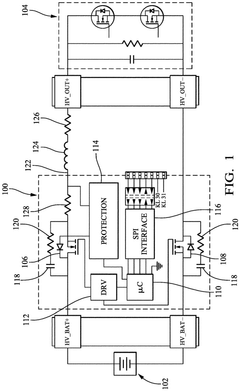
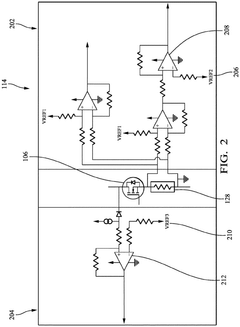
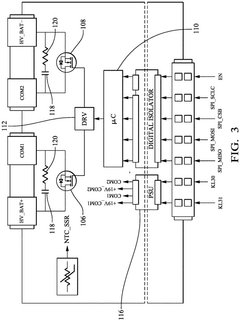
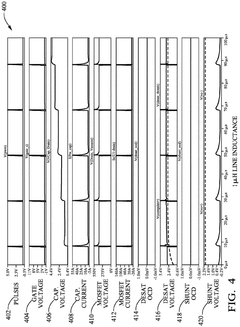
- A solid state relay module with shunt and desaturation overcurrent detection circuits, utilizing MOSFETs for fast and reliable switching, eliminates the need for dedicated bypass relays and resistors by quickly turning off during overcurrent conditions, employing pulsed energy to pre-charge capacitive loads and protect against high peak currents.
Reliability Testing and Certification Standards
Reliability testing and certification standards play a crucial role in ensuring that solid-state relay (SSR) overvoltage protection designs meet industry requirements and perform consistently under various operating conditions. The International Electrotechnical Commission (IEC) has established several standards specifically addressing SSR reliability, including IEC 62314 for solid-state relays and IEC 60947-4-3 for semiconductor controllers and contactors for non-motor loads.
Testing methodologies for SSR overvoltage protection typically include surge immunity tests according to IEC 61000-4-5, which evaluates the device's ability to withstand voltage surges of specified amplitudes and waveforms. These tests simulate lightning strikes and switching transients that could potentially damage unprotected circuits. Additionally, electrical fast transient (EFT) immunity tests per IEC 61000-4-4 assess the relay's resilience against rapid voltage spikes commonly encountered in industrial environments.
Temperature cycling tests represent another critical aspect of reliability assessment, as thermal stress can significantly impact the performance of semiconductor components in SSRs. These tests involve subjecting the devices to repeated temperature variations between specified extremes, often ranging from -40°C to +125°C, to evaluate their thermal endurance and identify potential failure modes under thermal stress conditions.
Underwriters Laboratories (UL) certification, particularly UL 508 for industrial control equipment, provides a standardized framework for evaluating SSR safety and reliability. Products meeting these standards demonstrate compliance with established safety requirements and performance criteria. Similarly, the CSA C22.2 No. 14 standard in Canada and various regional standards like EN 60947 in Europe ensure that SSRs with overvoltage protection meet local regulatory requirements.
Mean Time Between Failures (MTBF) calculations serve as quantitative indicators of reliability, with modern SSRs featuring robust overvoltage protection typically achieving MTBF values exceeding 100,000 hours under normal operating conditions. These calculations follow methodologies outlined in standards such as MIL-HDBK-217F or Telcordia SR-332, considering factors like component quality, operating temperature, and electrical stress levels.
Environmental testing standards, including IEC 60068 series, evaluate SSR performance under various environmental stressors such as humidity, vibration, and shock. These tests are particularly relevant for applications in harsh industrial environments where mechanical stress may compound electrical challenges, potentially compromising overvoltage protection mechanisms.
Accelerated life testing protocols help manufacturers predict long-term reliability by subjecting devices to intensified stress conditions. These tests often involve operating SSRs at elevated temperatures and voltages beyond normal specifications to induce accelerated aging, with results extrapolated to estimate expected service life under normal conditions.
Testing methodologies for SSR overvoltage protection typically include surge immunity tests according to IEC 61000-4-5, which evaluates the device's ability to withstand voltage surges of specified amplitudes and waveforms. These tests simulate lightning strikes and switching transients that could potentially damage unprotected circuits. Additionally, electrical fast transient (EFT) immunity tests per IEC 61000-4-4 assess the relay's resilience against rapid voltage spikes commonly encountered in industrial environments.
Temperature cycling tests represent another critical aspect of reliability assessment, as thermal stress can significantly impact the performance of semiconductor components in SSRs. These tests involve subjecting the devices to repeated temperature variations between specified extremes, often ranging from -40°C to +125°C, to evaluate their thermal endurance and identify potential failure modes under thermal stress conditions.
Underwriters Laboratories (UL) certification, particularly UL 508 for industrial control equipment, provides a standardized framework for evaluating SSR safety and reliability. Products meeting these standards demonstrate compliance with established safety requirements and performance criteria. Similarly, the CSA C22.2 No. 14 standard in Canada and various regional standards like EN 60947 in Europe ensure that SSRs with overvoltage protection meet local regulatory requirements.
Mean Time Between Failures (MTBF) calculations serve as quantitative indicators of reliability, with modern SSRs featuring robust overvoltage protection typically achieving MTBF values exceeding 100,000 hours under normal operating conditions. These calculations follow methodologies outlined in standards such as MIL-HDBK-217F or Telcordia SR-332, considering factors like component quality, operating temperature, and electrical stress levels.
Environmental testing standards, including IEC 60068 series, evaluate SSR performance under various environmental stressors such as humidity, vibration, and shock. These tests are particularly relevant for applications in harsh industrial environments where mechanical stress may compound electrical challenges, potentially compromising overvoltage protection mechanisms.
Accelerated life testing protocols help manufacturers predict long-term reliability by subjecting devices to intensified stress conditions. These tests often involve operating SSRs at elevated temperatures and voltages beyond normal specifications to induce accelerated aging, with results extrapolated to estimate expected service life under normal conditions.
Thermal Management Considerations for SSR Protection
Thermal management represents a critical aspect of solid-state relay (SSR) overvoltage protection design that directly impacts both performance and reliability. SSRs generate significant heat during normal operation due to the inherent resistance of semiconductor switching elements, with this thermal load substantially increasing during overvoltage events. The junction temperature of semiconductor components within SSRs must be maintained below manufacturer-specified thresholds to prevent thermal runaway conditions that can lead to catastrophic device failure.
Effective heat dissipation strategies typically employ multi-layered approaches combining passive and active cooling methods. Passive cooling solutions include appropriately sized heat sinks with optimized fin designs that maximize surface area while minimizing airflow resistance. Thermal interface materials (TIMs) such as phase-change compounds, thermal greases, or graphite pads are essential for reducing contact resistance between the SSR package and heat sink, with thermal conductivity values ranging from 3-12 W/m·K depending on the material selection.
For high-power applications exceeding 20A continuous current, forced-air cooling becomes necessary, requiring careful consideration of airflow patterns and potential thermal gradients. Computational fluid dynamics (CFD) modeling has emerged as a valuable tool for predicting thermal performance before physical prototyping, enabling engineers to identify potential hotspots and optimize cooling system designs accordingly.
Temperature monitoring represents another crucial aspect of thermal management for SSR protection circuits. Integrated temperature sensors with appropriate hysteresis characteristics can trigger protective responses before thermal damage occurs. Modern protection designs increasingly incorporate dynamic thermal impedance monitoring that adjusts operation based on real-time thermal conditions rather than relying solely on static thresholds.
The physical placement of SSRs within larger systems demands careful thermal planning. Proximity to other heat-generating components can create compounding thermal challenges, while inadequate spacing between multiple SSRs may lead to thermal coupling effects. Vertical mounting orientations typically offer superior natural convection cooling compared to horizontal placements.
Recent advances in packaging technology have introduced innovations such as direct bonded copper (DBC) substrates and insulated metal substrates (IMS) that significantly improve thermal conductivity pathways. These technologies reduce thermal resistance by 30-50% compared to traditional FR-4 PCB implementations, allowing for more compact designs without compromising thermal performance.
When designing overvoltage protection circuits for SSRs, engineers must consider worst-case thermal scenarios including ambient temperature extremes, transient thermal response during fault conditions, and long-term thermal cycling effects that may degrade thermal interface materials over time. Comprehensive thermal validation testing under these conditions remains essential for ensuring reliable operation throughout the expected service life of the protection system.
Effective heat dissipation strategies typically employ multi-layered approaches combining passive and active cooling methods. Passive cooling solutions include appropriately sized heat sinks with optimized fin designs that maximize surface area while minimizing airflow resistance. Thermal interface materials (TIMs) such as phase-change compounds, thermal greases, or graphite pads are essential for reducing contact resistance between the SSR package and heat sink, with thermal conductivity values ranging from 3-12 W/m·K depending on the material selection.
For high-power applications exceeding 20A continuous current, forced-air cooling becomes necessary, requiring careful consideration of airflow patterns and potential thermal gradients. Computational fluid dynamics (CFD) modeling has emerged as a valuable tool for predicting thermal performance before physical prototyping, enabling engineers to identify potential hotspots and optimize cooling system designs accordingly.
Temperature monitoring represents another crucial aspect of thermal management for SSR protection circuits. Integrated temperature sensors with appropriate hysteresis characteristics can trigger protective responses before thermal damage occurs. Modern protection designs increasingly incorporate dynamic thermal impedance monitoring that adjusts operation based on real-time thermal conditions rather than relying solely on static thresholds.
The physical placement of SSRs within larger systems demands careful thermal planning. Proximity to other heat-generating components can create compounding thermal challenges, while inadequate spacing between multiple SSRs may lead to thermal coupling effects. Vertical mounting orientations typically offer superior natural convection cooling compared to horizontal placements.
Recent advances in packaging technology have introduced innovations such as direct bonded copper (DBC) substrates and insulated metal substrates (IMS) that significantly improve thermal conductivity pathways. These technologies reduce thermal resistance by 30-50% compared to traditional FR-4 PCB implementations, allowing for more compact designs without compromising thermal performance.
When designing overvoltage protection circuits for SSRs, engineers must consider worst-case thermal scenarios including ambient temperature extremes, transient thermal response during fault conditions, and long-term thermal cycling effects that may degrade thermal interface materials over time. Comprehensive thermal validation testing under these conditions remains essential for ensuring reliable operation throughout the expected service life of the protection system.
Unlock deeper insights with Patsnap Eureka Quick Research — get a full tech report to explore trends and direct your research. Try now!
Generate Your Research Report Instantly with AI Agent
Supercharge your innovation with Patsnap Eureka AI Agent Platform!