Solid-State Relay Thermal Management for Extended Use
SEP 19, 20259 MIN READ
Generate Your Research Report Instantly with AI Agent
PatSnap Eureka helps you evaluate technical feasibility & market potential.
SSR Thermal Management Background and Objectives
Solid-state relays (SSRs) have evolved significantly since their introduction in the 1970s as alternatives to electromechanical relays. These semiconductor-based switching devices offer numerous advantages including no moving parts, silent operation, resistance to shock and vibration, and compatibility with digital control systems. However, thermal management has consistently remained a critical challenge throughout their development history, particularly for applications requiring extended operational periods.
The evolution of SSR thermal management technologies has progressed from basic heat sinks to more sophisticated cooling solutions. Early implementations relied primarily on passive cooling techniques, which proved inadequate for high-power applications. As industrial automation and power control systems advanced, the demand for SSRs capable of handling higher currents while maintaining reliability increased substantially, driving innovation in thermal management approaches.
Current industry trends indicate a growing adoption of SSRs in critical infrastructure, renewable energy systems, electric vehicle charging stations, and industrial automation—all applications where extended operational reliability is paramount. This expansion has heightened the importance of effective thermal management solutions that can ensure consistent performance over prolonged periods without degradation or failure.
The primary technical objective of SSR thermal management research is to develop solutions that efficiently dissipate heat generated during continuous operation while maintaining optimal junction temperatures. This involves addressing the fundamental challenge of managing heat transfer from the semiconductor junction to the ambient environment through various thermal interfaces and materials.
Secondary objectives include reducing the thermal resistance between components, minimizing the overall thermal footprint, enhancing reliability under varying environmental conditions, and extending operational lifespan. These objectives must be achieved while maintaining cost-effectiveness and compatibility with existing installation standards and form factors.
Recent technological advancements in materials science, particularly in thermal interface materials (TIMs), phase-change materials, and advanced ceramics, have opened new possibilities for SSR thermal management. Concurrently, computational fluid dynamics (CFD) modeling and thermal simulation tools have enabled more precise design and optimization of cooling solutions before physical prototyping.
The trajectory of SSR thermal management is increasingly moving toward integrated approaches that combine multiple cooling technologies—passive and active—optimized through advanced thermal modeling. This evolution is essential to support the growing demand for higher-power SSRs in applications where continuous operation is required, such as grid infrastructure, industrial processes, and critical systems where downtime is unacceptable.
The evolution of SSR thermal management technologies has progressed from basic heat sinks to more sophisticated cooling solutions. Early implementations relied primarily on passive cooling techniques, which proved inadequate for high-power applications. As industrial automation and power control systems advanced, the demand for SSRs capable of handling higher currents while maintaining reliability increased substantially, driving innovation in thermal management approaches.
Current industry trends indicate a growing adoption of SSRs in critical infrastructure, renewable energy systems, electric vehicle charging stations, and industrial automation—all applications where extended operational reliability is paramount. This expansion has heightened the importance of effective thermal management solutions that can ensure consistent performance over prolonged periods without degradation or failure.
The primary technical objective of SSR thermal management research is to develop solutions that efficiently dissipate heat generated during continuous operation while maintaining optimal junction temperatures. This involves addressing the fundamental challenge of managing heat transfer from the semiconductor junction to the ambient environment through various thermal interfaces and materials.
Secondary objectives include reducing the thermal resistance between components, minimizing the overall thermal footprint, enhancing reliability under varying environmental conditions, and extending operational lifespan. These objectives must be achieved while maintaining cost-effectiveness and compatibility with existing installation standards and form factors.
Recent technological advancements in materials science, particularly in thermal interface materials (TIMs), phase-change materials, and advanced ceramics, have opened new possibilities for SSR thermal management. Concurrently, computational fluid dynamics (CFD) modeling and thermal simulation tools have enabled more precise design and optimization of cooling solutions before physical prototyping.
The trajectory of SSR thermal management is increasingly moving toward integrated approaches that combine multiple cooling technologies—passive and active—optimized through advanced thermal modeling. This evolution is essential to support the growing demand for higher-power SSRs in applications where continuous operation is required, such as grid infrastructure, industrial processes, and critical systems where downtime is unacceptable.
Market Demand Analysis for High-Reliability SSRs
The global market for high-reliability Solid-State Relays (SSRs) has been experiencing robust growth, driven primarily by increasing automation across industrial sectors and the rising demand for energy-efficient switching solutions. Current market valuations indicate that the high-reliability SSR segment represents approximately 30% of the overall SSR market, with particular strength in applications requiring extended operational lifespans under challenging thermal conditions.
Industrial automation remains the largest application sector, accounting for a significant portion of high-reliability SSR demand. This sector's requirements are increasingly stringent, with expectations for devices that can maintain performance integrity under continuous operation for 10+ years while handling high-frequency switching operations. The automotive industry represents another rapidly expanding market, particularly with the transition toward electric vehicles where power management systems demand components with superior thermal management capabilities.
Market research indicates a compound annual growth rate of 7.8% for high-reliability SSRs through 2028, outpacing the broader relay market. This accelerated growth correlates directly with end-user emphasis on total cost of ownership rather than initial procurement costs, as thermal management improvements directly translate to extended service life and reduced maintenance intervals.
Regional analysis reveals that Asia-Pacific currently leads market consumption, with China and South Korea showing particularly strong demand growth trajectories. North America and Europe follow closely, with their markets characterized by higher price points and more specialized application requirements focused on thermal performance under extreme conditions.
Customer surveys across key industries indicate that thermal management capabilities rank among the top three selection criteria for SSRs in critical applications, alongside switching reliability and surge handling capacity. Approximately 68% of procurement engineers cite improved thermal performance as "very important" or "critical" in their selection process, highlighting the market's recognition of this feature's importance for operational reliability.
Emerging application areas showing substantial growth potential include renewable energy systems, where SSRs must operate reliably in variable environmental conditions, and data center infrastructure, where heat dissipation challenges are particularly acute due to increasing power densities. These sectors are projected to contribute significantly to market expansion over the next five years.
Price sensitivity analysis reveals that customers are willing to pay a premium of up to 40% for SSRs with demonstrably superior thermal management capabilities when total lifecycle costs are considered. This premium acceptance is highest in mission-critical applications where downtime costs substantially outweigh component costs.
Industrial automation remains the largest application sector, accounting for a significant portion of high-reliability SSR demand. This sector's requirements are increasingly stringent, with expectations for devices that can maintain performance integrity under continuous operation for 10+ years while handling high-frequency switching operations. The automotive industry represents another rapidly expanding market, particularly with the transition toward electric vehicles where power management systems demand components with superior thermal management capabilities.
Market research indicates a compound annual growth rate of 7.8% for high-reliability SSRs through 2028, outpacing the broader relay market. This accelerated growth correlates directly with end-user emphasis on total cost of ownership rather than initial procurement costs, as thermal management improvements directly translate to extended service life and reduced maintenance intervals.
Regional analysis reveals that Asia-Pacific currently leads market consumption, with China and South Korea showing particularly strong demand growth trajectories. North America and Europe follow closely, with their markets characterized by higher price points and more specialized application requirements focused on thermal performance under extreme conditions.
Customer surveys across key industries indicate that thermal management capabilities rank among the top three selection criteria for SSRs in critical applications, alongside switching reliability and surge handling capacity. Approximately 68% of procurement engineers cite improved thermal performance as "very important" or "critical" in their selection process, highlighting the market's recognition of this feature's importance for operational reliability.
Emerging application areas showing substantial growth potential include renewable energy systems, where SSRs must operate reliably in variable environmental conditions, and data center infrastructure, where heat dissipation challenges are particularly acute due to increasing power densities. These sectors are projected to contribute significantly to market expansion over the next five years.
Price sensitivity analysis reveals that customers are willing to pay a premium of up to 40% for SSRs with demonstrably superior thermal management capabilities when total lifecycle costs are considered. This premium acceptance is highest in mission-critical applications where downtime costs substantially outweigh component costs.
Current Thermal Challenges in SSR Technology
Solid-State Relays (SSRs) face significant thermal management challenges that limit their performance and longevity in industrial applications. The primary issue stems from the inherent heat generation during operation, with semiconductor junction temperatures often reaching critical levels under high load conditions. This heat accumulation accelerates component degradation and can lead to premature failure if not properly addressed.
The thermal resistance path from junction to case represents a fundamental challenge, as it creates a bottleneck for heat dissipation. Current SSR designs typically exhibit thermal resistance values between 0.5-1.5°C/W, which proves insufficient for applications requiring sustained high-current operation. This limitation becomes particularly problematic in confined installation spaces where natural convection cooling is restricted.
Heat concentration at semiconductor interfaces creates thermal hotspots that can reach temperatures 30-40% higher than average case temperatures. These localized temperature extremes accelerate semiconductor aging through mechanisms including metal migration, oxide breakdown, and package delamination. Industry data indicates that operating an SSR just 10°C above recommended junction temperature can reduce its operational lifespan by approximately 50%.
Environmental factors further complicate thermal management strategies. SSRs deployed in high-ambient-temperature environments (>40°C) or enclosed cabinets face compounded cooling challenges, as the temperature differential available for heat transfer diminishes significantly. This problem is particularly acute in applications like industrial furnace controls, outdoor telecommunications equipment, and automotive systems.
Current cooling solutions present their own limitations. Passive heatsinks increase device footprint and weight while offering diminishing returns as size increases. Active cooling systems introduce reliability concerns through additional failure points (fans, pumps) and increased power consumption. Phase-change materials show promise but face challenges in thermal cycling durability and long-term performance stability.
The miniaturization trend in industrial control systems creates additional thermal density challenges. As SSR packages shrink to accommodate space constraints, power density increases dramatically, with some modern designs exceeding 50W/cm³. This concentration of heat generation in smaller volumes demands innovative thermal management approaches beyond traditional solutions.
Thermal interface materials (TIMs) represent another challenge area. Current industry-standard TIMs degrade over time through pump-out, dry-out, and thermal cycling effects. This degradation can increase thermal resistance by 20-30% over a device's operational lifetime, progressively compromising cooling efficiency and accelerating thermal aging of the semiconductor components.
The thermal resistance path from junction to case represents a fundamental challenge, as it creates a bottleneck for heat dissipation. Current SSR designs typically exhibit thermal resistance values between 0.5-1.5°C/W, which proves insufficient for applications requiring sustained high-current operation. This limitation becomes particularly problematic in confined installation spaces where natural convection cooling is restricted.
Heat concentration at semiconductor interfaces creates thermal hotspots that can reach temperatures 30-40% higher than average case temperatures. These localized temperature extremes accelerate semiconductor aging through mechanisms including metal migration, oxide breakdown, and package delamination. Industry data indicates that operating an SSR just 10°C above recommended junction temperature can reduce its operational lifespan by approximately 50%.
Environmental factors further complicate thermal management strategies. SSRs deployed in high-ambient-temperature environments (>40°C) or enclosed cabinets face compounded cooling challenges, as the temperature differential available for heat transfer diminishes significantly. This problem is particularly acute in applications like industrial furnace controls, outdoor telecommunications equipment, and automotive systems.
Current cooling solutions present their own limitations. Passive heatsinks increase device footprint and weight while offering diminishing returns as size increases. Active cooling systems introduce reliability concerns through additional failure points (fans, pumps) and increased power consumption. Phase-change materials show promise but face challenges in thermal cycling durability and long-term performance stability.
The miniaturization trend in industrial control systems creates additional thermal density challenges. As SSR packages shrink to accommodate space constraints, power density increases dramatically, with some modern designs exceeding 50W/cm³. This concentration of heat generation in smaller volumes demands innovative thermal management approaches beyond traditional solutions.
Thermal interface materials (TIMs) represent another challenge area. Current industry-standard TIMs degrade over time through pump-out, dry-out, and thermal cycling effects. This degradation can increase thermal resistance by 20-30% over a device's operational lifetime, progressively compromising cooling efficiency and accelerating thermal aging of the semiconductor components.
Current Thermal Dissipation Techniques for SSRs
01 Heat sink and thermal interface materials for SSRs
Heat sinks are critical components for solid-state relay thermal management, providing a pathway for heat dissipation from the semiconductor elements. These heat sinks can be designed with various fin structures and materials to maximize surface area and thermal conductivity. Thermal interface materials like thermal greases, pads, or adhesives are used between the SSR and heat sink to improve thermal contact and reduce thermal resistance, enhancing overall heat transfer efficiency.- Heat sink and thermal interface materials: Heat sinks are critical components for solid-state relay thermal management, providing effective heat dissipation from the semiconductor elements. These are often combined with thermal interface materials such as thermal greases, pads, or adhesives to improve thermal conductivity between the relay and heat sink. Proper selection of heat sink design and thermal interface materials significantly reduces junction temperatures and extends relay life by efficiently transferring heat to the ambient environment.
- Integrated cooling structures: Advanced solid-state relays incorporate integrated cooling structures directly into their design. These include embedded cooling channels, integrated fans, or thermoelectric cooling elements that actively remove heat from critical components. Some designs feature multi-layer structures with dedicated thermal management layers that distribute heat more evenly across the device. These integrated approaches allow for more compact relay designs while maintaining safe operating temperatures under high load conditions.
- Thermal isolation techniques: Thermal isolation strategies are employed to protect sensitive components within solid-state relays from heat damage. These include using thermally insulating materials to separate heat-generating components from temperature-sensitive elements, creating thermal barriers between power and control circuits, and implementing strategic component placement to minimize thermal interference. Some designs incorporate air gaps or specialized insulating materials to reduce thermal coupling between different functional blocks of the relay.
- Active temperature monitoring and control: Modern solid-state relays incorporate active temperature monitoring and control systems to prevent thermal damage. These systems use integrated temperature sensors to continuously monitor critical points within the relay. When temperatures approach unsafe levels, control circuits can implement protective measures such as current limiting, load shedding, or complete shutdown. Some advanced designs include predictive thermal management that anticipates temperature rises based on load patterns and adjusts operation accordingly.
- Package design optimization: The physical package design of solid-state relays plays a crucial role in thermal management. Optimized package designs feature materials with high thermal conductivity, strategic component placement to facilitate heat flow, and increased surface area for better heat dissipation. Some packages incorporate direct bonded copper (DBC) substrates or advanced ceramic materials that efficiently conduct heat away from semiconductor junctions. Package geometry is also optimized to promote natural convection cooling when external heat sinks are not used.
02 Integrated cooling systems for SSRs
Advanced cooling systems can be integrated directly with solid-state relays to provide more efficient thermal management. These include liquid cooling channels, thermoelectric coolers, or forced-air cooling mechanisms that actively remove heat from the relay components. Such integrated cooling approaches are particularly valuable in high-power applications where passive cooling alone may be insufficient to maintain safe operating temperatures.Expand Specific Solutions03 Thermal isolation and substrate design
Thermal isolation techniques involve strategically separating heat-generating components from temperature-sensitive elements within the solid-state relay. This can be achieved through specialized substrate designs using materials with low thermal conductivity in specific areas, while maintaining high thermal conductivity paths for heat dissipation. Advanced ceramic substrates, insulated metal substrates, or composite materials can be employed to optimize heat flow patterns and prevent thermal interference between components.Expand Specific Solutions04 Temperature monitoring and protection circuits
Implementing temperature sensing and protection circuits within solid-state relays provides active thermal management capabilities. These systems can monitor operating temperatures in real-time and trigger protective responses when thermal thresholds are approached. Protection mechanisms may include current limiting, switching to lower power modes, or complete shutdown to prevent thermal damage. Some advanced designs incorporate predictive thermal modeling to anticipate temperature rises before they become critical.Expand Specific Solutions05 Package design and thermal spreading techniques
The physical package design of solid-state relays significantly impacts thermal management performance. Optimized package geometries can facilitate better heat spreading throughout the device, reducing hotspots and improving overall thermal performance. Advanced techniques include embedding heat spreaders made of high thermal conductivity materials like copper or aluminum within the package, using multi-layer structures to distribute heat more evenly, and designing packages with direct thermal paths to external cooling systems.Expand Specific Solutions
Key Industry Players in SSR Manufacturing
The solid-state relay thermal management market is currently in a growth phase, driven by increasing demand for reliable electronic components in industrial automation and energy systems. The market size is expanding steadily, with projections indicating significant growth as industries adopt more electronic control systems. Technologically, the field is moderately mature but evolving rapidly, with companies like Siemens AG, OMRON Corp., and Industrial Technology Research Institute leading innovation in thermal dissipation techniques. Newer entrants such as Contemporary Amperex Technology and Intramicron are advancing material science applications for heat management. Established industrial players including Lockheed Martin, Boeing, and Raytheon are implementing these technologies in high-reliability environments, while automotive companies like GM Global Technology Operations are driving adoption in transportation applications.
OMRON Corp.
Technical Solution: OMRON has developed advanced solid-state relay (SSR) thermal management solutions featuring integrated heat sink designs with optimized fin structures that increase surface area by up to 40% compared to conventional designs. Their G3PE series incorporates aluminum nitride (AlN) insulation substrates with thermal conductivity 7-9 times higher than traditional alumina ceramics, significantly improving heat dissipation. OMRON's thermal management approach includes phase-change materials (PCMs) embedded within the relay housing that absorb heat during peak loads and release it during low-load periods, maintaining more consistent operating temperatures. Their latest SSRs feature built-in temperature sensors and microcontroller-based thermal monitoring that enables predictive maintenance and prevents thermal runaway conditions through active load management.
Strengths: Industry-leading thermal conductivity materials and integrated cooling solutions that extend SSR lifespan by up to 30% in high-temperature applications. Comprehensive thermal modeling capabilities for application-specific optimization. Weaknesses: Premium pricing compared to conventional solutions and proprietary designs that may limit compatibility with third-party systems.
Siemens AG
Technical Solution: Siemens has pioneered a comprehensive thermal management approach for solid-state relays through their SIRIUS 3RF series, which employs a multi-layered strategy to address heat dissipation challenges. Their technology utilizes direct copper bonding (DCB) substrates with thermal conductivity exceeding 300 W/mK, creating efficient pathways for heat transfer from semiconductor junctions to external cooling systems. Siemens' patented "ThermoFrame" architecture incorporates microchannels within the relay housing that facilitate natural convection cooling while maintaining electrical isolation. For extended industrial applications, they've developed adaptive cooling algorithms that modulate switching frequencies based on thermal feedback, preventing hotspot formation during continuous operation. Their latest innovation includes phase-change composite materials integrated into the relay structure that provide thermal buffering during load fluctuations.
Strengths: Exceptional reliability in high-temperature industrial environments with documented MTBF improvements of 40% over standard SSRs. Comprehensive thermal simulation capabilities for application-specific optimization. Weaknesses: Higher initial investment costs and increased complexity requiring specialized installation knowledge for optimal performance.
Critical Patents in SSR Cooling Technology
Solid state relay module heating system and methods
PatentWO2022204603A1
Innovation
- A solid state relay module with a heat sink and integrated heating capabilities, allowing for localized heating and cooling of solid state relays within the enclosure, using a control system to manage heating cables and maintain a safe operating temperature.


High current high power solid state relay
PatentWO2016132372A1
Innovation
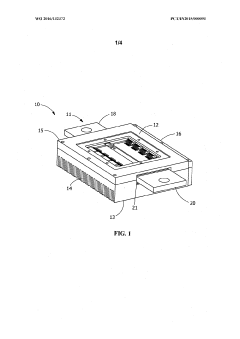
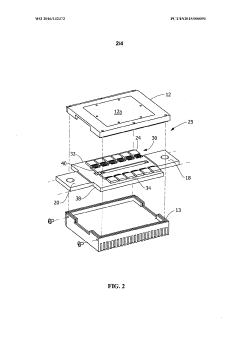
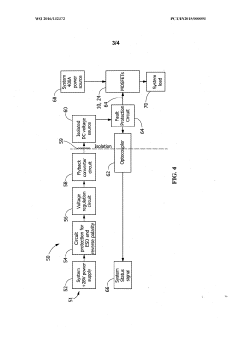
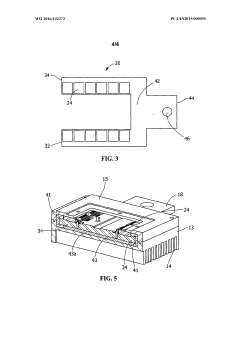
- A high current, high power solid state relay design featuring a planar metal bus bar and heat dissipating enclosure with a plurality of solid state switches and a control circuit using a Flyback converter for electrical isolation, allowing for efficient heat dissipation and reduced turn-on/turn-off times.
Material Science Advancements for SSR Applications
Material science innovations have become a cornerstone for advancing solid-state relay (SSR) thermal management capabilities. Recent developments in ceramic substrates have yielded significant improvements in thermal conductivity while maintaining essential electrical isolation properties. Aluminum nitride (AlN) and silicon nitride (Si3N4) ceramics now achieve thermal conductivity values of 170-200 W/mK, representing a 40% improvement over traditional alumina substrates used in earlier SSR generations.
Advanced metal matrix composites (MMCs) incorporating copper-tungsten and aluminum-silicon carbide combinations have emerged as superior heat spreader materials. These composites offer thermal expansion coefficients closely matching semiconductor materials while providing thermal conductivity approaching 300 W/mK. This compatibility significantly reduces thermal stress at material interfaces during temperature cycling, extending operational lifespan of SSRs in high-temperature industrial environments.
Phase change materials (PCMs) represent another breakthrough, offering temporary thermal buffering during peak load conditions. Metallic PCMs with melting points between 80-120°C can absorb substantial thermal energy during transient overload conditions without compromising the SSR's electrical performance. These materials effectively dampen thermal spikes that would otherwise accelerate degradation of semiconductor junctions.
Nano-enhanced thermal interface materials (TIMs) have revolutionized heat transfer between SSR components. Carbon nanotube and graphene-infused polymer composites achieve thermal conductivity exceeding 25 W/mK while maintaining compliance and gap-filling properties essential for manufacturing variability accommodation. These next-generation TIMs reduce thermal resistance at critical interfaces by up to 60% compared to conventional silicone-based compounds.
Diamond-like carbon (DLC) coatings applied through plasma-enhanced chemical vapor deposition provide exceptional surface protection for SSR components. With thermal conductivity approaching 1000 W/mK in optimal configurations, these ultra-thin (1-5μm) coatings create efficient thermal pathways while simultaneously offering electrical insulation and corrosion resistance properties critical for harsh operating environments.
Additive manufacturing techniques have enabled complex three-dimensional heat sink geometries previously impossible with traditional manufacturing methods. Selective laser melting of aluminum alloys with optimized lattice structures increases surface-to-volume ratios by up to 300%, dramatically improving convective heat transfer efficiency without increasing overall device dimensions. These structures maintain mechanical integrity while reducing material usage and weight by approximately 40%.
Advanced metal matrix composites (MMCs) incorporating copper-tungsten and aluminum-silicon carbide combinations have emerged as superior heat spreader materials. These composites offer thermal expansion coefficients closely matching semiconductor materials while providing thermal conductivity approaching 300 W/mK. This compatibility significantly reduces thermal stress at material interfaces during temperature cycling, extending operational lifespan of SSRs in high-temperature industrial environments.
Phase change materials (PCMs) represent another breakthrough, offering temporary thermal buffering during peak load conditions. Metallic PCMs with melting points between 80-120°C can absorb substantial thermal energy during transient overload conditions without compromising the SSR's electrical performance. These materials effectively dampen thermal spikes that would otherwise accelerate degradation of semiconductor junctions.
Nano-enhanced thermal interface materials (TIMs) have revolutionized heat transfer between SSR components. Carbon nanotube and graphene-infused polymer composites achieve thermal conductivity exceeding 25 W/mK while maintaining compliance and gap-filling properties essential for manufacturing variability accommodation. These next-generation TIMs reduce thermal resistance at critical interfaces by up to 60% compared to conventional silicone-based compounds.
Diamond-like carbon (DLC) coatings applied through plasma-enhanced chemical vapor deposition provide exceptional surface protection for SSR components. With thermal conductivity approaching 1000 W/mK in optimal configurations, these ultra-thin (1-5μm) coatings create efficient thermal pathways while simultaneously offering electrical insulation and corrosion resistance properties critical for harsh operating environments.
Additive manufacturing techniques have enabled complex three-dimensional heat sink geometries previously impossible with traditional manufacturing methods. Selective laser melting of aluminum alloys with optimized lattice structures increases surface-to-volume ratios by up to 300%, dramatically improving convective heat transfer efficiency without increasing overall device dimensions. These structures maintain mechanical integrity while reducing material usage and weight by approximately 40%.
Reliability Testing Standards for Extended-Use SSRs
Reliability testing standards for Solid-State Relays (SSRs) in extended-use applications are critical to ensure these components can withstand prolonged operational demands while maintaining thermal stability. The primary standards governing SSR reliability include IEC 62314, UL 508, and IEC 60947-4-3, which establish comprehensive testing protocols specifically designed for power semiconductor switching devices.
These standards mandate rigorous thermal cycling tests where SSRs must endure thousands of power cycles between minimum and maximum rated temperatures. For extended-use applications, the testing parameters typically exceed standard requirements, with cycle counts often reaching 10,000-50,000 compared to conventional 1,000-5,000 cycles for general-purpose relays. Temperature extremes during these tests commonly range from -40°C to +125°C, with dwell times at each extreme extended to simulate real-world conditions.
Load life testing represents another crucial standard requirement, where SSRs operate continuously at maximum rated current and temperature for extended periods—typically 1,000 to 5,000 hours for standard applications, but extended to 10,000+ hours for long-term use scenarios. During these tests, key parameters such as on-state voltage drop, leakage current, and thermal resistance are monitored for degradation indicators.
Thermal shock testing evaluates the relay's ability to withstand rapid temperature changes, with standards requiring SSRs to maintain functionality after repeated transfers between temperature extremes. For extended-use applications, the number of shock cycles is significantly increased, and recovery periods between cycles are shortened to stress the device more intensively.
Humidity and environmental testing standards (IEC 60068-2) assess performance under varying humidity levels (typically 85-95% RH) at elevated temperatures (85°C) for extended periods. These tests are particularly relevant for SSRs deployed in challenging environmental conditions where thermal management becomes more complex.
Accelerated life testing methodologies apply elevated stress levels (higher temperatures, voltages, or currents) to predict long-term reliability. The Arrhenius equation serves as the foundation for many of these tests, with acceleration factors carefully calculated to ensure accurate lifetime predictions without introducing failure mechanisms that wouldn't occur under normal operating conditions.
Industry-specific standards provide additional requirements for particular applications. For example, automotive standards (AEC-Q101) impose more stringent thermal cycling requirements, while medical device standards (IEC 60601) emphasize lower leakage currents and higher isolation requirements, both of which impact thermal management strategies.
Compliance with these standards not only ensures reliability but also provides quantifiable metrics for comparing different SSR solutions and their thermal management capabilities in extended-use scenarios.
These standards mandate rigorous thermal cycling tests where SSRs must endure thousands of power cycles between minimum and maximum rated temperatures. For extended-use applications, the testing parameters typically exceed standard requirements, with cycle counts often reaching 10,000-50,000 compared to conventional 1,000-5,000 cycles for general-purpose relays. Temperature extremes during these tests commonly range from -40°C to +125°C, with dwell times at each extreme extended to simulate real-world conditions.
Load life testing represents another crucial standard requirement, where SSRs operate continuously at maximum rated current and temperature for extended periods—typically 1,000 to 5,000 hours for standard applications, but extended to 10,000+ hours for long-term use scenarios. During these tests, key parameters such as on-state voltage drop, leakage current, and thermal resistance are monitored for degradation indicators.
Thermal shock testing evaluates the relay's ability to withstand rapid temperature changes, with standards requiring SSRs to maintain functionality after repeated transfers between temperature extremes. For extended-use applications, the number of shock cycles is significantly increased, and recovery periods between cycles are shortened to stress the device more intensively.
Humidity and environmental testing standards (IEC 60068-2) assess performance under varying humidity levels (typically 85-95% RH) at elevated temperatures (85°C) for extended periods. These tests are particularly relevant for SSRs deployed in challenging environmental conditions where thermal management becomes more complex.
Accelerated life testing methodologies apply elevated stress levels (higher temperatures, voltages, or currents) to predict long-term reliability. The Arrhenius equation serves as the foundation for many of these tests, with acceleration factors carefully calculated to ensure accurate lifetime predictions without introducing failure mechanisms that wouldn't occur under normal operating conditions.
Industry-specific standards provide additional requirements for particular applications. For example, automotive standards (AEC-Q101) impose more stringent thermal cycling requirements, while medical device standards (IEC 60601) emphasize lower leakage currents and higher isolation requirements, both of which impact thermal management strategies.
Compliance with these standards not only ensures reliability but also provides quantifiable metrics for comparing different SSR solutions and their thermal management capabilities in extended-use scenarios.
Unlock deeper insights with PatSnap Eureka Quick Research — get a full tech report to explore trends and direct your research. Try now!
Generate Your Research Report Instantly with AI Agent
Supercharge your innovation with PatSnap Eureka AI Agent Platform!