

Transparent Oxides and Their Effect on Smart Window Technology
SEP 19, 20259 MIN READ
Generate Your Research Report Instantly with AI Agent
PatSnap Eureka helps you evaluate technical feasibility & market potential.
Transparent Oxide Evolution and Smart Window Goals
Transparent oxides have evolved significantly over the past decades, transforming from simple passive materials to active components in advanced electronic applications. The journey began with basic tin oxide coatings in the 1950s, primarily used for their electrical conductivity properties, and has now reached sophisticated indium tin oxide (ITO) and fluorine-doped tin oxide (FTO) implementations that offer unprecedented control over light transmission and heat management. This technological evolution has been driven by the increasing demand for energy-efficient building solutions and the global push toward sustainable development.
The fundamental goal of transparent oxide technology in smart windows is to create dynamic glazing systems that can modulate their optical properties in response to environmental conditions or user preferences. These materials aim to maximize natural daylight utilization while minimizing unwanted heat gain or loss, thereby reducing building energy consumption for heating, cooling, and lighting. Current research indicates that effective implementation of transparent oxide-based smart windows can reduce building energy consumption by 20-30%, representing a significant contribution to global energy conservation efforts.
From a technical perspective, the evolution of transparent oxides has focused on enhancing three critical parameters: optical transparency in the visible spectrum, electrical conductivity, and durability under varying environmental conditions. Modern transparent conducting oxides (TCOs) achieve visible light transmission rates exceeding 90% while maintaining sheet resistances below 10 ohms per square, a remarkable balance of seemingly contradictory properties. This performance level enables the development of electrochromic, thermochromic, and photochromic smart window technologies that can dynamically adjust their properties.
The technological roadmap for transparent oxides in smart windows aims to address several persistent challenges. These include reducing dependency on scarce materials like indium, improving switching speeds in electrochromic applications, extending operational lifetimes beyond 20 years, and developing cost-effective manufacturing processes suitable for large-scale production. Recent breakthroughs in alternative TCO materials such as aluminum-doped zinc oxide (AZO) and graphene-based transparent conductors show promising potential to overcome these limitations.
Looking forward, the integration of transparent oxides with Internet of Things (IoT) capabilities represents the next frontier in smart window technology. This convergence aims to create adaptive building envelopes that automatically respond to occupant behavior patterns, weather forecasts, and grid demands, optimizing both comfort and energy efficiency. The ultimate goal is to develop self-powered smart windows that harvest solar energy through transparent photovoltaic layers while simultaneously providing dynamic shading and insulation properties, effectively transforming windows from energy liabilities into energy assets.
The fundamental goal of transparent oxide technology in smart windows is to create dynamic glazing systems that can modulate their optical properties in response to environmental conditions or user preferences. These materials aim to maximize natural daylight utilization while minimizing unwanted heat gain or loss, thereby reducing building energy consumption for heating, cooling, and lighting. Current research indicates that effective implementation of transparent oxide-based smart windows can reduce building energy consumption by 20-30%, representing a significant contribution to global energy conservation efforts.
From a technical perspective, the evolution of transparent oxides has focused on enhancing three critical parameters: optical transparency in the visible spectrum, electrical conductivity, and durability under varying environmental conditions. Modern transparent conducting oxides (TCOs) achieve visible light transmission rates exceeding 90% while maintaining sheet resistances below 10 ohms per square, a remarkable balance of seemingly contradictory properties. This performance level enables the development of electrochromic, thermochromic, and photochromic smart window technologies that can dynamically adjust their properties.
The technological roadmap for transparent oxides in smart windows aims to address several persistent challenges. These include reducing dependency on scarce materials like indium, improving switching speeds in electrochromic applications, extending operational lifetimes beyond 20 years, and developing cost-effective manufacturing processes suitable for large-scale production. Recent breakthroughs in alternative TCO materials such as aluminum-doped zinc oxide (AZO) and graphene-based transparent conductors show promising potential to overcome these limitations.
Looking forward, the integration of transparent oxides with Internet of Things (IoT) capabilities represents the next frontier in smart window technology. This convergence aims to create adaptive building envelopes that automatically respond to occupant behavior patterns, weather forecasts, and grid demands, optimizing both comfort and energy efficiency. The ultimate goal is to develop self-powered smart windows that harvest solar energy through transparent photovoltaic layers while simultaneously providing dynamic shading and insulation properties, effectively transforming windows from energy liabilities into energy assets.
Market Analysis for Energy-Efficient Smart Windows
The global market for energy-efficient smart windows is experiencing robust growth, driven by increasing environmental awareness, rising energy costs, and stringent building regulations. Current market valuations indicate that the smart window sector reached approximately 5.1 billion USD in 2022, with projections suggesting a compound annual growth rate (CAGR) of 12.4% through 2030. This growth trajectory is particularly pronounced in commercial construction, where energy efficiency has become a primary consideration in building design and renovation.
Transparent conductive oxides (TCOs) play a pivotal role in this market expansion, as they form the technological foundation for many smart window solutions. Indium tin oxide (ITO) currently dominates the TCO market segment, accounting for nearly 70% of applications in smart window technology. However, alternative materials such as fluorine-doped tin oxide (FTO) and aluminum-doped zinc oxide (AZO) are gaining traction due to indium's limited supply and cost volatility.
Regional analysis reveals that North America and Europe lead in smart window adoption, collectively representing over 60% of the global market share. This dominance stems from advanced building codes, higher disposable incomes, and greater emphasis on sustainable construction practices. The Asia-Pacific region, particularly China and Japan, is emerging as the fastest-growing market with annual growth rates exceeding 15%, driven by rapid urbanization and increasing green building initiatives.
Consumer demand patterns indicate a shift toward multi-functional smart windows that offer not only energy efficiency but also enhanced comfort, privacy options, and integration with smart home systems. Market research shows that buildings equipped with smart window technology can reduce energy consumption for heating, ventilation, and air conditioning (HVAC) by 20-30%, representing significant operational cost savings over a building's lifecycle.
The competitive landscape features established glass manufacturers who have expanded into smart technologies, specialized smart window startups, and chemical companies developing advanced materials for window coatings. Major players include Saint-Gobain, View Inc., and Gentex Corporation, who collectively hold approximately 45% of the market share. These companies are increasingly focusing on reducing production costs to make smart windows more accessible to mainstream construction projects.
Price sensitivity remains a significant market barrier, with smart windows typically costing 2-3 times more than conventional alternatives. However, this premium is gradually decreasing as manufacturing scales up and technologies mature. Market forecasts suggest that price parity with high-end conventional windows could be achieved within the next 5-7 years, potentially triggering widespread adoption across various building segments.
Transparent conductive oxides (TCOs) play a pivotal role in this market expansion, as they form the technological foundation for many smart window solutions. Indium tin oxide (ITO) currently dominates the TCO market segment, accounting for nearly 70% of applications in smart window technology. However, alternative materials such as fluorine-doped tin oxide (FTO) and aluminum-doped zinc oxide (AZO) are gaining traction due to indium's limited supply and cost volatility.
Regional analysis reveals that North America and Europe lead in smart window adoption, collectively representing over 60% of the global market share. This dominance stems from advanced building codes, higher disposable incomes, and greater emphasis on sustainable construction practices. The Asia-Pacific region, particularly China and Japan, is emerging as the fastest-growing market with annual growth rates exceeding 15%, driven by rapid urbanization and increasing green building initiatives.
Consumer demand patterns indicate a shift toward multi-functional smart windows that offer not only energy efficiency but also enhanced comfort, privacy options, and integration with smart home systems. Market research shows that buildings equipped with smart window technology can reduce energy consumption for heating, ventilation, and air conditioning (HVAC) by 20-30%, representing significant operational cost savings over a building's lifecycle.
The competitive landscape features established glass manufacturers who have expanded into smart technologies, specialized smart window startups, and chemical companies developing advanced materials for window coatings. Major players include Saint-Gobain, View Inc., and Gentex Corporation, who collectively hold approximately 45% of the market share. These companies are increasingly focusing on reducing production costs to make smart windows more accessible to mainstream construction projects.
Price sensitivity remains a significant market barrier, with smart windows typically costing 2-3 times more than conventional alternatives. However, this premium is gradually decreasing as manufacturing scales up and technologies mature. Market forecasts suggest that price parity with high-end conventional windows could be achieved within the next 5-7 years, potentially triggering widespread adoption across various building segments.
Current Limitations of Transparent Conductive Oxides
Despite significant advancements in transparent conductive oxide (TCO) technology for smart windows, several critical limitations continue to impede their widespread adoption and optimal performance. The most prominent challenge remains the inherent trade-off between optical transparency and electrical conductivity. As TCO films become more conductive, they typically sacrifice transparency, particularly in the visible light spectrum. This fundamental constraint limits the overall efficiency of smart windows, as they require both high transparency for natural lighting and sufficient conductivity for electrical switching mechanisms.
Material stability presents another significant limitation, particularly for indium tin oxide (ITO), the most widely used TCO. ITO exhibits degradation under repeated electrochemical cycling, resulting in performance deterioration over time. This degradation is accelerated by exposure to environmental factors such as humidity, temperature fluctuations, and UV radiation, substantially reducing the operational lifespan of smart window installations in real-world applications.
Manufacturing scalability poses considerable challenges for TCO implementation in large-area smart windows. Current deposition techniques, including sputtering and chemical vapor deposition, face difficulties in maintaining uniform film thickness and properties across large surface areas. This non-uniformity leads to inconsistent optical and electrical performance across the window, creating visual distortions and functional inefficiencies that compromise user experience and energy-saving potential.
Cost factors significantly restrict market penetration, particularly due to the scarcity of indium, a critical component in ITO. The limited global supply and increasing demand from various electronics industries have driven up prices, making ITO-based smart windows economically prohibitive for mass-market applications. Alternative TCOs often introduce their own limitations in terms of performance or processing requirements.
Energy consumption during TCO film production represents another limitation from a sustainability perspective. High-temperature annealing processes required to achieve optimal crystallinity and conductivity contribute significantly to the carbon footprint of smart window manufacturing, partially offsetting their environmental benefits during operational use.
Interface compatibility issues between TCOs and other functional layers in smart window assemblies create additional technical barriers. Poor adhesion, chemical incompatibility, and interfacial resistance can lead to delamination, electrical discontinuities, and accelerated degradation of the entire device structure, compromising long-term reliability and performance consistency.
Mechanical flexibility limitations restrict TCO application in next-generation flexible smart windows. Traditional TCOs like ITO are inherently brittle and develop microcracks under bending stress, leading to conductivity loss and functional failure in flexible applications, thus constraining innovation in architectural design and installation versatility.
Material stability presents another significant limitation, particularly for indium tin oxide (ITO), the most widely used TCO. ITO exhibits degradation under repeated electrochemical cycling, resulting in performance deterioration over time. This degradation is accelerated by exposure to environmental factors such as humidity, temperature fluctuations, and UV radiation, substantially reducing the operational lifespan of smart window installations in real-world applications.
Manufacturing scalability poses considerable challenges for TCO implementation in large-area smart windows. Current deposition techniques, including sputtering and chemical vapor deposition, face difficulties in maintaining uniform film thickness and properties across large surface areas. This non-uniformity leads to inconsistent optical and electrical performance across the window, creating visual distortions and functional inefficiencies that compromise user experience and energy-saving potential.
Cost factors significantly restrict market penetration, particularly due to the scarcity of indium, a critical component in ITO. The limited global supply and increasing demand from various electronics industries have driven up prices, making ITO-based smart windows economically prohibitive for mass-market applications. Alternative TCOs often introduce their own limitations in terms of performance or processing requirements.
Energy consumption during TCO film production represents another limitation from a sustainability perspective. High-temperature annealing processes required to achieve optimal crystallinity and conductivity contribute significantly to the carbon footprint of smart window manufacturing, partially offsetting their environmental benefits during operational use.
Interface compatibility issues between TCOs and other functional layers in smart window assemblies create additional technical barriers. Poor adhesion, chemical incompatibility, and interfacial resistance can lead to delamination, electrical discontinuities, and accelerated degradation of the entire device structure, compromising long-term reliability and performance consistency.
Mechanical flexibility limitations restrict TCO application in next-generation flexible smart windows. Traditional TCOs like ITO are inherently brittle and develop microcracks under bending stress, leading to conductivity loss and functional failure in flexible applications, thus constraining innovation in architectural design and installation versatility.
Existing Transparent Oxide Implementation Methods
01 Transparent Conductive Oxide (TCO) Materials
Transparent conductive oxides are materials that combine electrical conductivity with optical transparency. These materials, such as indium tin oxide (ITO), zinc oxide (ZnO), and aluminum-doped zinc oxide (AZO), are widely used in electronic displays, touch screens, and solar cells. The transparency of these oxides can be optimized through controlling the deposition parameters, doping levels, and post-treatment processes to achieve high visible light transmission while maintaining good electrical conductivity.- Transparent Conductive Oxide (TCO) Materials: Transparent conductive oxides are materials that combine electrical conductivity with optical transparency. These materials, such as indium tin oxide (ITO), zinc oxide (ZnO), and aluminum-doped zinc oxide (AZO), are widely used in electronic displays, touch screens, and solar cells. The transparency of these oxides can be optimized through controlling the deposition parameters, doping levels, and post-treatment processes to achieve high visible light transmission while maintaining good electrical conductivity.
- Fabrication Methods for Transparent Oxide Films: Various fabrication techniques are employed to produce transparent oxide films with enhanced transparency. These methods include sputtering, chemical vapor deposition, sol-gel processing, and atomic layer deposition. The processing conditions, such as temperature, pressure, and gas composition, significantly influence the crystallinity, density, and microstructure of the oxide films, which in turn affect their optical transparency. Post-deposition treatments like annealing can further improve transparency by reducing defects and enhancing crystallinity.
- Doping Strategies for Enhanced Transparency: Doping transparent oxides with specific elements can significantly enhance their optical properties. For example, doping zinc oxide with aluminum, gallium, or indium can increase its transparency in the visible spectrum while maintaining or improving electrical conductivity. The concentration and distribution of dopants must be carefully controlled to optimize transparency without compromising other functional properties. Co-doping strategies, where multiple dopant elements are incorporated simultaneously, can provide synergistic effects for achieving superior transparency.
- Nanostructured Transparent Oxides: Nanostructuring transparent oxides can significantly enhance their optical transparency. By creating nanostructured surfaces or incorporating nanoparticles, the light scattering and reflection can be minimized, leading to improved transparency. Techniques such as nanopatterning, nanoporous structures, and hierarchical architectures can be employed to create anti-reflective surfaces that allow more light to pass through. Additionally, nanocomposite structures combining different transparent oxides can offer tunable transparency across different wavelength ranges.
- Applications of Transparent Oxides in Display Technologies: Transparent oxides play a crucial role in modern display technologies. They are used as transparent electrodes in liquid crystal displays (LCDs), organic light-emitting diodes (OLEDs), and touch screens. The transparency of these oxides directly impacts the brightness, color accuracy, and energy efficiency of displays. Recent advancements focus on developing transparent oxides with higher transparency in the visible spectrum, flexibility for curved displays, and stability under various environmental conditions to enhance display performance and user experience.
02 Deposition Methods for Transparent Oxide Films
Various deposition techniques are employed to create transparent oxide films with optimal transparency. These methods include sputtering, chemical vapor deposition (CVD), atomic layer deposition (ALD), and sol-gel processes. Each technique offers different advantages in terms of film uniformity, thickness control, and optical properties. Post-deposition annealing treatments can further enhance the transparency by improving crystallinity and reducing defects in the oxide structure.Expand Specific Solutions03 Nanostructured Transparent Oxides
Nanostructuring of transparent oxides can significantly improve their optical properties. By creating nanoparticles, nanowires, or nanoporous structures, the light scattering and absorption characteristics can be tailored. These nanostructured transparent oxides exhibit enhanced transparency across specific wavelength ranges and can be designed to minimize reflection. The controlled arrangement of oxide nanostructures allows for the development of materials with both high transparency and specific functional properties.Expand Specific Solutions04 Doping Strategies for Enhanced Transparency
Doping is a critical approach to enhance the transparency of oxide materials while maintaining or improving other functional properties. By introducing specific elements into the oxide lattice, the electronic band structure can be modified to reduce absorption in the visible spectrum. Common dopants include aluminum, gallium, and fluorine for zinc oxide, and niobium or tantalum for titanium dioxide. The concentration and distribution of dopants must be carefully controlled to achieve optimal transparency without compromising other properties.Expand Specific Solutions05 Multilayer Transparent Oxide Structures
Multilayer structures composed of different transparent oxides can achieve enhanced optical properties beyond what is possible with single-layer films. By alternating layers with different refractive indices, these structures can be designed to minimize reflection and maximize transmission across specific wavelength ranges. Advanced multilayer designs incorporate gradient compositions or thickness variations to create broadband transparency. These structures find applications in anti-reflection coatings, optical filters, and high-efficiency photovoltaic devices.Expand Specific Solutions
Leading Manufacturers and Research Institutions
The transparent oxides smart window technology market is currently in a growth phase, with increasing adoption driven by energy efficiency demands. The global market size is expanding rapidly, expected to reach significant value as smart building technologies gain traction. Technologically, the field shows moderate maturity with established players like Corning, 3M, and Samsung Electronics leading commercial applications, while research institutions such as University of California and various Chinese academic institutions (USTC, Shanghai Institute of Ceramics) drive innovation. BOE Technology and Cardinal CG are advancing manufacturing processes, while specialized companies like ITN Energy Systems focus on novel applications. The ecosystem demonstrates a balance between established corporations commercializing current technologies and research entities developing next-generation solutions for improved performance and cost efficiency.
Technical Institute of Physics & Chemistry CAS
Technical Solution: The Technical Institute of Physics & Chemistry CAS has developed innovative transparent oxide-based smart window technologies focusing on nanostructured materials. Their approach utilizes sol-gel synthesized tungsten oxide (WO3) nanoparticles with controlled porosity to enhance ion diffusion rates, achieving switching times under 2 minutes for large-area applications[2]. The institute has pioneered composite electrochromic layers combining WO3 with reduced graphene oxide (rGO) to improve electrical conductivity while maintaining high optical transparency. Their smart window structure employs indium-free transparent conductive oxides, specifically fluorine-doped tin oxide (FTO) and aluminum-doped zinc oxide (AZO), addressing sustainability concerns while achieving sheet resistances below 10 Ω/sq[4]. A significant innovation is their development of all-solid-state devices using lithium-ion conducting metal oxide electrolytes that eliminate leakage and evaporation issues associated with liquid electrolytes. Recent research has focused on multifunctional smart windows that combine electrochromic properties with self-cleaning photocatalytic oxides (primarily TiO2 nanoparticles) and hydrophobic surface treatments to create low-maintenance building envelope solutions with demonstrated durability exceeding 10,000 switching cycles.
Strengths: Cutting-edge nanomaterial synthesis capabilities; focus on sustainable, indium-free oxide compositions; integration of multiple functionalities. Weaknesses: Technology still in research/early commercialization phase; potential scalability challenges for large-area production; higher costs associated with complex material systems.
Corning, Inc.
Technical Solution: Corning has developed advanced transparent conductive oxide (TCO) materials for smart window applications, focusing on indium tin oxide (ITO) and fluorine-doped tin oxide (FTO) coatings. Their proprietary deposition techniques create uniform, highly transparent films with excellent electrical conductivity. Corning's smart window technology utilizes these TCO layers as electrodes in electrochromic devices that can modulate visible light transmission from 70% in clear state to less than 5% in tinted state[1]. Their process involves magnetron sputtering for precise thickness control (typically 100-300nm) and post-deposition treatments to optimize optical and electrical properties. Corning has also pioneered TCO materials with reduced indium content to address supply chain concerns, developing alternative materials like aluminum-doped zinc oxide (AZO) that maintain performance while reducing costs[3]. Their smart window solutions incorporate multiple oxide layers in a laminated glass structure that provides durability and long-term stability with switching times under 5 minutes.
Strengths: Industry-leading expertise in glass manufacturing and coating technologies; extensive R&D capabilities; established supply chain and manufacturing infrastructure. Weaknesses: Higher production costs compared to some competitors; reliance on indium which faces supply constraints; relatively slow switching speeds compared to newer technologies.
Key Patents in Electrochromic and Thermochromic Technologies
Liquid metal printed 2d ultrahigh mobility conducting oxide transistors
PatentPendingUS20240332017A1
Innovation
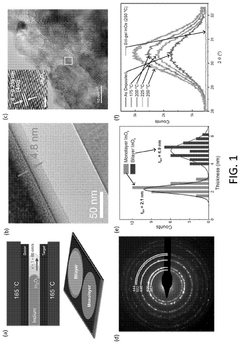
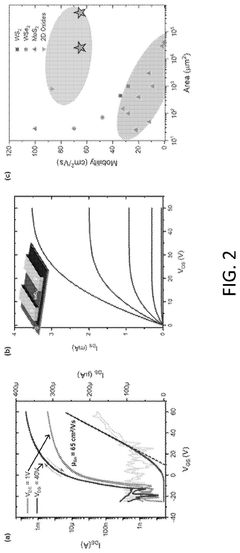
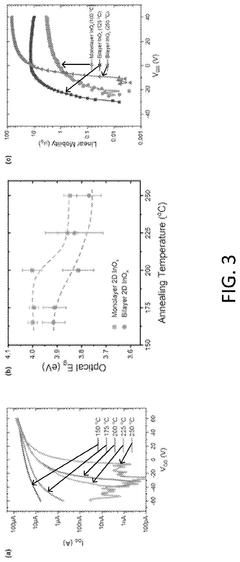
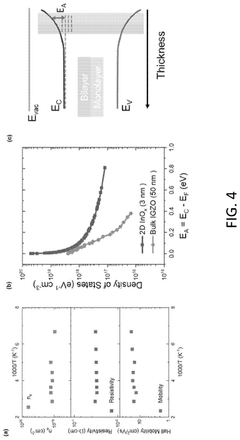
- A liquid metal printing method that operates at low temperatures (40° C to 450° C) to form alloyed oxide films, enabling the deposition of nanocrystalline ultrathin films with high conductivity and transparency, suitable for large-area flexible electronics, by using a dielectric and metal workpieces to form an alloyed oxide film with precise control over thickness and electronic properties.
Articles with resistance gradients for uniform switching
PatentInactiveUS20190353970A1
Innovation
- A transparent conductive coating system with a graded thickness of non-conducting and conducting layers, where the thickness of the non-conducting layer decreases in one direction and the conducting layer in the opposite direction, maintaining uniform optical transmission and varying sheet resistance to reduce or eliminate the iris effect.

Environmental Impact and Sustainability Factors
The integration of transparent oxides in smart window technology represents a significant advancement in sustainable building design. These materials enable dynamic control of solar radiation and heat transfer, directly impacting energy consumption in buildings, which account for approximately 40% of global energy usage. By optimizing visible light transmission while managing infrared radiation, smart windows incorporating transparent oxide layers can reduce heating, cooling, and lighting energy requirements by 20-30% compared to conventional glazing systems.
From a lifecycle perspective, transparent oxide-based smart windows demonstrate favorable environmental credentials. The primary materials used—including indium tin oxide (ITO), fluorine-doped tin oxide (FTO), and aluminum-doped zinc oxide (AZO)—require less energy-intensive manufacturing processes than traditional energy-saving technologies. Life cycle assessment (LCA) studies indicate that the embodied carbon in smart window production is typically offset within 3-5 years through operational energy savings, resulting in net positive environmental impact over the product lifespan of 20-30 years.
Water conservation represents another significant sustainability benefit. Buildings equipped with smart windows require smaller HVAC systems, which consume less water for cooling operations. In regions facing water scarcity, this indirect water saving can amount to thousands of gallons annually for a mid-sized commercial building.
However, certain sustainability challenges remain unresolved. The mining and processing of rare earth elements used in some transparent oxide formulations raise concerns regarding habitat disruption and toxic waste generation. Indium, a critical component in ITO, faces potential supply constraints due to limited global reserves and geopolitical factors affecting extraction regions.
End-of-life management presents both challenges and opportunities. While the composite nature of smart window assemblies complicates recycling, recent technological advances have improved recovery rates for valuable materials. Emerging circular economy initiatives are establishing take-back programs and developing specialized recycling processes that can recover up to 85% of transparent oxide materials for reuse in new products.
Regulatory frameworks increasingly recognize the sustainability benefits of smart window technologies. Green building certification systems such as LEED and BREEAM award significant points for their implementation, while energy efficiency standards in the EU, North America, and parts of Asia are beginning to incorporate specific provisions for dynamic glazing systems utilizing transparent oxide technologies.
From a lifecycle perspective, transparent oxide-based smart windows demonstrate favorable environmental credentials. The primary materials used—including indium tin oxide (ITO), fluorine-doped tin oxide (FTO), and aluminum-doped zinc oxide (AZO)—require less energy-intensive manufacturing processes than traditional energy-saving technologies. Life cycle assessment (LCA) studies indicate that the embodied carbon in smart window production is typically offset within 3-5 years through operational energy savings, resulting in net positive environmental impact over the product lifespan of 20-30 years.
Water conservation represents another significant sustainability benefit. Buildings equipped with smart windows require smaller HVAC systems, which consume less water for cooling operations. In regions facing water scarcity, this indirect water saving can amount to thousands of gallons annually for a mid-sized commercial building.
However, certain sustainability challenges remain unresolved. The mining and processing of rare earth elements used in some transparent oxide formulations raise concerns regarding habitat disruption and toxic waste generation. Indium, a critical component in ITO, faces potential supply constraints due to limited global reserves and geopolitical factors affecting extraction regions.
End-of-life management presents both challenges and opportunities. While the composite nature of smart window assemblies complicates recycling, recent technological advances have improved recovery rates for valuable materials. Emerging circular economy initiatives are establishing take-back programs and developing specialized recycling processes that can recover up to 85% of transparent oxide materials for reuse in new products.
Regulatory frameworks increasingly recognize the sustainability benefits of smart window technologies. Green building certification systems such as LEED and BREEAM award significant points for their implementation, while energy efficiency standards in the EU, North America, and parts of Asia are beginning to incorporate specific provisions for dynamic glazing systems utilizing transparent oxide technologies.
Standardization and Building Code Integration
The integration of transparent oxide-based smart window technologies into building codes and standards represents a critical step toward mainstream adoption in the construction industry. Currently, several international organizations are developing comprehensive standards specifically addressing smart glazing technologies. The International Organization for Standardization (ISO) has established technical committees focused on defining performance metrics for electrochromic, thermochromic, and other dynamic glazing systems utilizing transparent conductive oxides (TCOs). These standards aim to create uniform testing methodologies for measuring key parameters such as visible light transmission ranges, switching speeds, and durability under various environmental conditions.
In the United States, ASTM International has published several standards relevant to smart window technologies, including test methods for evaluating the durability of electrochromic coatings and procedures for measuring optical and thermal performance. The National Fenestration Rating Council (NFRC) has also expanded its certification program to include dynamic glazing products, providing a standardized way to communicate performance characteristics to architects, builders, and consumers.
Building code integration presents both challenges and opportunities for transparent oxide-based smart windows. The International Energy Conservation Code (IECC) and ASHRAE 90.1 have begun incorporating provisions for dynamic glazing systems, recognizing their potential for significant energy savings. However, these codes typically specify performance requirements rather than prescriptive requirements, allowing flexibility in how manufacturers achieve compliance while ensuring minimum performance standards are met.
European building regulations, particularly those aligned with the Energy Performance of Buildings Directive (EPBD), have taken a more progressive approach by offering incentives for buildings that incorporate advanced glazing technologies. Several EU member states now provide pathways for smart windows to contribute toward nearly zero-energy building (nZEB) requirements, creating market pull for transparent oxide technologies.
A significant standardization challenge involves developing testing protocols that accurately reflect real-world performance over the expected lifetime of smart window installations. Accelerated aging tests must reliably predict how transparent oxide layers will perform after thousands of switching cycles and years of UV exposure. Industry stakeholders and research institutions are collaborating to establish these protocols, with particular attention to degradation mechanisms in various TCO materials.
For manufacturers, navigating the complex landscape of regional building codes and standards presents a substantial barrier to market entry. Organizations like the Smart Windows Materials Consortium are working to harmonize requirements across jurisdictions and provide clear guidance on compliance pathways, potentially accelerating adoption of these technologies in commercial and residential construction.
In the United States, ASTM International has published several standards relevant to smart window technologies, including test methods for evaluating the durability of electrochromic coatings and procedures for measuring optical and thermal performance. The National Fenestration Rating Council (NFRC) has also expanded its certification program to include dynamic glazing products, providing a standardized way to communicate performance characteristics to architects, builders, and consumers.
Building code integration presents both challenges and opportunities for transparent oxide-based smart windows. The International Energy Conservation Code (IECC) and ASHRAE 90.1 have begun incorporating provisions for dynamic glazing systems, recognizing their potential for significant energy savings. However, these codes typically specify performance requirements rather than prescriptive requirements, allowing flexibility in how manufacturers achieve compliance while ensuring minimum performance standards are met.
European building regulations, particularly those aligned with the Energy Performance of Buildings Directive (EPBD), have taken a more progressive approach by offering incentives for buildings that incorporate advanced glazing technologies. Several EU member states now provide pathways for smart windows to contribute toward nearly zero-energy building (nZEB) requirements, creating market pull for transparent oxide technologies.
A significant standardization challenge involves developing testing protocols that accurately reflect real-world performance over the expected lifetime of smart window installations. Accelerated aging tests must reliably predict how transparent oxide layers will perform after thousands of switching cycles and years of UV exposure. Industry stakeholders and research institutions are collaborating to establish these protocols, with particular attention to degradation mechanisms in various TCO materials.
For manufacturers, navigating the complex landscape of regional building codes and standards presents a substantial barrier to market entry. Organizations like the Smart Windows Materials Consortium are working to harmonize requirements across jurisdictions and provide clear guidance on compliance pathways, potentially accelerating adoption of these technologies in commercial and residential construction.
Unlock deeper insights with PatSnap Eureka Quick Research — get a full tech report to explore trends and direct your research. Try now!
Generate Your Research Report Instantly with AI Agent
Supercharge your innovation with PatSnap Eureka AI Agent Platform!