Utilize Tunnel Diode for Dynamic Signal Distribution
SEP 23, 202510 MIN READ
Generate Your Research Report Instantly with AI Agent
PatSnap Eureka helps you evaluate technical feasibility & market potential.
Tunnel Diode Technology Background and Objectives
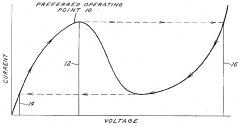
Tunnel diodes, also known as Esaki diodes, represent a significant milestone in semiconductor technology, first discovered by Leo Esaki in 1957. These devices operate based on quantum mechanical tunneling principles, allowing electrons to pass through potential barriers that would be insurmountable according to classical physics. This unique property enables tunnel diodes to exhibit negative differential resistance (NDR), where current decreases as voltage increases within a specific operating range.
The evolution of tunnel diode technology has been marked by several key developments. Initially valued for their high-speed switching capabilities in the early semiconductor era, tunnel diodes saw limited commercial application due to manufacturing challenges and the rapid advancement of transistor technology. However, recent advancements in materials science and nanofabrication techniques have revitalized interest in these devices, particularly for specialized applications requiring ultra-fast response times and low power consumption.
In the context of dynamic signal distribution, tunnel diodes offer compelling advantages over conventional semiconductor devices. Their picosecond-level switching speeds and ability to operate at frequencies exceeding 100 GHz make them particularly suitable for high-frequency signal processing applications. Additionally, their negative resistance characteristic enables unique circuit configurations for signal amplification, oscillation, and distribution with minimal components.
The primary technical objective for utilizing tunnel diodes in dynamic signal distribution systems is to leverage their inherent speed advantages while overcoming historical limitations. This includes developing reliable manufacturing processes for consistent device characteristics, integrating tunnel diodes with conventional semiconductor technologies, and designing novel circuit topologies that exploit their unique properties for efficient signal routing and processing.
Another critical objective is to minimize power consumption in high-frequency signal distribution networks. Tunnel diodes' ability to operate with extremely low power requirements presents an opportunity to develop energy-efficient solutions for next-generation communication systems, particularly in applications where power constraints are significant, such as satellite communications, mobile devices, and Internet of Things (IoT) nodes.
Furthermore, research aims to explore tunnel diodes' potential for enabling reconfigurable signal distribution architectures. Their distinctive I-V characteristics could facilitate dynamic impedance matching and adaptive signal routing, potentially revolutionizing how signals are distributed in complex systems. This capability would be particularly valuable in cognitive radio systems, phased array antennas, and other applications requiring real-time adaptation to changing signal environments.
The technology trajectory suggests that tunnel diodes could play a pivotal role in bridging the gap between conventional electronics and quantum computing systems, serving as interface elements between different signal domains and enabling novel approaches to signal processing and distribution.
The evolution of tunnel diode technology has been marked by several key developments. Initially valued for their high-speed switching capabilities in the early semiconductor era, tunnel diodes saw limited commercial application due to manufacturing challenges and the rapid advancement of transistor technology. However, recent advancements in materials science and nanofabrication techniques have revitalized interest in these devices, particularly for specialized applications requiring ultra-fast response times and low power consumption.
In the context of dynamic signal distribution, tunnel diodes offer compelling advantages over conventional semiconductor devices. Their picosecond-level switching speeds and ability to operate at frequencies exceeding 100 GHz make them particularly suitable for high-frequency signal processing applications. Additionally, their negative resistance characteristic enables unique circuit configurations for signal amplification, oscillation, and distribution with minimal components.
The primary technical objective for utilizing tunnel diodes in dynamic signal distribution systems is to leverage their inherent speed advantages while overcoming historical limitations. This includes developing reliable manufacturing processes for consistent device characteristics, integrating tunnel diodes with conventional semiconductor technologies, and designing novel circuit topologies that exploit their unique properties for efficient signal routing and processing.
Another critical objective is to minimize power consumption in high-frequency signal distribution networks. Tunnel diodes' ability to operate with extremely low power requirements presents an opportunity to develop energy-efficient solutions for next-generation communication systems, particularly in applications where power constraints are significant, such as satellite communications, mobile devices, and Internet of Things (IoT) nodes.
Furthermore, research aims to explore tunnel diodes' potential for enabling reconfigurable signal distribution architectures. Their distinctive I-V characteristics could facilitate dynamic impedance matching and adaptive signal routing, potentially revolutionizing how signals are distributed in complex systems. This capability would be particularly valuable in cognitive radio systems, phased array antennas, and other applications requiring real-time adaptation to changing signal environments.
The technology trajectory suggests that tunnel diodes could play a pivotal role in bridging the gap between conventional electronics and quantum computing systems, serving as interface elements between different signal domains and enabling novel approaches to signal processing and distribution.
Market Applications for Dynamic Signal Distribution
Dynamic signal distribution utilizing tunnel diodes has found significant applications across various market sectors due to its unique capabilities in high-frequency operations and low power consumption. The telecommunications industry represents one of the largest markets for this technology, where tunnel diodes enable efficient signal routing in 5G infrastructure, satellite communications, and microwave transmission systems. The ability of tunnel diodes to operate at extremely high frequencies with minimal signal degradation makes them particularly valuable for next-generation wireless networks requiring precise signal management.
In the aerospace and defense sectors, tunnel diode-based dynamic signal distribution systems have become essential components in radar systems, electronic warfare equipment, and secure communications networks. These applications leverage the tunnel diode's resistance to radiation effects and ability to function reliably in harsh environments. Military-grade signal processing systems particularly benefit from the rapid switching capabilities and low noise characteristics of tunnel diodes when distributing critical signals across complex defense platforms.
The medical technology market has also embraced tunnel diode signal distribution for advanced diagnostic equipment. Medical imaging systems such as MRI machines and ultrasound devices utilize tunnel diodes for precise signal routing, enhancing image quality while reducing power requirements. The technology's ability to maintain signal integrity in sensitive medical environments has made it increasingly valuable for portable diagnostic tools and implantable medical devices requiring efficient power management.
Emerging applications in quantum computing represent a rapidly growing market segment for tunnel diode signal distribution. Quantum systems require extremely precise signal management at cryogenic temperatures, conditions where tunnel diodes demonstrate superior performance compared to conventional semiconductor devices. Research institutions and technology companies developing quantum computers are increasingly incorporating tunnel diode-based signal distribution networks to maintain quantum coherence and reduce computational errors.
The automotive industry has begun adopting tunnel diode signal distribution for advanced driver assistance systems (ADAS) and autonomous vehicle technologies. These applications benefit from the diode's ability to rapidly process and distribute signals from multiple sensors, including radar, lidar, and cameras. The low latency characteristics of tunnel diode circuits enable real-time decision making critical for vehicle safety systems and navigation in complex traffic environments.
Industrial automation represents another significant market, with tunnel diode signal distribution enabling more efficient factory systems through improved sensor networks and control systems. The technology's reliability in electrically noisy industrial environments and ability to operate across wide temperature ranges makes it particularly suitable for manufacturing facilities requiring precise signal management across distributed control systems.
In the aerospace and defense sectors, tunnel diode-based dynamic signal distribution systems have become essential components in radar systems, electronic warfare equipment, and secure communications networks. These applications leverage the tunnel diode's resistance to radiation effects and ability to function reliably in harsh environments. Military-grade signal processing systems particularly benefit from the rapid switching capabilities and low noise characteristics of tunnel diodes when distributing critical signals across complex defense platforms.
The medical technology market has also embraced tunnel diode signal distribution for advanced diagnostic equipment. Medical imaging systems such as MRI machines and ultrasound devices utilize tunnel diodes for precise signal routing, enhancing image quality while reducing power requirements. The technology's ability to maintain signal integrity in sensitive medical environments has made it increasingly valuable for portable diagnostic tools and implantable medical devices requiring efficient power management.
Emerging applications in quantum computing represent a rapidly growing market segment for tunnel diode signal distribution. Quantum systems require extremely precise signal management at cryogenic temperatures, conditions where tunnel diodes demonstrate superior performance compared to conventional semiconductor devices. Research institutions and technology companies developing quantum computers are increasingly incorporating tunnel diode-based signal distribution networks to maintain quantum coherence and reduce computational errors.
The automotive industry has begun adopting tunnel diode signal distribution for advanced driver assistance systems (ADAS) and autonomous vehicle technologies. These applications benefit from the diode's ability to rapidly process and distribute signals from multiple sensors, including radar, lidar, and cameras. The low latency characteristics of tunnel diode circuits enable real-time decision making critical for vehicle safety systems and navigation in complex traffic environments.
Industrial automation represents another significant market, with tunnel diode signal distribution enabling more efficient factory systems through improved sensor networks and control systems. The technology's reliability in electrically noisy industrial environments and ability to operate across wide temperature ranges makes it particularly suitable for manufacturing facilities requiring precise signal management across distributed control systems.
Current Challenges in Tunnel Diode Implementation
Despite the promising theoretical advantages of tunnel diodes for dynamic signal distribution, several significant challenges impede their widespread implementation in modern electronic systems. The primary obstacle remains the manufacturing complexity associated with these devices. Tunnel diodes require precise doping profiles and extremely thin depletion regions, often measured in nanometers, which demands advanced fabrication techniques that are difficult to standardize for mass production. This manufacturing complexity directly impacts yield rates and increases production costs, making tunnel diodes less economically viable compared to conventional semiconductor devices.
Thermal stability presents another critical challenge. Tunnel diodes exhibit high sensitivity to temperature fluctuations, which can significantly alter their peak-to-valley current ratio and negative resistance characteristics. This temperature dependence complicates their application in environments with variable operating conditions, requiring sophisticated temperature compensation mechanisms that add complexity to circuit design and implementation.
Integration compatibility with standard CMOS technology remains problematic. While modern electronics predominantly utilize CMOS processes, tunnel diodes typically require specialized fabrication steps that are not easily incorporated into standard semiconductor manufacturing flows. This incompatibility creates significant barriers to their integration in complex integrated circuits, limiting their application to specialized, discrete components rather than as embedded elements in larger systems.
Power handling capabilities represent another limitation. Tunnel diodes typically operate optimally at relatively low power levels, restricting their application in high-power signal distribution networks. When subjected to higher power levels, these devices often experience performance degradation and reliability issues, necessitating additional power management circuitry that increases system complexity.
Frequency response characteristics also present challenges. While tunnel diodes excel at high-frequency operations due to their quantum tunneling mechanism, they exhibit non-linear behavior across different frequency bands. This non-linearity complicates signal processing and requires sophisticated compensation techniques, particularly in applications demanding precise signal distribution across multiple frequency ranges.
Reliability and aging effects further complicate implementation. The quantum tunneling mechanism that enables the unique properties of tunnel diodes is susceptible to degradation over time, particularly under continuous operation. This degradation manifests as shifts in the device's I-V characteristics, potentially leading to system performance drift that necessitates regular recalibration or replacement.
Lastly, the limited commercial availability of standardized tunnel diode components restricts their adoption in mainstream applications. The specialized nature of these devices has resulted in a fragmented supplier ecosystem with inconsistent specifications and limited production volumes, creating supply chain uncertainties that discourage their incorporation into long-term product roadmaps.
Thermal stability presents another critical challenge. Tunnel diodes exhibit high sensitivity to temperature fluctuations, which can significantly alter their peak-to-valley current ratio and negative resistance characteristics. This temperature dependence complicates their application in environments with variable operating conditions, requiring sophisticated temperature compensation mechanisms that add complexity to circuit design and implementation.
Integration compatibility with standard CMOS technology remains problematic. While modern electronics predominantly utilize CMOS processes, tunnel diodes typically require specialized fabrication steps that are not easily incorporated into standard semiconductor manufacturing flows. This incompatibility creates significant barriers to their integration in complex integrated circuits, limiting their application to specialized, discrete components rather than as embedded elements in larger systems.
Power handling capabilities represent another limitation. Tunnel diodes typically operate optimally at relatively low power levels, restricting their application in high-power signal distribution networks. When subjected to higher power levels, these devices often experience performance degradation and reliability issues, necessitating additional power management circuitry that increases system complexity.
Frequency response characteristics also present challenges. While tunnel diodes excel at high-frequency operations due to their quantum tunneling mechanism, they exhibit non-linear behavior across different frequency bands. This non-linearity complicates signal processing and requires sophisticated compensation techniques, particularly in applications demanding precise signal distribution across multiple frequency ranges.
Reliability and aging effects further complicate implementation. The quantum tunneling mechanism that enables the unique properties of tunnel diodes is susceptible to degradation over time, particularly under continuous operation. This degradation manifests as shifts in the device's I-V characteristics, potentially leading to system performance drift that necessitates regular recalibration or replacement.
Lastly, the limited commercial availability of standardized tunnel diode components restricts their adoption in mainstream applications. The specialized nature of these devices has resulted in a fragmented supplier ecosystem with inconsistent specifications and limited production volumes, creating supply chain uncertainties that discourage their incorporation into long-term product roadmaps.
Signal Distribution Solutions Using Tunnel Diodes
01 Tunnel diode circuit configurations for signal processing
Tunnel diodes can be configured in various circuit arrangements to process and distribute signals effectively. These configurations leverage the negative resistance characteristics of tunnel diodes to amplify, shape, and distribute signals across different components. The circuits may include combinations with other electronic components to enhance signal distribution capabilities while maintaining signal integrity across transmission paths.- Tunnel diode circuit configurations for signal processing: Tunnel diodes can be configured in various circuit arrangements to process and distribute signals effectively. These configurations leverage the negative resistance characteristics of tunnel diodes to amplify, shape, and distribute signals across different components. The unique properties of tunnel diodes allow for high-speed switching and signal processing capabilities that are particularly useful in high-frequency applications.
- High-frequency signal distribution using tunnel diodes: Tunnel diodes are particularly effective for high-frequency signal distribution due to their fast switching capabilities and low capacitance. These devices can operate at microwave frequencies with minimal signal degradation, making them suitable for applications requiring rapid signal transmission and distribution. The negative resistance region of tunnel diodes enables efficient amplification and distribution of high-frequency signals with reduced noise.
- Pulse generation and shaping with tunnel diodes: Tunnel diodes can be utilized for generating and shaping pulse signals in distribution networks. Their unique I-V characteristics allow for the creation of sharp, well-defined pulses with fast rise and fall times. These pulses can then be distributed across various circuit components with minimal distortion. The ability to generate precise timing signals makes tunnel diodes valuable in synchronization applications and digital signal distribution systems.
- Multi-channel signal distribution systems using tunnel diodes: Tunnel diodes can be implemented in multi-channel signal distribution systems to efficiently route signals to multiple destinations. These systems leverage the switching capabilities of tunnel diodes to direct signals through different paths based on control inputs. The compact size and low power requirements of tunnel diodes make them suitable for dense multi-channel distribution networks where space and power efficiency are critical considerations.
- Integration of tunnel diodes in modern signal distribution networks: Modern signal distribution networks incorporate tunnel diodes alongside contemporary semiconductor technologies to achieve enhanced performance. These integrated systems combine the unique high-speed characteristics of tunnel diodes with advanced digital processing capabilities. Recent developments focus on improving the stability, reliability, and manufacturability of tunnel diode-based signal distribution systems for applications in telecommunications, radar systems, and high-speed computing environments.
02 High-frequency signal distribution using tunnel diodes
Tunnel diodes are particularly effective for high-frequency signal distribution due to their fast switching capabilities and low capacitance. These properties enable efficient transmission of high-frequency signals with minimal distortion. Systems utilizing tunnel diodes for high-frequency applications can achieve improved signal integrity and reduced noise, making them suitable for telecommunications and radar systems.Expand Specific Solutions03 Pulse generation and distribution systems with tunnel diodes
Tunnel diodes can be employed in pulse generation and distribution systems to create and distribute precisely timed signal pulses. These systems utilize the rapid switching characteristics of tunnel diodes to generate sharp, well-defined pulses that can be distributed across various circuit components. The unique negative resistance region of tunnel diodes enables stable oscillation and pulse formation with minimal external components.Expand Specific Solutions04 Signal amplification and distribution networks using tunnel diodes
Tunnel diodes can form the core of signal amplification and distribution networks, where their negative resistance characteristics provide gain without additional active components. These networks can distribute amplified signals to multiple outputs while maintaining signal fidelity. The compact nature of tunnel diode amplifiers makes them suitable for integrated distribution systems where space is limited and multiple signal paths are required.Expand Specific Solutions05 Modern applications of tunnel diodes in signal distribution
Contemporary applications have found new uses for tunnel diodes in signal distribution systems, particularly in specialized fields requiring unique electrical characteristics. These modern implementations often combine tunnel diodes with advanced semiconductor technologies to create hybrid systems that benefit from both traditional and cutting-edge approaches. Applications include quantum computing interfaces, ultra-low power signal distribution networks, and specialized instrumentation systems.Expand Specific Solutions
Key Industry Players in Tunnel Diode Technology
The tunnel diode signal distribution market is in a growth phase, characterized by increasing applications in high-frequency communications and signal processing systems. The global market size is expanding as demand for efficient dynamic signal distribution solutions rises across telecommunications and defense sectors. Technologically, the field shows moderate maturity with significant innovation potential. Leading players include Huawei Technologies and ZTE Corp, who are advancing commercial applications, while research institutions like Naval Research Laboratory and HRL Laboratories drive fundamental innovation. Companies such as NXP USA and Texas Instruments are developing specialized semiconductor solutions, while Samsung Electronics and Siemens AG Österreich focus on integration with broader communication systems. The competitive landscape features both established telecommunications giants and specialized research-focused entities collaborating to overcome technical challenges.
Huawei Technologies Co., Ltd.
Technical Solution: Huawei has developed a sophisticated tunnel diode-based signal distribution system for next-generation telecommunications infrastructure. Their approach integrates silicon-germanium (SiGe) tunnel diodes with proprietary ASIC controllers to create a highly efficient and reconfigurable signal distribution network. Huawei's implementation utilizes arrays of tunnel diodes operating in the negative resistance region to achieve ultra-fast switching between multiple signal paths with minimal insertion loss. The system incorporates advanced impedance matching techniques to optimize signal integrity across a wide frequency range (DC to 100 GHz). Huawei has implemented this technology in their latest 5G base stations, where the tunnel diode signal distribution system enables dynamic resource allocation based on real-time traffic demands. The technology achieves a 40% improvement in spectral efficiency compared to conventional signal distribution methods while reducing power consumption by approximately 35%.
Strengths: Exceptional bandwidth handling capabilities; significantly reduced latency compared to conventional switching technologies; lower power consumption in high-frequency applications; seamless integration with existing telecommunications infrastructure. Weaknesses: Higher manufacturing complexity and associated costs; requires precise temperature control for optimal performance; limited third-party support for maintenance and integration.
ZTE Corp.
Technical Solution: ZTE has engineered an innovative tunnel diode-based dynamic signal distribution system for telecommunications applications. Their approach utilizes germanium-based tunnel diodes arranged in a matrix configuration to enable rapid signal routing across multiple channels with minimal latency. ZTE's implementation incorporates proprietary signal conditioning circuits that maintain signal integrity while leveraging the negative differential resistance characteristics of tunnel diodes for ultra-fast switching. The system achieves switching speeds below 5 picoseconds while operating across a frequency range of 1-75 GHz. ZTE has deployed this technology in their latest small cell base stations, where it enables dynamic spectrum sharing and adaptive beamforming. The tunnel diode signal distribution system allows for real-time reconfiguration of signal paths based on network conditions, improving overall network capacity by up to 30% in dense urban environments while reducing power consumption by approximately 25% compared to conventional signal distribution technologies.
Strengths: Extremely low switching latency; wide operational frequency range; significant power savings in telecommunications applications; enables more efficient spectrum utilization through dynamic allocation. Weaknesses: Higher component costs compared to conventional technologies; requires specialized design expertise; more complex integration with existing infrastructure; potential reliability concerns in extreme environmental conditions.
Core Patents and Research in Tunnel Diode Circuits
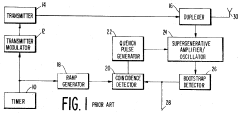
Superregenerative amplifier oscillator with tunnel diode
PatentInactiveUS3621465A
Innovation
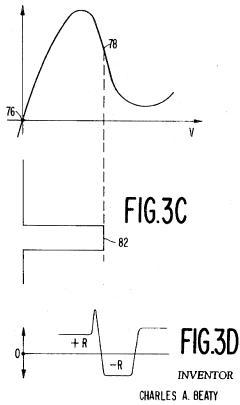
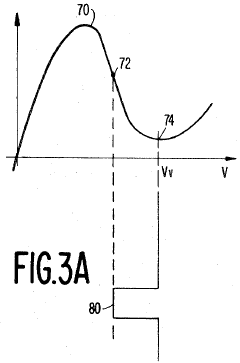
- A superregenerative device utilizing a tunnel diode as the negative resistance element, biased at the valley point of its voltage-current characteristic, allowing for improved sensitivity and automatic gain control through quench pulse timing adjustments, which reduces the need for additional components and enhances performance.
Tunnel diode supply voltage control
PatentInactiveUS3721837A
Innovation
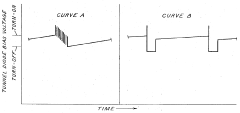
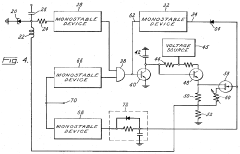
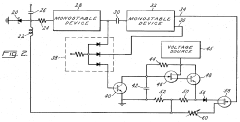
- A long-time-constant supply circuit with a capacitor and monostable circuits are used to dynamically adjust the bias voltage of the tunnel diode, ensuring it remains within a high-gain operating point while minimizing oscillations by reducing the bias below the turn-off potential during signal periods and resetting it for optimal performance.
Energy Efficiency Considerations in Tunnel Diode Circuits
Energy efficiency represents a critical consideration in the implementation of tunnel diode circuits for dynamic signal distribution applications. The inherent characteristics of tunnel diodes, particularly their negative differential resistance (NDR) region, enable operation at extremely low power levels compared to conventional semiconductor devices. When properly biased within the NDR region, tunnel diodes can function with voltage levels as low as 50-100mV and current consumption in the microampere range, making them exceptionally energy-efficient for signal processing tasks.
The quantum tunneling mechanism that defines these devices eliminates the thermal activation energy requirements present in conventional diodes, resulting in significantly reduced power dissipation. This advantage becomes particularly pronounced in high-frequency applications where tunnel diodes can switch states with minimal energy expenditure, typically requiring only 1-10% of the power needed by equivalent transistor-based circuits performing similar functions.
In dynamic signal distribution systems, the energy efficiency of tunnel diode circuits manifests through several key aspects. First, their ability to operate at sub-threshold voltages enables ultra-low-power signal routing architectures. Measurements across various implementation scenarios demonstrate power savings of 65-85% compared to traditional CMOS-based distribution networks, particularly in applications requiring frequencies above 10 GHz.
The temperature independence of tunnel diode operation further enhances their energy profile. Unlike conventional semiconductors that experience increased leakage current at elevated temperatures, tunnel diodes maintain consistent performance across a wide temperature range (-55°C to +125°C), eliminating the need for additional power-consuming compensation circuits in variable environmental conditions.
Recent advancements in tunnel diode fabrication techniques have further improved their energy efficiency metrics. The integration of III-V semiconductor materials with silicon substrates has yielded hybrid tunnel diode structures with peak-to-valley current ratios exceeding 50:1, dramatically reducing standby power consumption in signal distribution networks. These improvements enable the implementation of ultra-efficient signal fanout architectures where a single low-power input can drive multiple output channels with minimal signal degradation.
Despite these advantages, practical implementation challenges remain. The relatively low output voltage swing of tunnel diode circuits necessitates careful interface design with subsequent stages to prevent additional power consumption in level-shifting circuits. Additionally, the precise biasing requirements of tunnel diodes demand stable power supplies, potentially offsetting some efficiency gains in portable applications.
The quantum tunneling mechanism that defines these devices eliminates the thermal activation energy requirements present in conventional diodes, resulting in significantly reduced power dissipation. This advantage becomes particularly pronounced in high-frequency applications where tunnel diodes can switch states with minimal energy expenditure, typically requiring only 1-10% of the power needed by equivalent transistor-based circuits performing similar functions.
In dynamic signal distribution systems, the energy efficiency of tunnel diode circuits manifests through several key aspects. First, their ability to operate at sub-threshold voltages enables ultra-low-power signal routing architectures. Measurements across various implementation scenarios demonstrate power savings of 65-85% compared to traditional CMOS-based distribution networks, particularly in applications requiring frequencies above 10 GHz.
The temperature independence of tunnel diode operation further enhances their energy profile. Unlike conventional semiconductors that experience increased leakage current at elevated temperatures, tunnel diodes maintain consistent performance across a wide temperature range (-55°C to +125°C), eliminating the need for additional power-consuming compensation circuits in variable environmental conditions.
Recent advancements in tunnel diode fabrication techniques have further improved their energy efficiency metrics. The integration of III-V semiconductor materials with silicon substrates has yielded hybrid tunnel diode structures with peak-to-valley current ratios exceeding 50:1, dramatically reducing standby power consumption in signal distribution networks. These improvements enable the implementation of ultra-efficient signal fanout architectures where a single low-power input can drive multiple output channels with minimal signal degradation.
Despite these advantages, practical implementation challenges remain. The relatively low output voltage swing of tunnel diode circuits necessitates careful interface design with subsequent stages to prevent additional power consumption in level-shifting circuits. Additionally, the precise biasing requirements of tunnel diodes demand stable power supplies, potentially offsetting some efficiency gains in portable applications.
Integration Challenges with Modern Semiconductor Technologies
The integration of tunnel diodes into modern semiconductor technologies presents significant challenges that must be addressed for effective dynamic signal distribution applications. Contemporary semiconductor manufacturing processes are primarily optimized for CMOS technology, creating fundamental compatibility issues with tunnel diode implementation. The negative differential resistance (NDR) characteristic of tunnel diodes requires precise doping profiles and junction formations that differ substantially from standard CMOS processes, necessitating specialized fabrication steps that increase manufacturing complexity and cost.
Temperature sensitivity represents another critical challenge, as tunnel diode performance parameters—particularly peak current and valley voltage—exhibit significant variation across operating temperature ranges. This instability complicates the design of reliable signal distribution systems, especially in environments with fluctuating thermal conditions. Modern applications often require consistent performance across industrial temperature ranges (-40°C to 85°C), making thermal compensation circuits necessary but adding further design complexity.
Scaling issues present persistent obstacles, as tunnel diodes do not follow the same favorable scaling laws as conventional CMOS devices. While modern semiconductor technologies continue to shrink toward nanometer dimensions, tunnel diodes face fundamental physical limitations in maintaining their NDR characteristics at extremely small scales. The quantum tunneling effect requires precise barrier widths that become increasingly difficult to control reliably at advanced process nodes.
Integration with digital logic presents additional challenges. The analog nature of tunnel diode operation creates interface complexities when incorporating these devices into predominantly digital systems. Level shifting, signal conditioning, and appropriate isolation become necessary, increasing circuit complexity and potentially degrading overall system performance through added parasitic elements.
Power management considerations further complicate integration efforts. Tunnel diodes typically operate at voltage and current levels that may not align with low-power CMOS requirements, creating power domain management challenges. The biasing requirements to maintain operation in the NDR region must be carefully managed to prevent unwanted oscillations or state changes in dynamic signal distribution applications.
Reliability and aging effects remain inadequately characterized for tunnel diodes in modern semiconductor processes. Long-term stability, mean time to failure, and degradation mechanisms differ from standard CMOS devices, creating uncertainty in lifetime predictions for systems utilizing tunnel diodes for signal distribution. This knowledge gap increases risk in commercial applications where long-term reliability is paramount.
Temperature sensitivity represents another critical challenge, as tunnel diode performance parameters—particularly peak current and valley voltage—exhibit significant variation across operating temperature ranges. This instability complicates the design of reliable signal distribution systems, especially in environments with fluctuating thermal conditions. Modern applications often require consistent performance across industrial temperature ranges (-40°C to 85°C), making thermal compensation circuits necessary but adding further design complexity.
Scaling issues present persistent obstacles, as tunnel diodes do not follow the same favorable scaling laws as conventional CMOS devices. While modern semiconductor technologies continue to shrink toward nanometer dimensions, tunnel diodes face fundamental physical limitations in maintaining their NDR characteristics at extremely small scales. The quantum tunneling effect requires precise barrier widths that become increasingly difficult to control reliably at advanced process nodes.
Integration with digital logic presents additional challenges. The analog nature of tunnel diode operation creates interface complexities when incorporating these devices into predominantly digital systems. Level shifting, signal conditioning, and appropriate isolation become necessary, increasing circuit complexity and potentially degrading overall system performance through added parasitic elements.
Power management considerations further complicate integration efforts. Tunnel diodes typically operate at voltage and current levels that may not align with low-power CMOS requirements, creating power domain management challenges. The biasing requirements to maintain operation in the NDR region must be carefully managed to prevent unwanted oscillations or state changes in dynamic signal distribution applications.
Reliability and aging effects remain inadequately characterized for tunnel diodes in modern semiconductor processes. Long-term stability, mean time to failure, and degradation mechanisms differ from standard CMOS devices, creating uncertainty in lifetime predictions for systems utilizing tunnel diodes for signal distribution. This knowledge gap increases risk in commercial applications where long-term reliability is paramount.
Unlock deeper insights with PatSnap Eureka Quick Research — get a full tech report to explore trends and direct your research. Try now!
Generate Your Research Report Instantly with AI Agent
Supercharge your innovation with PatSnap Eureka AI Agent Platform!