Formal description method for adaptive software architecture during operation

A technology of software architecture and formal description, applied in the direction of program control devices, etc., can solve problems such as poor comprehensibility, poor adaptability, and poor execution

CN102270130AInactive Publication Date: 2011-12-07ZHEJIANG IND POLYTECHNIC COLLEGE
3 Cites 14 Cited by

Patent Information

Authority / Receiving Office
CN · China
Patent Type
Applications(China)
Current Assignee / Owner
Publication Date
2011-12-07
Estimated Expiration
Not applicable · inactive patent

Smart Images

  • Figure 1
    Figure 1
  • Figure 2
    Figure 2
  • Figure 3
    Figure 3
Patent Text Reader

Abstract

The invention discloses a formal description method for adaptive software architecture during operation. The formal description method comprises the following steps of: (1) describing the adaptive software architecture framework and setting a formally described architecture framework, wherein the framework comprises components, a connecting element and architecture configuration; (2) building an adaptive component model based on Agent internetware, and forming the internal part of the adaptive component by using a computing module which finishes calculation action and an adaptive model which finishes dynamic action in a manner of using the adaptive component as a component in the internetware; (3) formally describing various mental attitudes of the adaptive component in sequence, and providing formal definition of an atomic component and the connecting element; and (4) finishing appointed definition of the calculation action and dynamic action of the adaptive component, providing the corresponding relation of pi calculation thereof, and then dynamically reasoning the architecture action according to the performability and embedded background debug interface (EBDI) of the Pi calculation. The formal description method for adaptive software architecture during operation has performability, reasonability and legibility.
Need to check novelty before this filing date? Find Prior Art

Description

technical field

[0001] The invention relates to software modeling technology, in particular to a formalized description method of software architecture during runtime. Background technique

[0002] Formal methods are also widely used in the research of component-based software system design. One is to directly use general formal methods to describe the architecture, and the other is to propose a special architecture description language to describe the architecture.

[0003] 1. A general formal method to describe the architecture

[0004] In recent years, a lot of research work has appeared in the description of software architecture specification using general formal methods. Current work in this area broadly falls into four categories:

[0005] (1) Model-based approach

[0006] The formalization method based on the model is to support the specification of the system by constructing a mathematical model, which gives the state of the system and the explicit operation of t...

Examples

Embodiment Construction

[0103] The present invention will be further described below in conjunction with accompanying drawings.

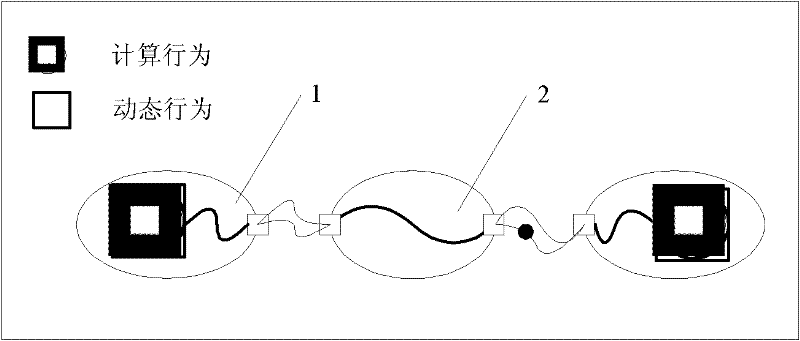
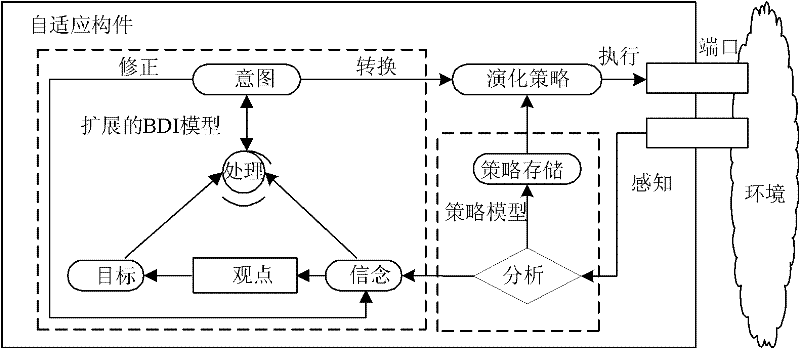
[0104] refer to figure 1 with figure 2 , a formal method for describing runtime adaptive software architecture, according to the formally described architecture, its content includes component 1, connector 2 and architecture configuration, the present invention models around the above entities, such as figure 1 shown. FDA4RSA uses high-order polytype π-calculus as the basis for describing behavioral semantics, and provides support for describing the concurrency and interaction characteristics of SA from the perspective of runtime.

[0105] Component is one of the basic elements of SA. From the structural view, it is composed of external ports and internal behaviors. External ports are the links between components and the external environment or other connectors. A A port is composed of one or more channels, which include sending data channels, receiving data channels, ...