
Confidence dominance-based rough set analysis model and attribute reduction methods
A technology of attribute reduction and rough set, applied in special data processing applications, instruments, electrical digital data processing, etc., can solve problems such as semantic contradictions, under-consideration of "sequence" system characteristics, incomplete sequence information, etc.
- Summary
- Abstract
- Description
- Claims
- Application Information
AI Technical Summary
Problems solved by technology
Method used
Image



Examples
Embodiment 1
[0071] This example first introduces the existing extended advantage relationship:
[0072] Definition 12: Extended dominance relation,
[0073] use express. A restricted dominance relation is a special form of Definition 12 that allows expansion only at attribute maximum and minimum values.
[0074] Definition 13: A finitely extended dominance relation,
[0075]
[0076] use express.
[0077] Definition 14: Generalized Extended Dominance Relations
[0078]
[0079] use express. The dominance relation of k-degree extended characteristics is a special form of definition 14, which subdivides missing values into two cases for expansion.
[0080] Definition 15: Similar Dominance Relationship
[0081] SDR + ( P ) = { ( x ...
Embodiment 2
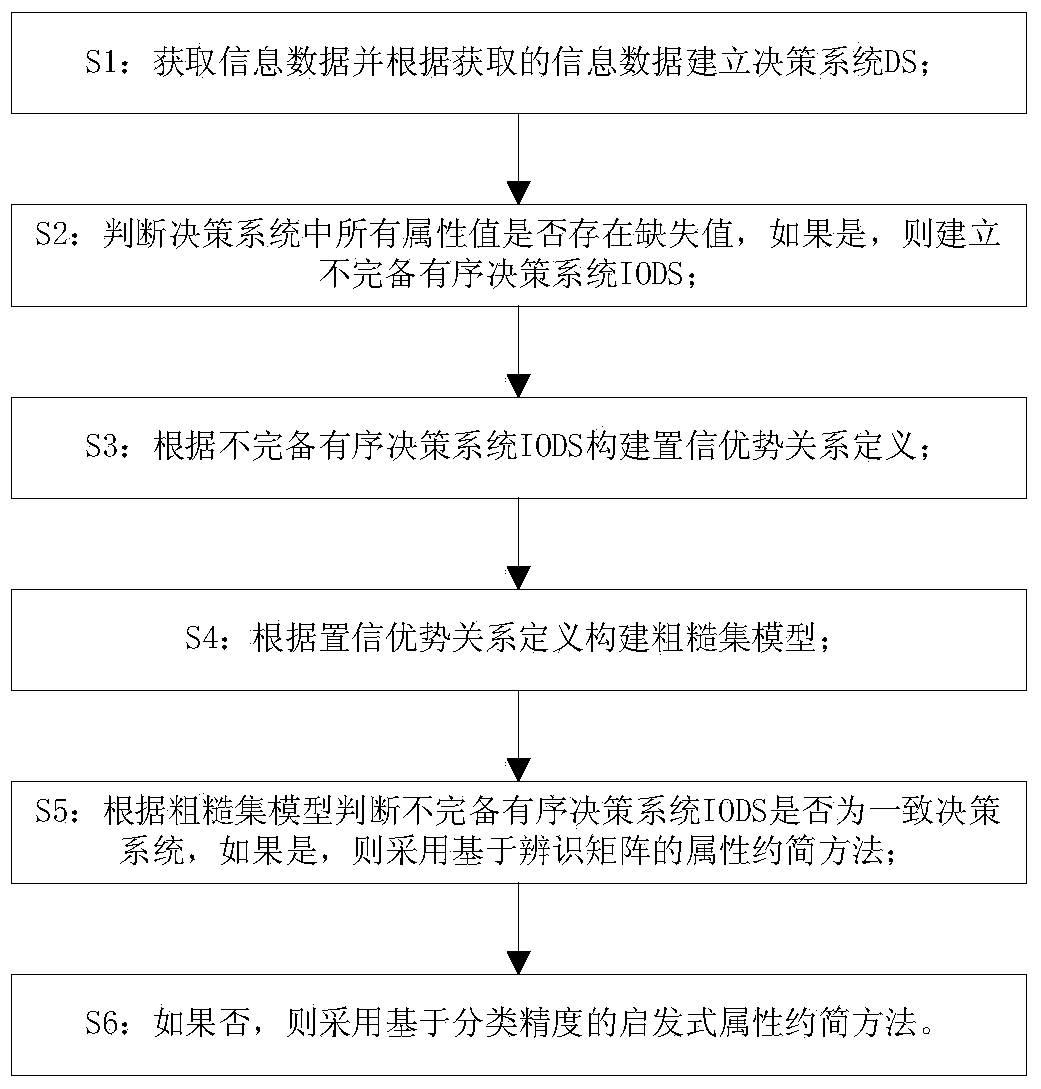
[0095] figure 1 The flow chart of the belief-dominant relational rough set model and the attribute reduction method provided by the embodiment of the present invention is shown in the figure: the belief-dominant relational rough set model and the attribute reduction method provided by the present invention include the following steps:
[0096] S1: Obtain information data and establish a decision-making system DS based on the obtained information data;
[0097] S2: Determine whether there are missing values for all attribute values in the decision-making system, and if so, establish an incomplete orderly decision-making system IODS;
[0098] S3: Construct the definition of confidence advantage relationship according to the incomplete order decision system IODS;
[0099] S4: Construct a rough set model according to the definition of confidence dominance relationship;
[0100]S5: According to the rough set model, judge whether the incomplete ordered decision system IODS is ...
Embodiment 3
[0153] The difference between this embodiment and embodiment 2 only lies in:
[0154] The belief advantage relational rough set model and attribute reduction method provided by the embodiments of the present invention include the following steps:
[0155] S1: Definition of the confidence advantage relationship;
[0156] S2: Rough set model based on confidence dominance relationship;
[0157] S3: An attribute reduction method based on the identification matrix in the incomplete consistent information table.
[0158] S4: A heuristic attribute reduction method based on classification accuracy in incomplete and inconsistent information tables.
[0159] The definition of Confidential Dominate Relation (CDR) satisfies the characteristics of order relations, and satisfies reflexivity, transitivity and order symmetry; Confidential Dominate Relation defines that the dominant class object of an object A should be better than the known properties of A , and the amount of known informa...
PUM
 Login to View More
 Abstract
Description
Claims
Application Information
 Login to View More