
Insertion/deletion (InDel) molecular marker AAD closely-linked to tomato anthocyanin absent character and application thereof
A tomato anthocyanin, indel technology, applied in DNA/RNA fragment, recombinant DNA technology, microbial determination/inspection, etc., can solve the problems of indistinguishable, long cycle, low efficiency, etc., to shorten the breeding cycle, improve the Effects of Breeding Efficiency
- Summary
- Abstract
- Description
- Claims
- Application Information
AI Technical Summary
Problems solved by technology
Method used
Image

Examples
Embodiment 1
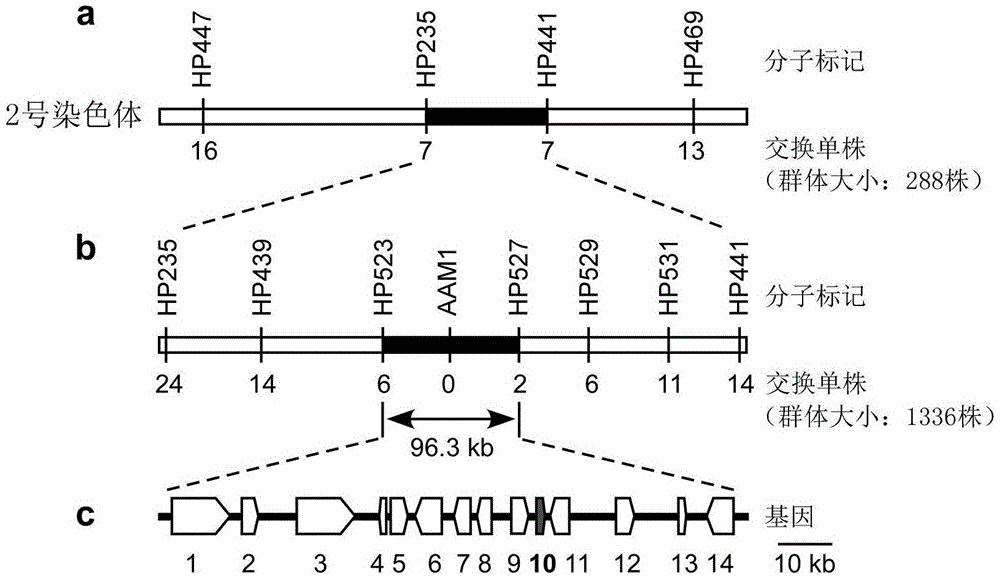
[0021] Example 1 Determination of tomato anthocyanin deficiency gene locus InDelAAD
[0022] The tomato material containing anthocyanin-deficient mutation site aa is used as the female parent, and the gooseberry tomato material with purple plant surface is used as the male parent, and the two are crossed to obtain F 1 . F1 single plant is self-crossed, and its seeds are propagated into F 2 There are nearly 6,000 plants isolated from generation to generation, and conventional water and fertilizer management. Observe the color (purple or green) of the hypocotyls of the seedlings, and pick out the plants containing anthocyanins and lacking homozygous mutation sites whose hypocotyls are green. For the seedlings with green hypocotyls in the female parent, male parent, F1, and F2 populations, the genomic DNA was extracted by conventional CTAB method in individual plants.
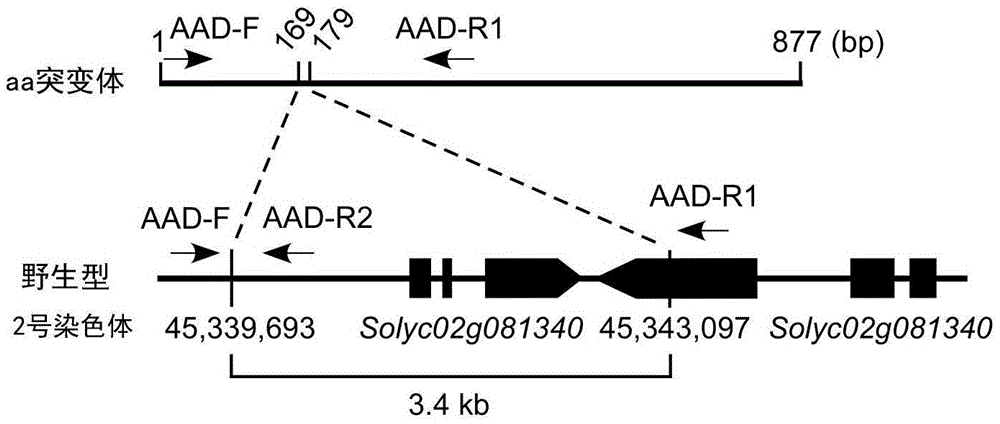
[0023] Comparing the sequence of tomato variety Heinz1706 sequenced by Tomato International Genome Project a...
Embodiment 2I
[0027] Example 2 Development and Verification of InDel Molecular Marker AAD
[0028] Primer Design of InDel Molecular Marker AAD
[0029] According to AAD and its flanking sequences, 3 primers were designed. The forward primer (AAD-F) was 5-GGGACAAAATACAACGACGAC-3, the reverse primer 1 (AAD-R1) was 5-GCTGATGTTGATGTGAAGGAA-3, and the reverse primer 2 (AAD-R2) was 5-TAAAAGGGCTAGTGACTTGGTGT-3.
[0030] Polymorphism Detection of InDel Molecular Marker AAD
[0031] PCR amplification.
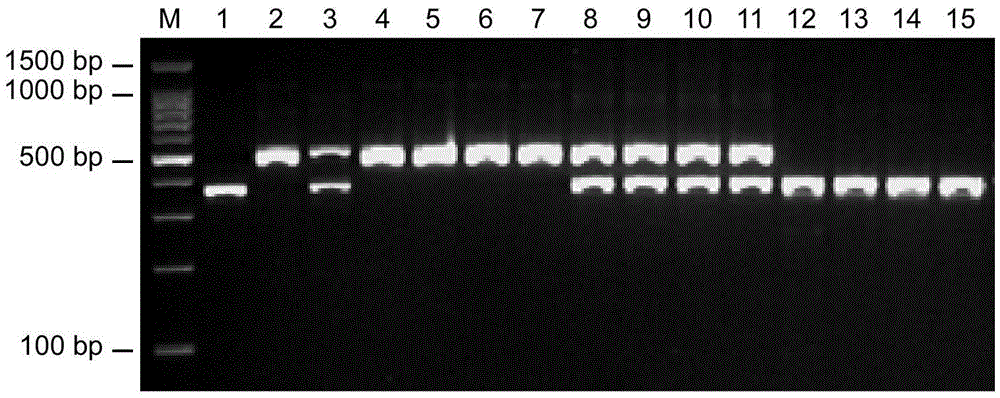
[0032] Based on female parent, male parent and its F 1 The genomic DNA of AAD was used as a template, and three specific primers for detecting InDel-labeled AAD were used for PCR amplification. A 363bp band can be detected in the female parent plant containing tomato anthocyanin deficiency (aa) homozygous mutation site; a 487bp band can be detected in the male parent plant whose aa site is normal homozygous (wild type) ; The aa site is F in a heterozygous state 1 Plants can detect the above two...
PUM
 Login to View More
 Abstract
Description
Claims
Application Information
 Login to View More