
Obstructive sleep apnea (OSA) biomarker panel
Patent Information
- Authority / Receiving Office
- US · United States
- Current Assignee / Owner
- Publication Date
- 2018-06-07
- Estimated Expiration
- Not applicable · inactive patent
Smart Images
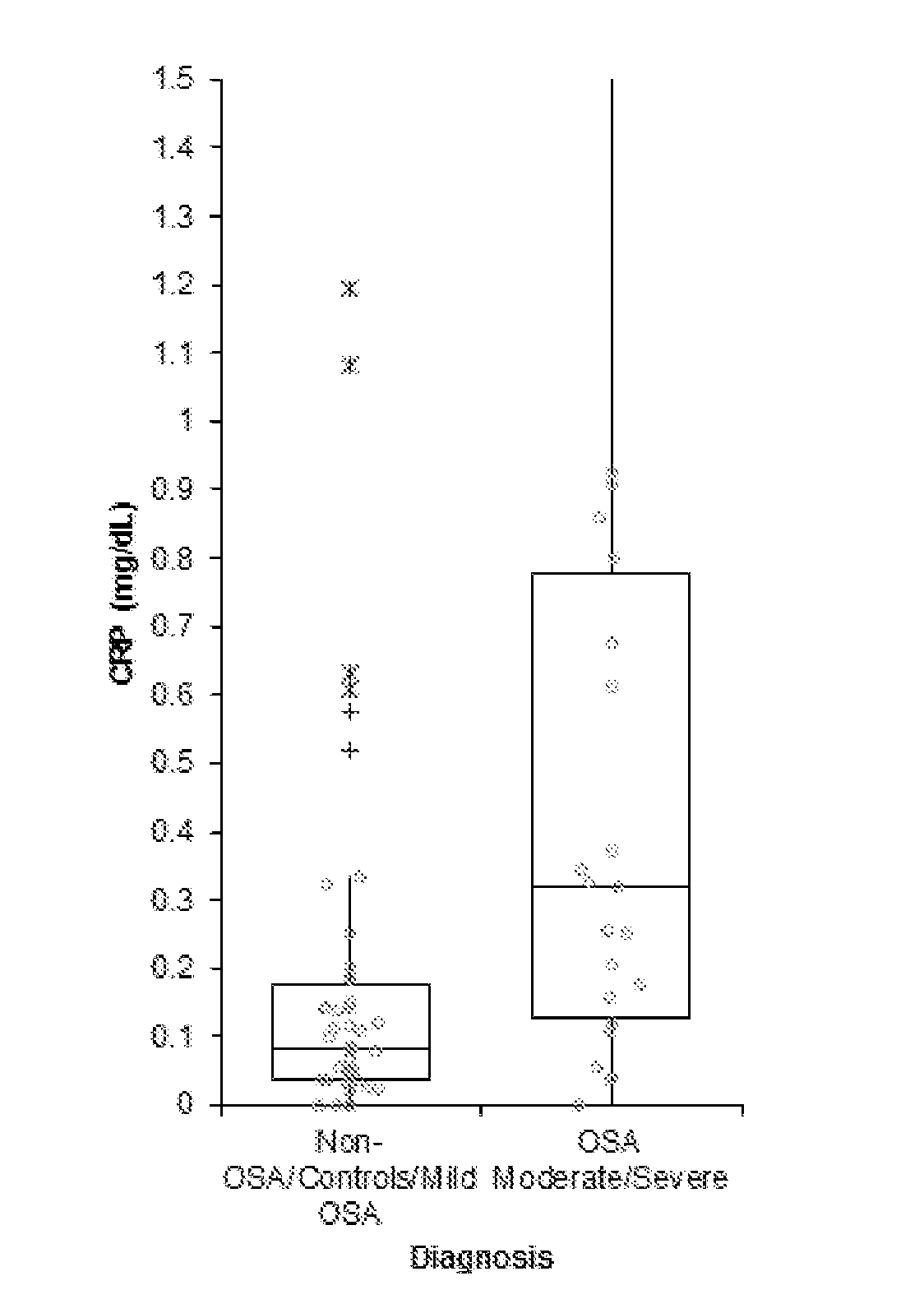
Figure 1 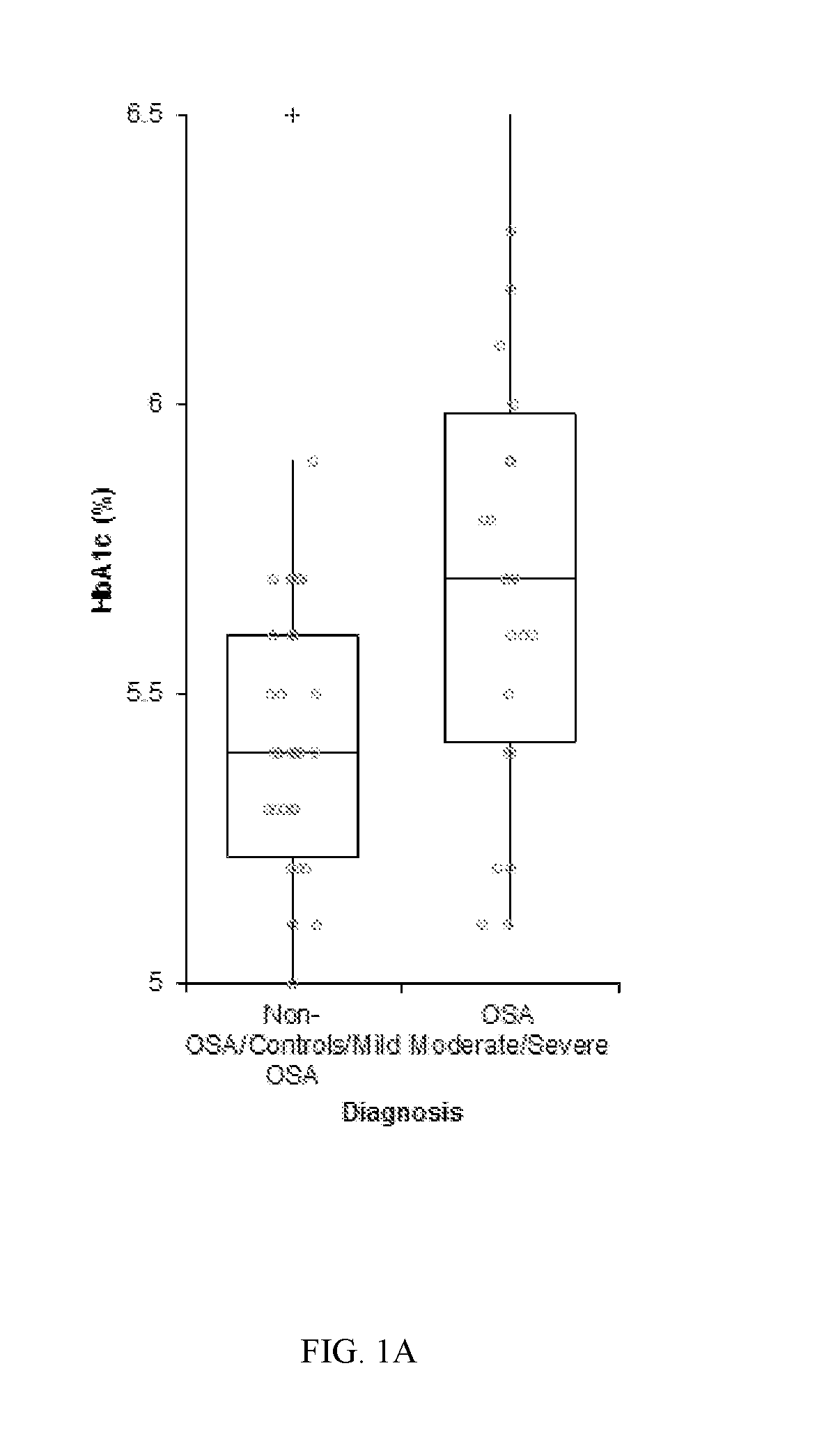
Figure 2 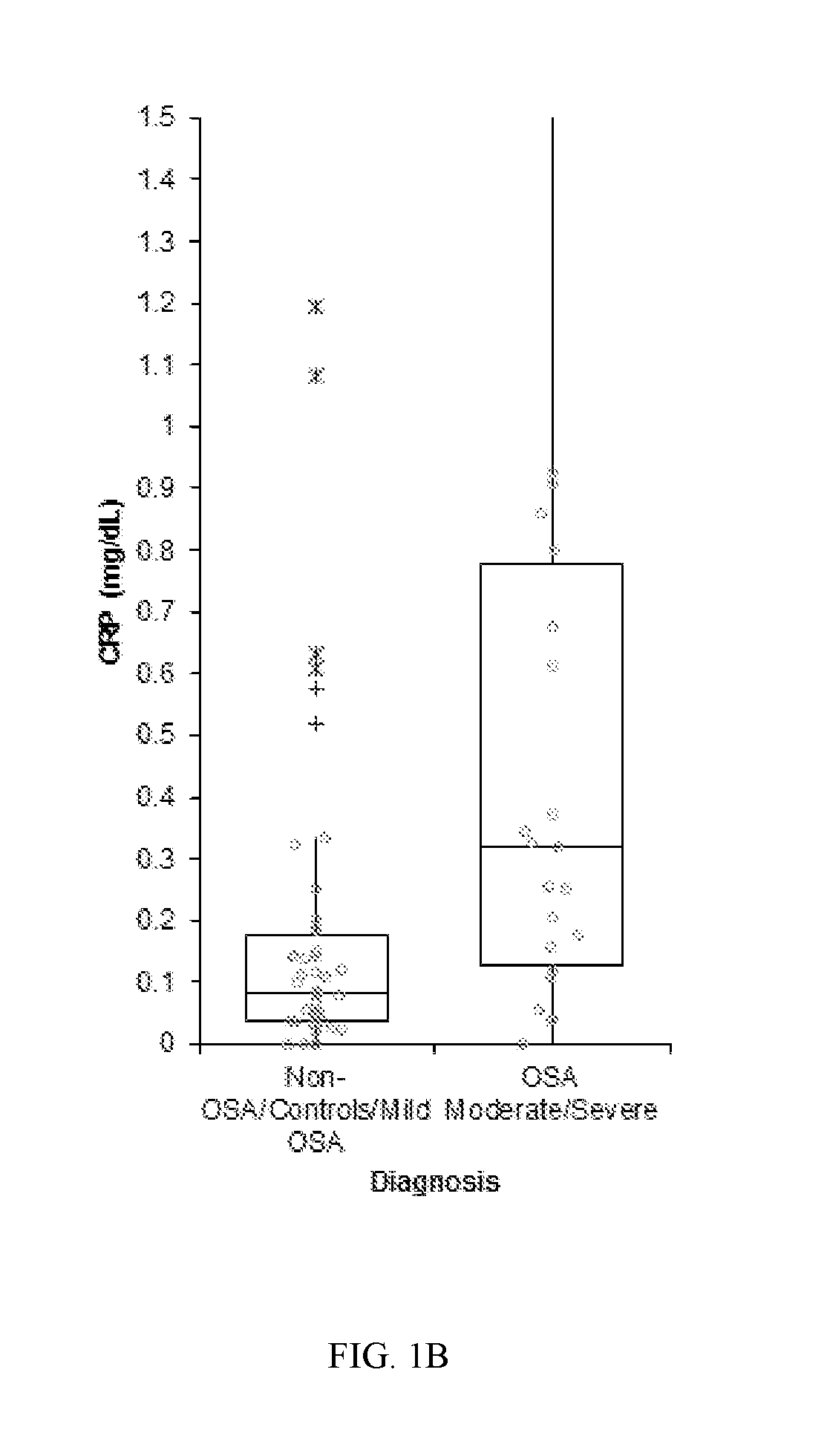
Figure 3
Abstract
Description
CROSS-REFERENCES TO RELATED APPLICATIONS
[0001] The present application claims priority to U.S. Provisional Application No. 62 / 171,754, filed Jun. 5, 2015, the disclosure of which is incorporated herein in its entirety.FIELD OF THE INVENTION
[0002] This invention relates to methods to aid the diagnosis and management of obstructive sleep apnea.BACKGROUND OF THE INVENTION
[0003] Obstructive sleep apnea (OSA) is a common disorder, characterized by repetitive episodes of complete (apnea) or partial (hypopnea) obstructions of the upper airway during sleep, with decreasing oxygen saturation and sleep fragmentation. More than 22 million American adults have OSA. In the Wisconsin Sleep Cohort Study, representing a large, random sample of 30 to 60 year old individuals reporting habitual snoring, 9% of women and 24% of men had OSA.
[0004] The World Health Organization estimates 100 million worldwide have OSA, and up to 90% of individuals with OSA remain undiagnosed. OSA prevalence is increasing and ...
Examples
example 1
Selecting Biomarkers
[0132]A multicenter prospective trial was conducted enrolling 128 patients with suspected OSA as well as a control group of healthy individuals who do not have OSA. A group of biomarkers, including HbA1c, CRP, IL-6, uric acid, EPO, were tested by personnel blinded to patient characteristics. All subjects underwent a diagnostic sleep study (polysomnography). Patients and control group's AHI, minimum oxygen saturation, BMI and ESS, and other standard clinical assessment for OSA were measured. The diagnosis of the presence and the severity of OSA of each patient were accordingly made. Clinicians were not provided with biomarker results prior to patient diagnosis.
[0133]Table 2 shows the clinician's diagnosis of the 128 patients: 26 were diagnosed with moderate to severe OSA; 21 were diagnosed as having mild OSA; and 23 were diagnosed as having no OSA.
[0134]Correlations between the clinical diagnosis and the single biomarker diagnosis using the statistical analysis di...
example 2
orithms of Combinations of Biomarkers to for OSA Diagnosis
[0137]This example shows that algorithms combining of two to three biomarkers—to produce a multimarker index for these biomarkers—can be used for accurately diagnosing OSA. A multimarker index produced for a subject using any one of these algorithms can be used as an aid in the diagnosis of OSA in conjunction with polysomnography (sleep study) findings and clinical signs and symptoms.
[0138]During the algorithm development process, the discriminative power of a group of 5 biomarkers (HbA1c, CRP, IL-6, uric acid, EPO) were investigated. Algorithms using 2- and 3-biomarker combinations in the group were developed and optimized using Linear Model and Non-Linear Model, and 4 optimization methods: Simulated Annealing (http: / / en.wikipedia.org / wiki / Simulated_annealing), Pattern Search (http: / / en.wikipedia.org / wiki / Pattern_search_(optimization)), Brute Force, and Genetic Algorithm (http: / / en.wikipedia.org / wiki / Genetic_algorithm). Line...