
Direction measurement method applicable to phase interference signal source under non stabilized noise background
A non-stationary noise and signal source technology, applied in the fields of communication and radar, it can solve problems such as large disturbance of noise eigenvalues, incomplete orthogonality of subspaces, and non-stationary noise space and time.
Patent Information
- Authority / Receiving Office
- CN · China
- Patent Type
- Patents(China)
- Current Assignee / Owner
- Publication Date
- 2011-11-23
- Estimated Expiration
- Not applicable · inactive patent
Smart Images
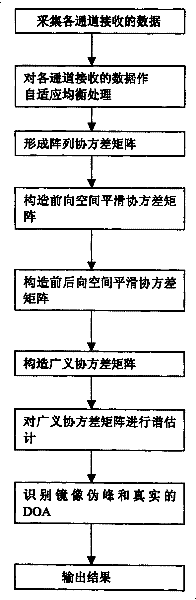
Figure 1 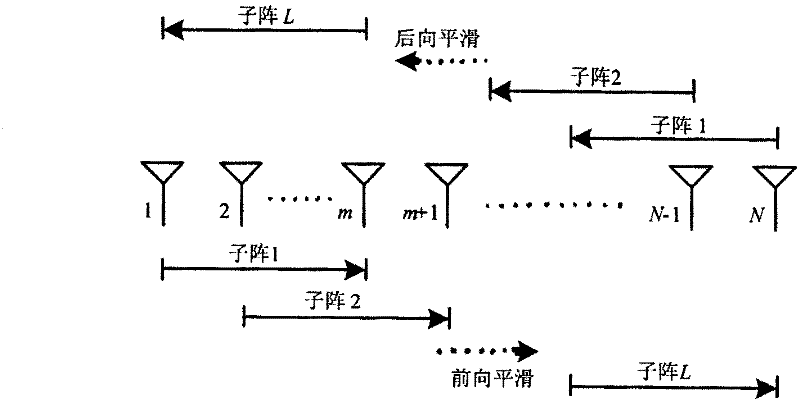
Figure 2 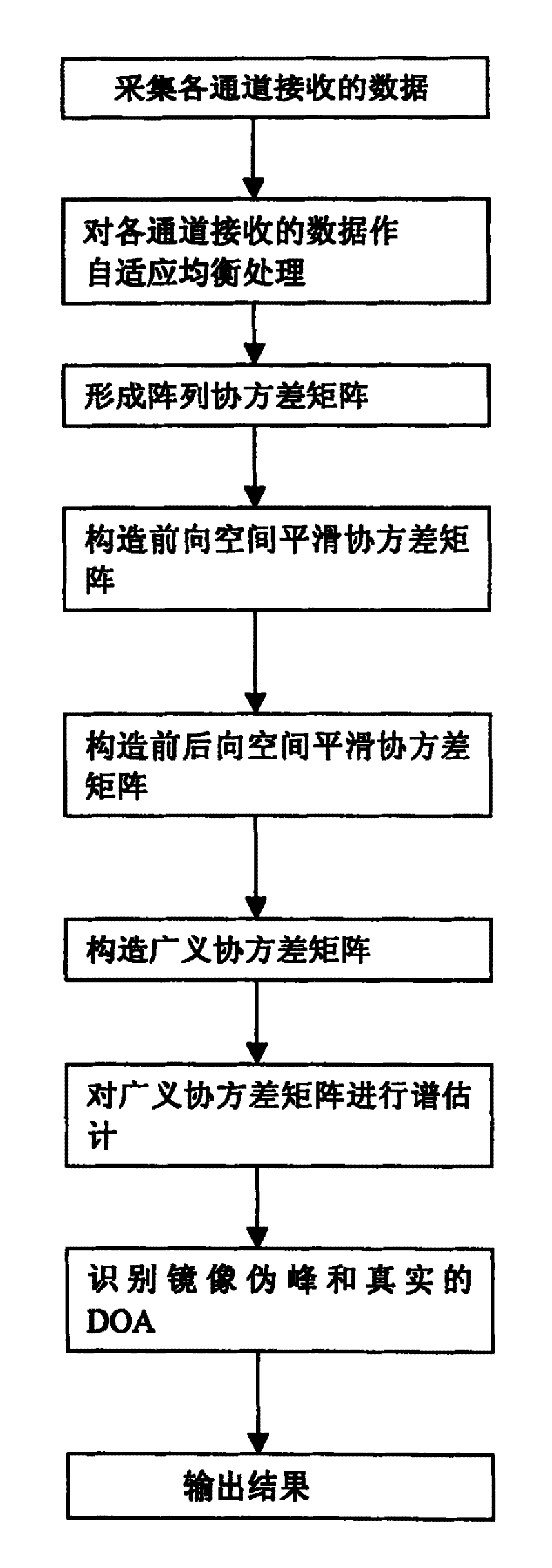
Figure 3
Abstract
Description
technical field
[0001] The invention belongs to the field of radar and communication, and relates to a spatial spectrum estimation signal processing method in the field. Specifically, the invention relates to a direction finding method suitable for coherent information sources under the background of non-stationary noise. Background technique
[0002] Spatial spectrum estimation is widely used in radar, sonar, communication, seismic exploration and other fields, and it is a key technology to improve the performance of parameter estimation. However, conventional spatial spectrum estimation algorithms (such as MUSIC, ESPRIT, ML, WSF, etc.) mostly assume that the array noise is Gaussian white noise or stationary correlated colored noise. However, in the actual environment, the noise is often unknown or time-varying, and the non-stationary noise with unknown statistical properties (the noise covariance matrix is a diagonal matrix of unknown unequal elements) often appears. Fo...
Examples
Embodiment Construction
[0035] In the present invention, the array covariance matrix is firstly smoothed and preprocessed by using the forward and backward space smoothing technology, and then the generalized covariance matrix is constructed. According to the subspace principle, the spectral estimation is performed on the generalized covariance matrix, and the mirror image false peak is identified, thereby obtaining the real DOA (DOA is Direction of Arrival, which is the direction of incidence of the source). The present invention realizes the direction finding principle of the coherent signal source under the unbalanced noise background:
[0036] (1) Construct forward spatial smoothing covariance matrix R f .
[0037] Using the translation invariance of the uniform linear array (ULA), the array is divided into L sub-arrays that overlap each other, and the number of array elements corresponding to each sub-array is m=N-L+1; respectively calculate the autocovariance matrix of the L sub-arrays , ...