
Plant source fruit and vegetable fresh-keeping agent and its preparation method
A fruit and vegetable preservative and plant source technology, applied in the field of preservatives, can solve the problems of secondary pollution of fruits and vegetables, the effect of fresh-keeping cannot meet the actual requirements, etc., and achieve the effects of good inhibitory effect, maintaining the appearance of fruits and vegetables, and simple processing technology.
Patent Information
- Authority / Receiving Office
- CN · China
- Patent Type
- Applications(China)
- Current Assignee / Owner
- Publication Date
- 2008-11-19
- Estimated Expiration
- Not applicable · inactive patent
Smart Images
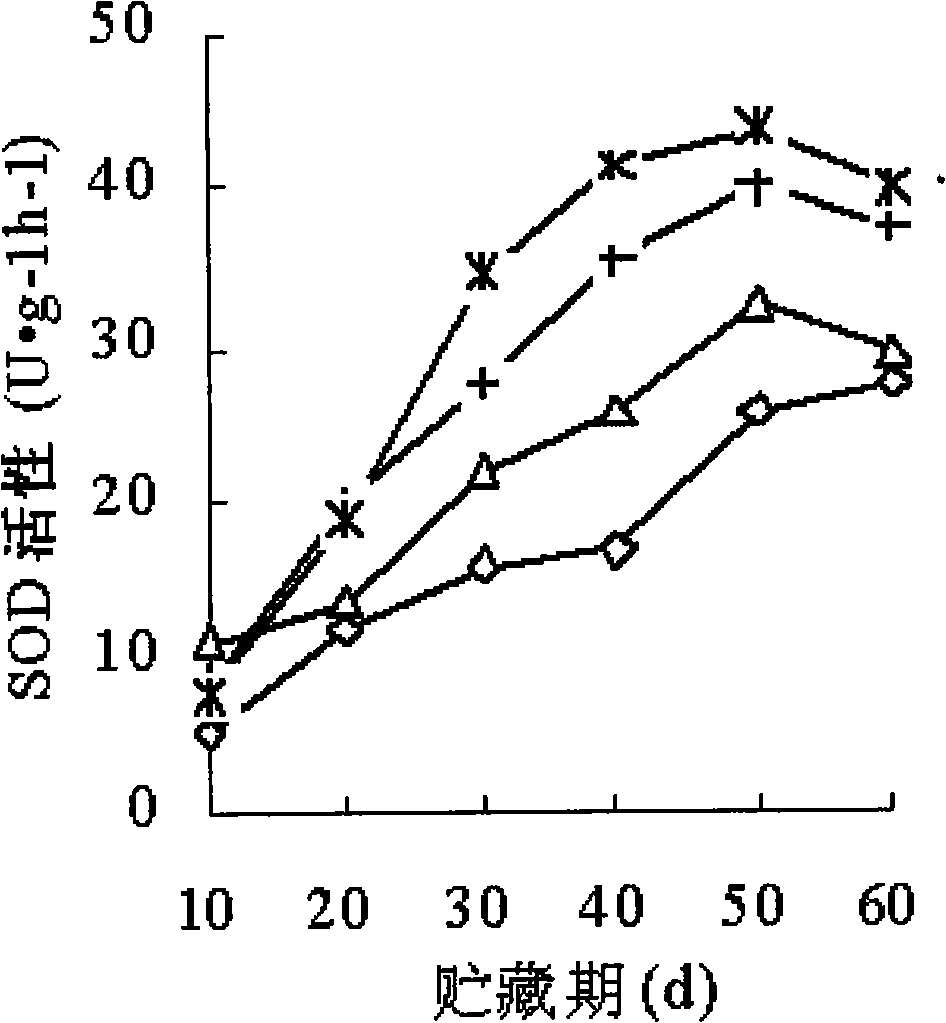
Figure 1 
Figure 2 
Figure 3
Abstract
Description
technical field
[0001] The invention relates to a fresh-keeping agent, in particular to a plant-source fruit and vegetable fresh-keeping agent and a preparation method thereof. Background technique
[0002] Fresh-keeping of fruits and vegetables is an important problem faced in the process of post-harvest storage of fruits and vegetables. The current fresh-keeping technology of fruits and vegetables mainly uses chemically synthesized preservatives. However, when using chemical preservatives, it is easy to cause secondary pollution to fruits and vegetables, and the fresh-keeping effect cannot meet the actual requirements. It has been proved by the applicant's research that the natural plant extracts contained in the natural plant extracts have a high inhibitory effect on the germs that are prone to appear during the post-harvest storage of fruits and vegetables, have no negative effects, and have a good antiseptic and fresh-keeping effect. , Economic resources of plant-sourc...
Examples
Embodiment 1
[0021] RZJ microemulsion is prepared according to the following formula:
[0022] Cinnamon essential oil 5%, chitosan 1%, CaCl 2 1%, emulsifier 11%, solvent 15%, water balance; Solvent selects the mixed solvent of ethyl acetate and dehydrated alcohol (wherein ethyl acetate and dehydrated alcohol respectively account for 50%), emulsifier selects Tween-20 and Mixture of NP-15 (Tween-20 and NP-15 account for 50% each).
[0023] Its preparation method is as follows:
[0024] (1) Weigh cinnamon essential oil, chitosan, CaCl 2 , emulsifier and solvent, first add cinnamon essential oil to the mixed solvent of ethyl acetate and absolute ethanol, stir until uniform, then add chitosan and CaCl 2 respectively added to the solution and stirred until uniform to obtain the microemulsion oil phase;
[0025] (2) Weigh the emulsifier according to the formula, choose the mixture of Tween-20 and NP-15 as the emulsifier, add it to a certain amount of water, stir until uniform, and obtain the...
Embodiment 2
[0028] Choose cinnamon essential oil 6%, chitosan 1.5%, CaCl 2 1.5%, emulsifier 12%, solvent 16%, water surplus, the preparation method is the same as embodiment 1, all can be mixed with RZJ microemulsion.
Embodiment 3
[0030] Choose cinnamon essential oil 4%, chitosan 2%, CaCl 2 1%, emulsifier 10%, solvent 14%, water balance, the preparation method is the same as embodiment 1, all can be mixed with RZJ microemulsion.
[0031] The RZJ microemulsions prepared by the above-mentioned Examples 1 to 3, according to the inhibitory activity test of fruit pathogenic bacteria, the impact on fruit sensory indicators, the impact on physiological and biochemical indicators, and the impact on superoxide dismutase (SOD) activity in the storage process show that , there was no significant difference in the effect.
[0032] 2. Research on the preservation effect of RZJ microemulsion
[0033] 2.1 Inhibitory activity of RZJ microemulsion against several fruit pathogenic bacteria
[0034] Several rot-causing fungi (Rhizopus nigricans ehrenberg, Monilinia laxa, Botrytis cinerea, Penicilliumitalicum, Xanthomonas campestris, Colletotrichum gloeosporioides and Marssonina mali) common in storage period of fruits ...