
Heterocyclic substituted piperazine compounds with CXCR3 antagonist activity
A compound and solvate technology, applied in the field of treating diseases and diseases involving CXCR3, can solve the problem of not showing such effects
Patent Information
- Authority / Receiving Office
- CN · China
- Current Assignee / Owner
- Publication Date
- 2009-08-26
- Estimated Expiration
- Not applicable · inactive patent
Smart Images
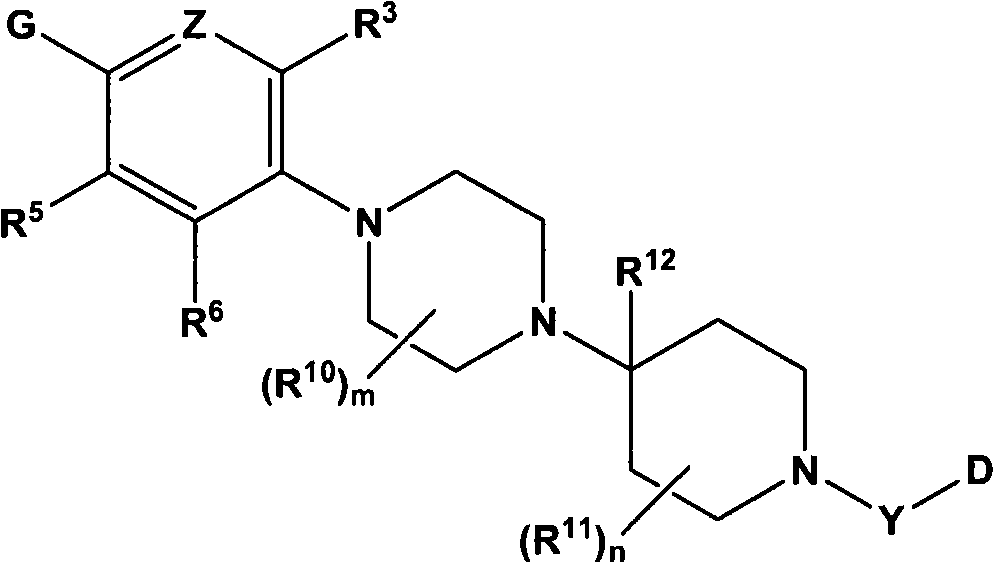
Figure 1 
Figure 2 
Figure 3
Abstract
Description
Field of Invention
[0001] The present invention relates to novel heterocyclic substituted piperazine compounds having CXCR3 antagonist activity; pharmaceutical compositions containing one or more such antagonists, one or more such compounds in combination with other compounds having chemokine activity class antagonists, one or more such antagonists in combination with known immunosuppressants, non-limiting examples of which include methotrexate, interferon, cyclosporine, FK-506 and FTY720; methods of making such antagonists and methods of modulating CXCR3 activity using such antagonists. The present invention also discloses methods of treating (non-limiting examples including palliative, curative and prophylactic therapy) diseases and disorders involving CXCR3 using such CXCR3 antagonists. Diseases and disorders involving CXCR3 include, but are not limited to, inflammatory diseases (psoriasis and inflammatory bowel disease), autoimmune diseases (multiple sclerosis, rheumatoid...
Examples
Embodiment 1
[0401]
[0402] To a cold (-78°C) 1000ml round bottom flask containing 200ml methanol was added dropwise thionyl chloride (10ml, 140mmol) followed by 5-bromopyridinecarboxylic acid (15g, 75mmol). After stirring at -78°C for 10 minutes, the reaction was allowed to warm to room temperature and stirred for 16 hours. Excess thionyl chloride and methanol were removed in vacuo to give A2 (18 g, 95%) as a light brown solid. M+H=216
Embodiment 2
[0404]
[0405] A 250 ml round bottom flask was charged with A2 (4 g, 15.9 mmol), 1-Boc-2-S-ethylpiperazine A3 (prepared according to Kiley et al., Org. Prep. Proc. Int. 1990, 22, 761; 4.2 g, 18.6 mmol), tris(dibenzylideneacetone)dipalladium (340 mg, 0.37 mmol), rac-2,2'-bis(diphenylphosphino)-1,1'-binaphthyl (BINAP ) (495 mg, 0.74 mmol), cesium carbonate (12 g, 37.2 mmol) and toluene (80 ml). After heating the mixture at 100°C for 16 hours, fresh tris(dibenzylideneacetone)dipalladium (340 mg, 0.37 mmol) and BINAP (495 mg, 0.74 mmol) were added and heating continued for 3 days. The solvent was removed in vacuo and the residue was suspended in 100 ml of ethyl acetate. The mixture was extracted with water and brine, dried over sodium sulfate, and concentrated in vacuo. The residue was purified via silica gel flash chromatography (5% methanol / 95% DCM) to yield 5.3 g of partially purified material which was used directly in the next step. M+H=350
Embodiment 3
[0407]
[0408] Intermediate A4 (5.28 g, 15.1 mmol) was stirred with N-bromo-succinimide (5.4 g, 30.2 mmol) in 30 ml DMF at room temperature for 24 hours. The solvent was removed in vacuo and the residue was purified directly by flash chromatography on silica gel eluting with 50% ethyl acetate / 50% hexanes to afford A5 (1.22 g, 19% yield, M+H=428). The column was further eluted with 10% 7N ammonia in methanol / 90% DCM to afford A6 (1.28 g, 25%, M+H=328).