
Salt of carbostyril formic acid compound as well as preparation method and application of salt
A methoxyquinolone formic acid and compound technology, which is applied to the salt of 8-methoxyquinolone formic acid compounds, the application field of moxifloxacin hydrochloride quality detection and analysis, can solve the problem of affecting the quality of moxifloxacin hydrochloride and increase clinical Drug risks, undisclosed determination of moxifloxacin, etc.
Patent Information
- Authority / Receiving Office
- CN · China
- Patent Type
- Applications(China)
- Current Assignee / Owner
- Publication Date
- 2012-07-18
Smart Images
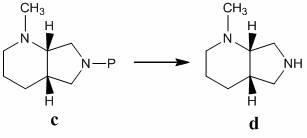
Figure 1 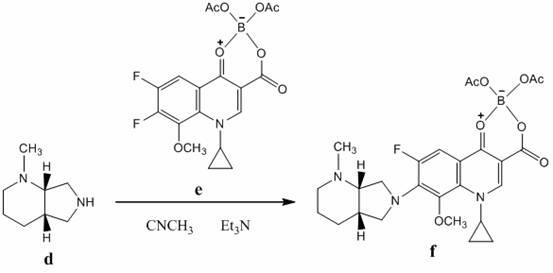
Figure 2 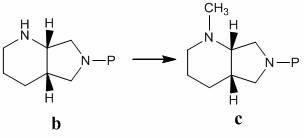
Figure 3
Abstract
Description
technical field
[0001] The present invention relates to the technical field of pharmaceuticals, in particular to a salt of N-methylated 8-methoxyquinolone formic acid compound, a preparation method of the salt and the performance of the salt in the quality detection and analysis of moxifloxacin hydrochloride application. technical background
[0002] Moxifloxacin hydrochloride is an extended-spectrum quinolone antibiotic developed by Bayer Pharmaceuticals. Its chemical name is: 1-cyclopropyl-6-fluoro-1,4-dihydro-8-methoxy-7- [(4αS,7αS)-octahydro-6 H -Pyrrolo[3,4-b]pyridin-6-yl]-4-oxo-3-quinolinecarboxylic acid hydrochloride, Cas No.: 151096-09-2, has the chemical structure shown in the following formula .
[0003]
[0004] Moxifloxacin hydrochloride was launched in Germany for the first time in September 1999, and was approved by the FDA in the United States in December of the same year. Moxifloxacin hydrochloride has broad-spectrum antibacterial activity, especially ...
Examples
Embodiment 1
[0047] Example 1 Mode Synthesis of the hydrochloride salt of the compound
[0048] (1), N-methyl-(S,S)-2,8-diazabicyclo[4,3,0]nonane ( d )Synthesis
[0049]
[0050] Measure 30g formula a The compound was dissolved in 200ml of dry dichloromethane, and 46.5g of di-tert-butyl dicarbonate (Boc 2 O) A solution in 50 ml of dichloromethane. Stir at room temperature for 3 h, concentrate under reduced pressure to remove the solvent, and use dichloromethane-methanol (20:1) as the eluent to separate the residue by silica gel column chromatography, collect the product, concentrate under reduced pressure to remove the solvent, and add the residue to Dissolve 100ml of dichloromethane, add dropwise a solution of 35g of iodomethane dissolved in 50ml of dichloromethane at room temperature, stir at room temperature for 2 hours, concentrate under reduced pressure and evaporate the solvent, add 50ml of methanol to the residue to dissolve, add dropwise methanolic hydrochloric acid ...
Embodiment 2
[0057] Example 2 Mode Synthesis of the sodium salt of the compound
[0058] (1), N-methyl-(S,S)-2,8-diazabicyclo[4,3,0]nonane ( d )Synthesis
[0059] Measure 10g formula a The compound was dissolved in 100ml of dry dichloromethane, and 15.5g of di-tert-butyl dicarbonate (Boc 2 O) A solution in 15 ml of dichloromethane. Stir at room temperature for 5 hours, concentrate under reduced pressure to remove the solvent, and use dichloromethane-methanol (20:1) as the eluent to separate the residue by silica gel column chromatography, collect the product, concentrate under reduced pressure to remove the solvent, and add the residue to Dissolve 35ml of dichloromethane, add dropwise a solution of 8.8g dimethyl sulfate dissolved in 15ml of dichloromethane at room temperature, stir at room temperature for 3h, concentrate under reduced pressure and evaporate the solvent, add 20ml methanol to the residue to dissolve, add dropwise methanol hydrochloric acid solution (2ml Conce...
Embodiment 3
[0064] Example 3 Mode mesylate of compound
[0065] (1), N-methyl-(S,S)-2,8-diazabicyclo[4,3,0]nonane ( d )Synthesis
[0066] Measure 10g formula a The compound was dissolved in 100ml of dry dichloromethane, and 15.5g of di-tert-butyl dicarbonate (Boc 2 O) A solution in 15 ml of dichloromethane. Stir at room temperature for 5 hours, concentrate under reduced pressure to remove the solvent, and use dichloromethane-methanol (20:1) as the eluent to separate the residue by silica gel column chromatography, collect the product, concentrate under reduced pressure to remove the solvent, and add the residue to Dissolve 35ml of dichloromethane, add dropwise a solution of 6.3g dimethyl carbonate dissolved in 15ml of dichloromethane at room temperature, stir at room temperature for 5h, concentrate under reduced pressure and evaporate the solvent, add 20ml of methanol to the residue to dissolve, add dropwise methanolic hydrochloric acid solution (2ml Dissolve concentrated ...