
Detecting method for multiple kinds of poly brominated diphenyl ethers in aquatic product
A technology with multiple polybrominated and detection methods, applied in the field of determination of polybrominated diphenyl ethers, can solve the problems of large amount of solvent consumption, difficult to achieve, long peak time, etc., to shorten the detection cycle, reduce the detection cost and short detection time Effect
Patent Information
- Authority / Receiving Office
- CN · China
- Patent Type
- Applications(China)
- Current Assignee / Owner
- Publication Date
- 2013-08-07
- Estimated Expiration
- Not applicable · inactive patent
Smart Images
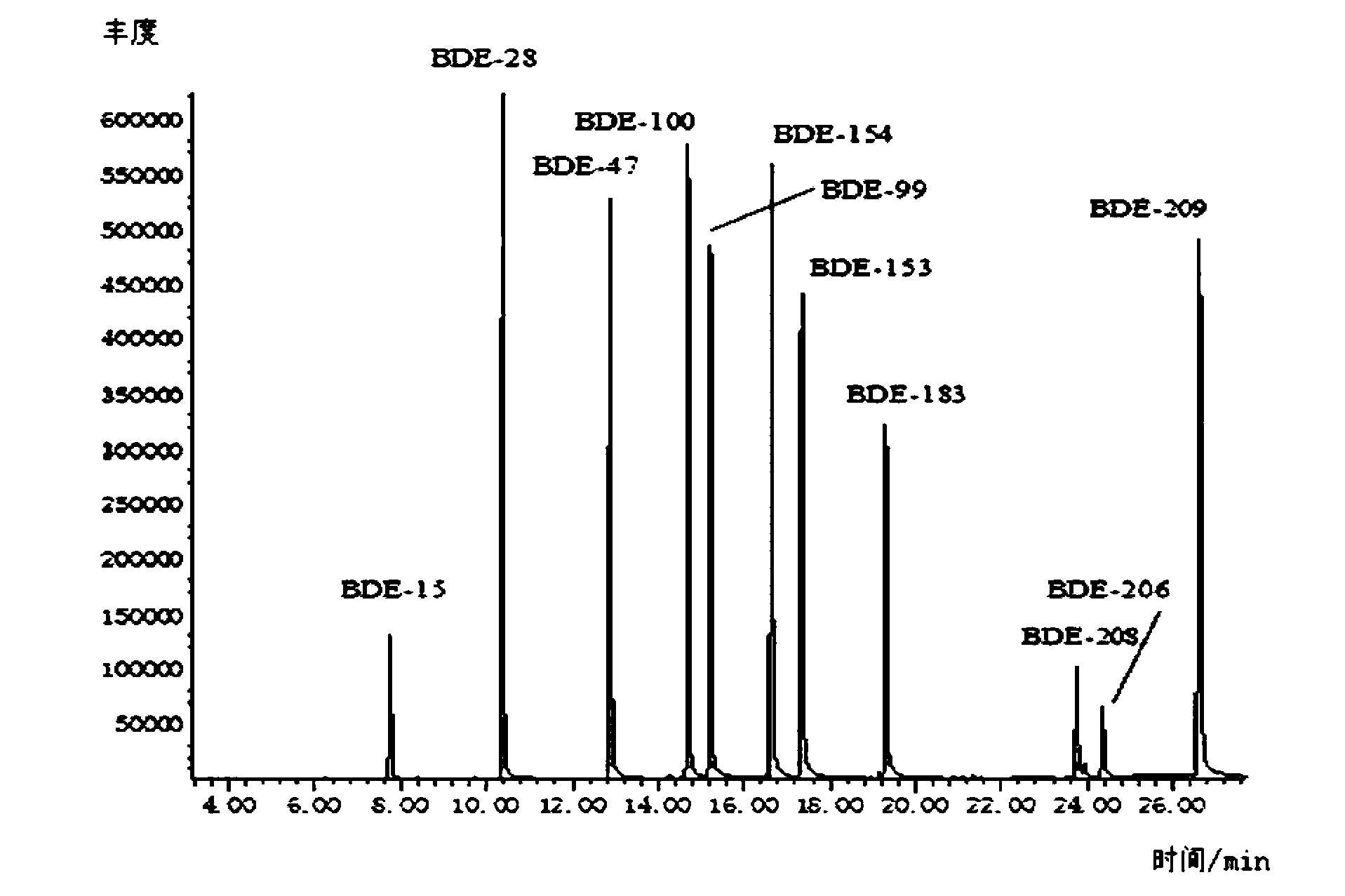
Figure 1 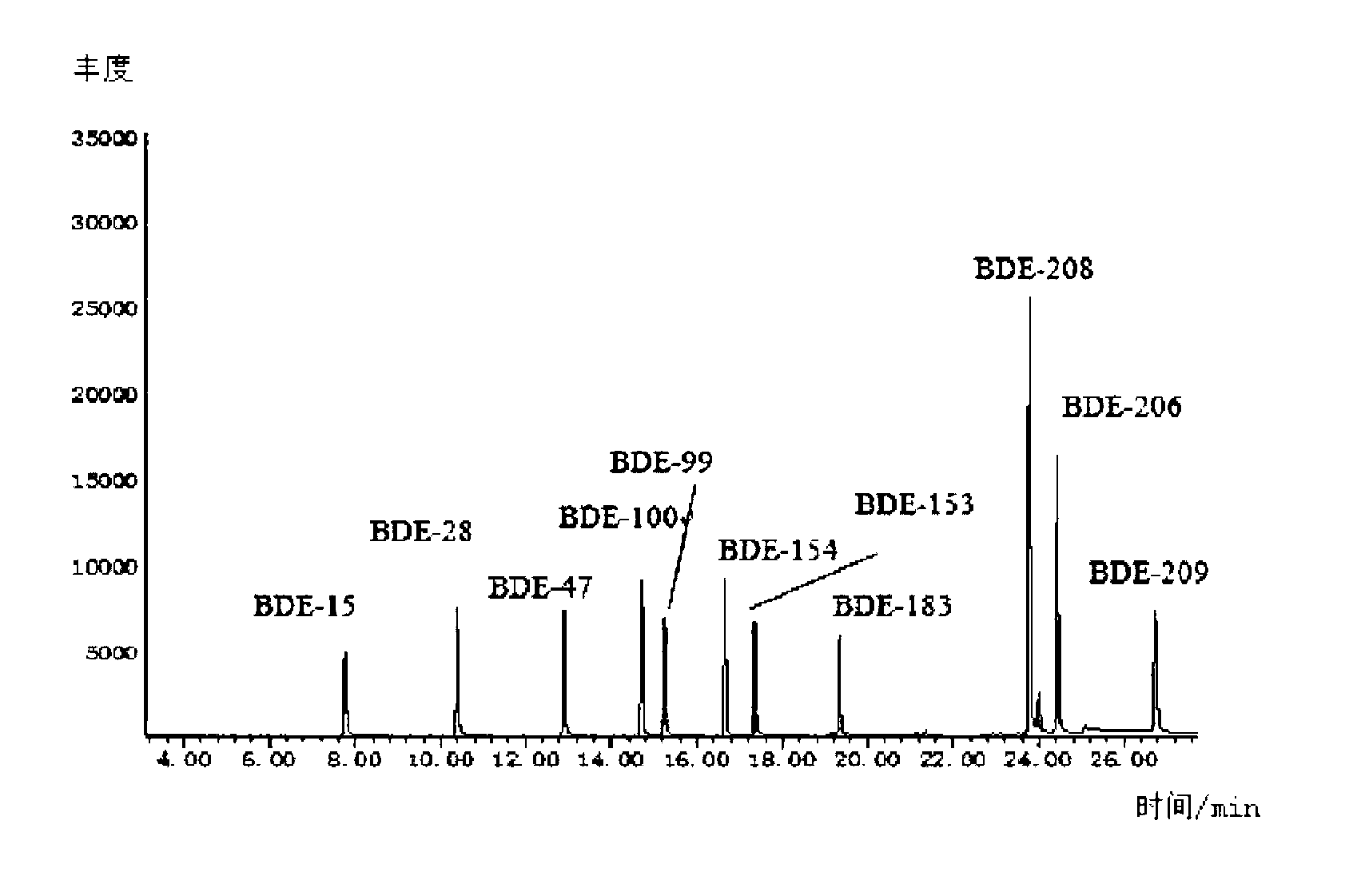
Figure 2 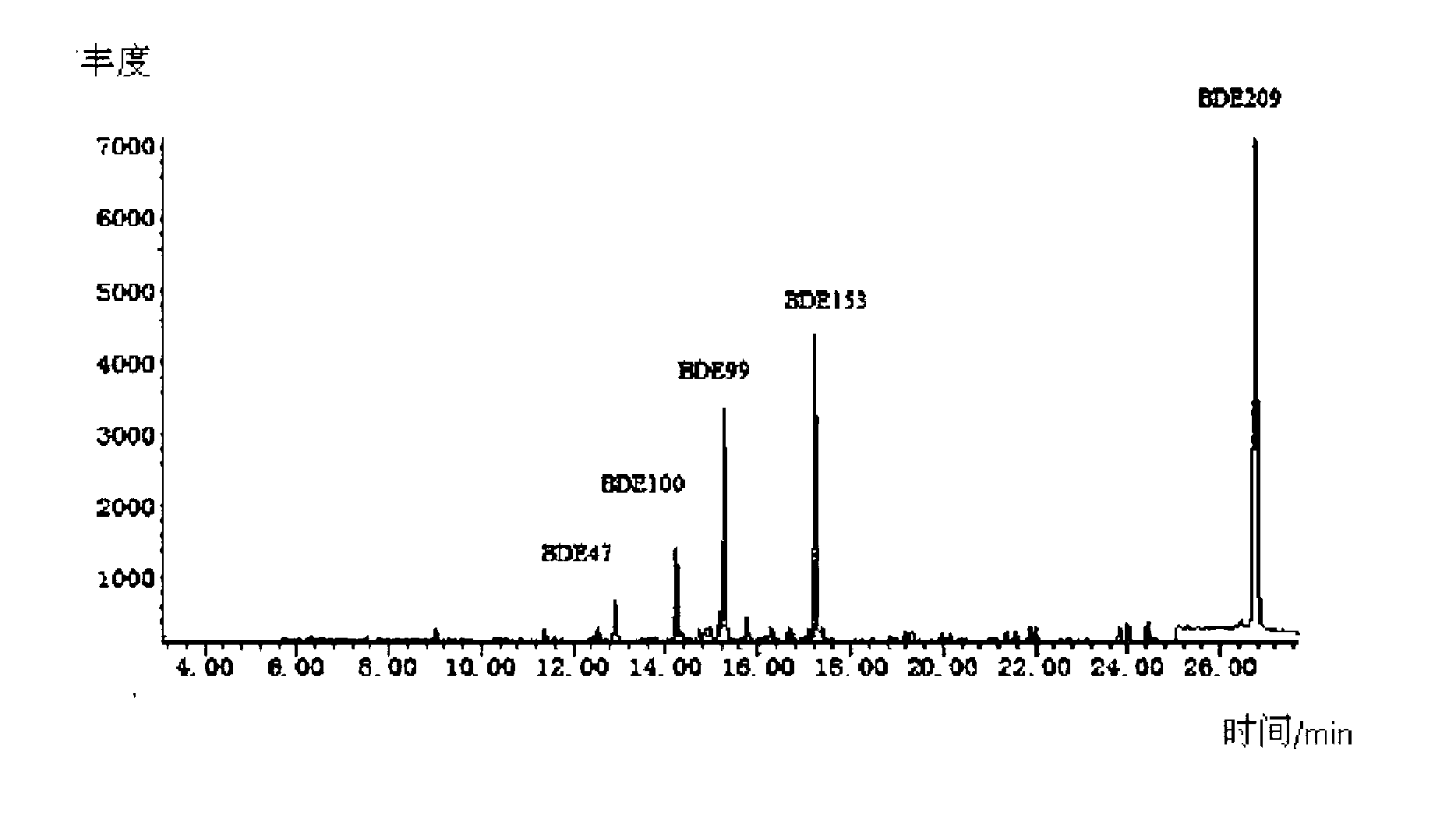
Figure 3
Abstract
Description
technical field
[0001] The invention provides a detection method for biologically toxic and harmful substances, in particular a method for determining up to eleven kinds of polybrominated diphenyl ethers in aquatic products, and belongs to the field of safety detection of harmful substance residues in agricultural by-products. Background technique
[0002] Polybrominated diphenyl ethers (Polybrominated Diphenyl Ethers, PBDEs) are a class of brominated flame retardants. Due to their excellent flame retardancy, good thermal stability, small addition, and low price, they are widely used in the electronics industry, foam plastics, It has been widely used in textiles, building materials, home appliances, home decoration, chemical products, petroleum, mining and other fields, and the annual demand is huge.
[0003] Polybrominated diphenyl ethers have up to 209 homologues due to changes in the number and position of bromine, mainly including: 4,4'-dibromodiphenyl ether (BDE-15), 2,...
Examples
Embodiment 1
[0063] Because the 11 kinds of PBDEs homologues involved in the present invention all have differences in their respective boiling points, polarity and adsorption properties, resulting in different adsorption or dissolution capabilities of each component in the fixed phase sample, that is, each component is in the stationary phase and The partition coefficients between mobile phases are different, so their peak eluting times will be different. In order to ensure that each target pollutant has a good separation effect and chromatographic peak shape, by adopting the detection method of the present invention, not only the separation of 11 kinds of PBDEs is well realized, but also the separation degree of each peak is large, the peak shape is sharp, and the symmetry is good . After many experiments and repeated identification, the reference retention time of each standard substance under the operating conditions of the present invention is obtained, which is specifically shown in ...
Embodiment 2
[0072] Prepare 11 kinds of PBDEs with n-hexane to prepare a single standard solution with a certain concentration, and then take a certain amount of each, and mix them to prepare a series of 11 kinds of PBDEs standard working solutions: the serial concentrations of BDE206 and 208 are 0.1, 0.2, 0.4 respectively , 1.0, 2.0, 4.0, 10.0, 20.0, 40.0, 100.0, 200.0 and 2000.0ng / mL, the serial concentrations of BDE209 are 0.5, 1.0, 2.0, 5.0, 10.0, 20.0, 50.0, 100.0, 200.0, 500.0, 1000.0 and 10000.0ng / mL, the serial concentrations of other PBDEs were 0.05, 0.1, 0.2, 0.5, 1.0, 2.0, 5.0, 10.0, 20.0, 50.0, 100.0 and 1000.0ng / mL. According to the above-mentioned instrument detection conditions sample introduction detection of embodiment 1, carry out linear regression analysis to the mass concentration x (ng / mL) of standard working solution with the peak area y of each component respectively, draw the linear regression equation, correlation of each standard substance Coefficients and method ...
Embodiment 3
[0077] The recovery rate experiments of crucian carp and herring were carried out to investigate the applicability of the established detection method.
[0078] Weigh 1.00g of crucian carp and herring muscle samples with no PBDEs detected, and add 200ng of BDE-15, BDE-28, BDE-47, BDE-100, BDE-99, BDE-154, BDE -153 and BDE-183 standard samples, BDE-208 and BDE-206 standard samples were added in an amount of 400ng, and BDE-209 standard samples were added in an amount of 2000ng. The spiked amounts of PBDEs in these three groups were equivalent to 200ng / g, 400ng / g and 2000ng / g, respectively.
[0079] Weigh 1.00 g of crucian carp and herring muscle samples without PBDEs detected, and add 100 ng of BDE-15, BDE-28, BDE-47, BDE-100, BDE-99, BDE-154, BDE -153 and BDE-183 standard samples, BDE-208 and BDE-206 standard samples were added in an amount of 200ng, and BDE-209 standard samples were added in an amount of 1000ng. The spiked amounts of PBDEs in these three groups were equivale...