
Composite gas hydrate accelerator and preparation method thereof
A gas hydrate and accelerator technology, which is applied in the field of gas hydrate enhanced generation technology and the application field of hydrate method, can solve the problems of slow hydrate generation rate and low gas storage density, shorten the reaction time and reduce the gas-liquid level. Tension, good gas solubilization effect
Patent Information
- Authority / Receiving Office
- CN · China
- Patent Type
- Patents(China)
- Current Assignee / Owner
- Publication Date
- 2014-12-03
Smart Images
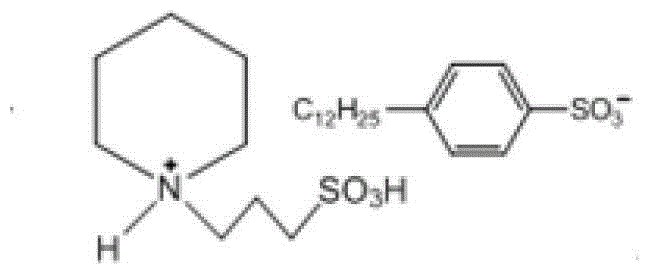
Figure 1
Abstract
Description
technical field
[0001] The invention belongs to the field of gas hydrate enhanced generation technology and hydrate method application technology, and in particular relates to an enhanced CO 2 Composite Kinetic Accelerator for Hydrate Formation. technical background
[0002] Gas hydrate is a clathrate crystal compound similar to ice formed by the interaction between gas molecules and water molecules under high pressure and low temperature conditions. Since the types and quantities of gas molecules constituting hydrates vary, gas hydrates do not have a fixed stoichiometry. Water molecules connected to each other by hydrogen bonds form a divergent lattice network, and gas molecules constrained by van der Waals force fill in the network pores, and the filling degree of gas molecules determines the stability of hydrates. As early as 1990, Gudmundsson et al. proposed the concept of hydrate method for solid-state storage of natural gas. Since then, the industrial application tec...
Examples
Embodiment 1
[0026] Take a certain mass concentration of 1-(3-sulfonic acid group) propylpiperidine dodecylbenzenesulfonic acid ionic liquid and APG to form a composite accelerator with a molar concentration ratio of 1:1.33 and a total molar mass fraction of 0.07%. , Take 200mL and inject it into a high-pressure magnetic dynamic stirring reactor. Set the temperature of the constant temperature water bath to 4°C, and inject CO 2 Gas, the experimental pressure is 3.5Mpa, CO begins to form at the gas-liquid interface about 1min after the gas intake ends 2 Hydrate crystal nuclei, the induction time is very short, after 6 minutes the dense hydrate layer covers the entire gas-liquid interface, at this time start stirring, the stirring speed is 400-500rpm, after 40 minutes of reaction, the hydrate is full of the reaction kettle, wait for the temperature and pressure to stabilize for half Hours later, the exhaust gas was started, and the equilibrium pressure was found to be 1.83 MPa through const...
Embodiment 2
[0028] Take a certain mass concentration of 1-(3-sulfonic acid group) propylpiperidine dodecylbenzenesulfonic acid ionic liquid and APG to form a composite accelerator with a molar concentration ratio of 1:1.67 and a total molar mass fraction of 0.24%. , Take 200mL and inject it into a high-pressure magnetic dynamic stirring reactor. Set the temperature of the constant temperature water bath to 4°C, and inject CO 2 Gas, the experimental pressure is 3.5Mpa, and CO begins to form at the gas-liquid interface about 0.5min after the gas intake ends 2 Hydrate crystal nuclei, the induction time is very short, after 7 minutes, the dense hydrate layer covers the entire gas-liquid interface, at this time start stirring, the stirring speed is 400-500rpm, after 35 minutes of reaction, the hydrate is full of the reactor, and when the temperature and pressure are stable for half Hours later, the exhaust gas was started, and the equilibrium pressure was found to be 2.34MPa by constant tempe...
Embodiment 3
[0030] Take a certain mass concentration of 1-(3-sulfonic acid group) propylpiperidine dodecylbenzenesulfonic acid ionic liquid and APG to form a composite accelerator with a molar concentration ratio of 1:1.6 and a total molar mass fraction of 0.13%. , Take 200mL and inject it into a high-pressure magnetic dynamic stirring reactor. Set the temperature of the constant temperature water bath to 4°C, and inject CO 2 Gas, the experimental pressure is 3.5Mpa, the moment the intake ends, CO begins to form at the gas-liquid interface 2Hydrate crystal nuclei, the induction time is very short, after 3.5 minutes, the dense hydrate layer covers the entire gas-liquid interface, at this time, start stirring, the stirring speed is 400-500rpm, after 20 minutes of reaction, the hydrate is full of the reactor, and the temperature and pressure are stable Half an hour later, the exhaust gas was started, and the equilibrium pressure was found to be 1.73MPa by constant temperature and pressure s...