
Chinese medicinal herb-containing feed additive capable of preventing weaned pig multisystem failure syndrome and pig feed containing same
A technology of Chinese herbal medicine additive and wasting syndrome, which is applied in animal feed, animal feed, food processing, etc., and can solve problems that have not yet been seen
Patent Information
- Authority / Receiving Office
- CN · China
- Current Assignee / Owner
- Publication Date
- 2014-02-19
- Estimated Expiration
- Not applicable · inactive patent
Smart Images
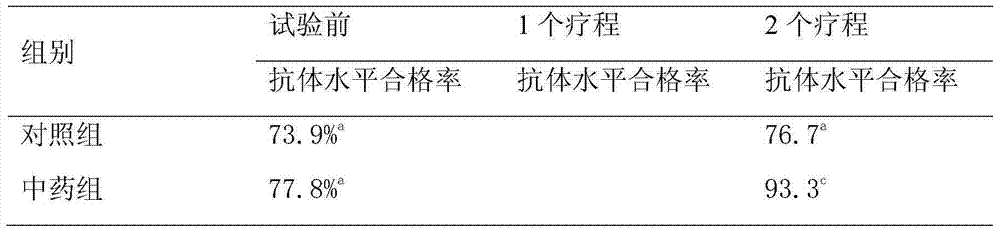
Figure 1 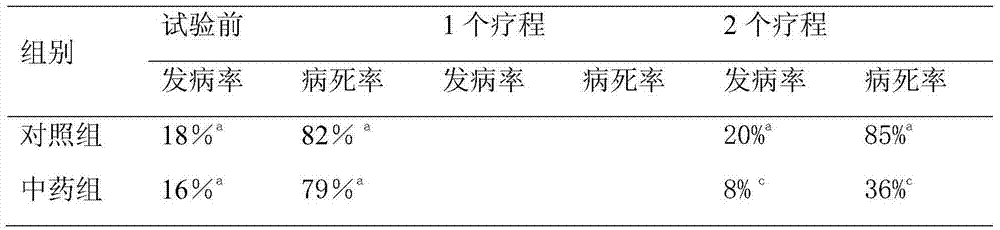
Figure 2
Abstract
Description
technical field
[0001] The invention relates to a Chinese herbal medicine additive for preventing multi-system failure syndrome of weaned piglets and a pig feed thereof in the technical field of medicine. Background technique
[0002] post-weaning multisystemic wasting syndrome
[0003] (PostweaningMultisystemicWastingSyndrome, PMWS) is a comprehensive disease in the growth stage of piglets after weaning caused by the co-infection of multiple viruses such as porcine circovirus type 2 (PCV2) and / or porcine reproductive and respiratory syndrome virus (PRRSV). Can lead to very high mortality and culling rates in weaners and finishers. The disease is distributed worldwide and seriously endangers the healthy development of the pig industry. It mainly occurs in pigs aged 5 to 16 weeks, and is most common in pigs aged 6 to 8 weeks. It usually begins 2 to 3 days or 1 week after weaning. In pigs with acute onset, the fatality rate can reach 10%, but Often due to concurrent or seco...
Examples
Embodiment 1
[0021]The parts by weight of the Chinese herbal medicine additive components for preventing multisystem failure syndrome in weaned piglets in this example are: 60 parts of Codonopsis pilosula, 20 parts of Atractylodes macrocephala, 30 parts of Poria cocos, 60 parts of Chinese yam, 60 parts of astragalus, 40 parts of white lentils, barley 60 parts, 20 parts of lotus seeds, 15 parts of amomum, 20 parts of tangerine peel, 60 parts of Jiao Shenqu, 60 parts of burnt malt, 60 parts of burnt hawthorn, 20 parts of bellflower, 20 parts of lily, 40 parts of Baibu, 40 parts of Polygonum multiflorum, epimedium 40 parts of hydrangea, 20 parts of Ligustrum lucidum, 20 parts of Eclipta, 15 parts of Coptis chinensis, 20 parts of Hu Huanglian, 20 parts of Shijunzi, and 18 parts of licorice.
[0022] The preparation method of the Chinese herbal medicine additive comprises the steps of: batching, screening, drying and pulverizing, passing through an 80-mesh sieve, mixing uniformly to form a powde...
Embodiment 2
[0038] The parts by weight of the Chinese herbal additive components in this example are: 30 parts of Codonopsis pilosula, 10 parts of Atractylodes macrocephala, 20 parts of Poria cocos, 30 parts of yam, 30 parts of astragalus, 20 parts of white lentils, 30 parts of barley, 10 parts of lotus seeds, and 10 parts of amomum. 10 parts of tangerine peel, 30 parts of Jiao Shenqu, 30 parts of Jiao Maiya, 30 parts of Jiao Hawthorn, 10 parts of Bellflower, 10 parts of Lily, 20 parts of Baibu, 20 parts of Polygonum multiflorum, 20 parts of Epimedium, 10 parts of Ligustrum lucidum, 10 parts of Eclipta, 10 parts of Coptis chinensis, 10 parts of Hu Huanglian, 10 parts of Shijunzi, and 10 parts of licorice.
[0039] The preparation method of the Chinese herbal medicine additive comprises the steps of: batching, screening, drying and pulverizing, passing through an 80-mesh sieve, mixing uniformly to form a powder, and subpackaging for use.
Embodiment 3
[0041] The parts by weight of the Chinese herbal additive components in this example are: 90 parts of Codonopsis pilosula, 30 parts of Atractylodes macrocephala, 60 parts of Poria cocos, 90 parts of Chinese yam, 90 parts of astragalus, 60 parts of white lentils, 90 parts of barley, 30 parts of lotus seeds, and 20 parts of amomum. 30 parts, 30 parts of tangerine peel, 90 parts of Jiao Shenqu, 90 parts of Jiao Maiya, 90 parts of Jiao Hawthorn, 30 parts of Bellflower, 30 parts of Lily, 60 parts of Baibu, 60 parts of Polygonum multiflorum, 60 parts of Epimedium, 30 parts of Ligustrum lucidum, 30 parts of Eclipta, 20 parts of Coptis chinensis, 30 parts of Hu Huanglian, 30 parts of Shijunzi, and 30 parts of licorice.
[0042] The preparation method of the Chinese herbal medicine additive comprises the steps of: batching, screening, drying and pulverizing, passing through an 80-mesh sieve, mixing uniformly to form a powder, and subpackaging for use.