

A kind of bone implant filling material and preparation method thereof
A filling material and bone grafting technology, which is applied in pharmaceutical formulations, medical preparations containing active ingredients, and pharmaceutical sciences, etc., can solve the problem that the protein is not easily absorbed and degraded by immobilized calcium sulfate, and achieves no or low immunogenicity, easy to use. Effects of shaping, biodegradability and biocompatibility
Patent Information
- Authority / Receiving Office
- CN · China
- Patent Type
- Patents(China)
- Current Assignee / Owner
- Publication Date
- 2015-11-25
Smart Images
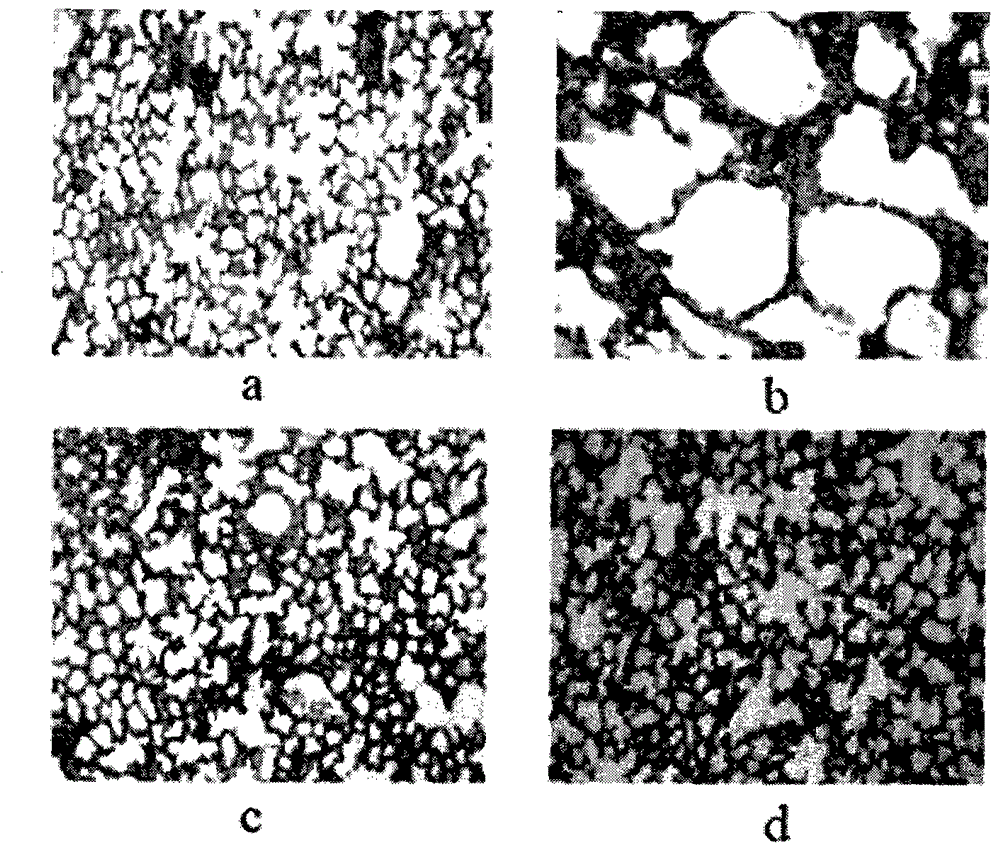
Figure 1
Abstract
Description
technical field
[0001] The invention belongs to the technical field of medical biomaterials, and in particular relates to a bone implant filling material and a preparation method thereof. Background technique
[0002] Inorganic bone graft materials are non-toxic, non-immunogenic, easy to sterilize, and have unlimited dosage. However, it is fragile, has low shear force, and poor fracture resistance. It can only provide minimal mechanical stabilization in the short term after surgery, and usually only has osteoconduction, not osteoinduction. Bone morphogenetic proteins (BMP), especially BMP-2, can promote osteogenesis, have the ability to promote cell differentiation and induce osteogenesis in vitro, and have the ability to make the precursor cells of osteoblasts differentiate into osteoblasts. However, BMP is inactivated by diffusion or protein degradation in the body, and it is difficult to maintain an effective concentration at the fusion site. Moreover, the effect of diff...
Examples
Embodiment 1
[0029] (1) Mix 10g of biphasic calcium phosphate, 10g of calcium sulfate and 1g of iron oxide and grind them to a particle size of 0.1-1 mm, heat up to 800°C at a rate of 10°C / min and calcinate for 3 hours, take out the calcined bone and place it in the 1M (NH 4 ) 2 HPO 4 Soak in the solution for 24 hours, dry for 2 days, heat up again at a rate of 5°C / min to 1100°C for 1 to 2 hours, slowly cool down, rinse twice with deionized water, and dry at 50°C to obtain a skeleton structure;
[0030] (2) 15g, 0.5mm thick layer of collagen surface spraying 2g bone morphogenetic protein, at this bone morphogenetic protein surface spraying 15 and another layer of 0.5mm thick collagen protein, obtain composite protein layer, described compound The protein layer is dried at 30°C and ultrafinely pulverized to obtain protein particles with a particle size of 50-100nm;
[0031] (3) Add 10 g of the skeleton structure and 15 g of protein particles into 60 ml of absolute ethanol, and place it u...
Embodiment 2
[0034] (1) Mix 10g of biphasic calcium phosphate, 20g of calcium sulfate and 2g of iron oxide and grind them to a particle size of 0.1-1 mm, heat up to 800°C at a rate of 10°C / min and calcinate for 3 hours, take out the calcined bone and place it in 1M (NH 4 ) 2 HPO 4 Soak in the solution for 24 hours, dry for 2 days, heat up again at a rate of 5°C / min to 1100°C for 1 to 2 hours, slowly cool down, rinse twice with deionized water, and dry at 50°C to obtain a skeleton structure;
[0035] (2) 15g, 0.4mm thick layer of collagen surface spraying 5g bone morphogenetic protein, at this bone morphogenetic protein surface spraying another layer of 15g, 0.4mm thick collagen, obtain composite protein layer; The composite protein layer is dried at 30°C and ultrafinely pulverized to obtain protein particles with a particle size of 50-100nm;
[0036] (3) Add 40g of skeleton structure and 25g of protein particles into 80ml of absolute ethanol, and place it under the conditions of 1-5°C a...
Embodiment 3
[0039] (1) Mix 10g of biphasic calcium phosphate, 20g of calcium sulfate and 1g of iron oxide and crush them to a particle size of 0.1-1 mm, heat up to 800°C at a rate of 10°C / min and calcinate for 3 hours, take out the calcined bone and place it in the 1M (NH 4 ) 2 HPO4 Soak in the solution for 24 hours, dry for 2 days, heat up again at a rate of 5°C / min to 1100°C for 1 to 2 hours, slowly cool down, rinse twice with deionized water, and dry at 50°C to obtain a skeleton structure;
[0040] (2) 10g, 4mm thick layer of collagen surface spraying 5g sustained-release agent, spray another layer of 20g, 4mm thick collagen on this sustained-release agent surface, obtain composite protein layer, described slow-release agent is 2g A mixture of bone morphogenetic protein, 2 g of fibronectin, and 1 g of hyaluronic acid; drying the composite protein layer at a temperature of 30° C., and ultrafinely pulverizing to obtain protein particles with a particle size of 50-100 nm;
[0041] (3) A...