
Method for preparing magnetic powder core with high-flux magnet ring performance
A high-flux, magnetic powder core technology, used in inductor/transformer/magnet manufacturing, electrical components, circuits, etc., can solve the problem of high price, achieve the effect of low cost, high AC and DC superposition characteristics, and low core loss
Patent Information
- Authority / Receiving Office
- CN · China
- Patent Type
- Applications(China)
- Current Assignee / Owner
- Publication Date
- 2014-10-15
- Estimated Expiration
- Not applicable · inactive patent
Smart Images
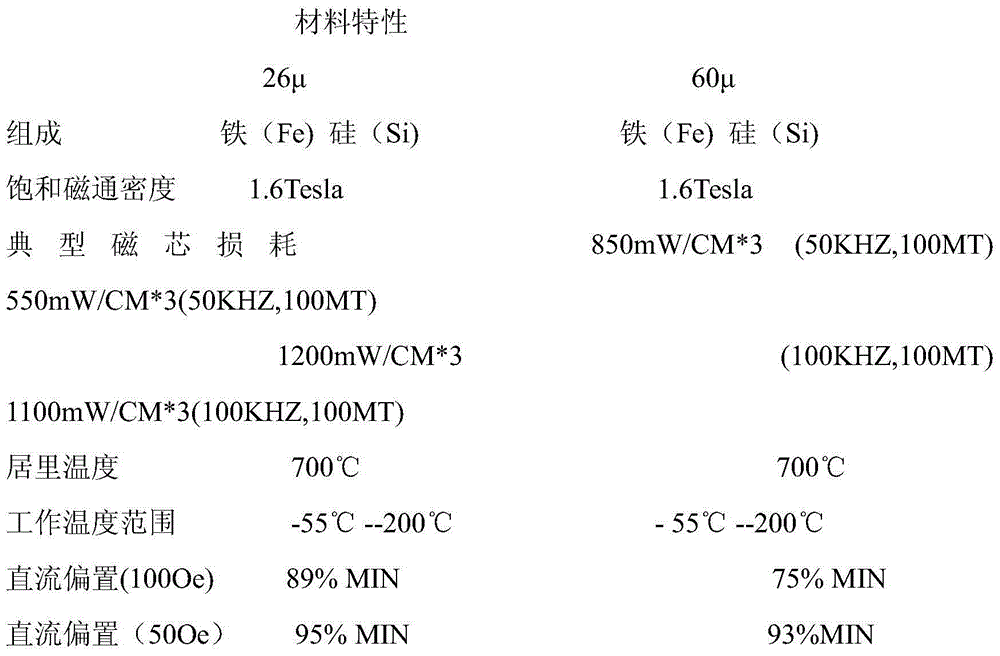
Figure 1
Abstract
Description
technical field
[0001] The invention relates to the technical field of magnetic core preparation, in particular to a preparation method of a magnetic powder core with high magnetic flux magnetic ring performance. Background technique
[0002] The magnetic powder core is a kind of soft magnetic material made by mixing ferromagnetic powder and insulating medium. Since the ferromagnetic particles are very small (0.5 to 5 microns used at high frequencies) and are separated by non-magnetic electrical insulating film materials, on the one hand, eddy currents can be isolated, and the material is suitable for higher frequencies; on the other hand, due to the particles The gap effect between the two leads to the material with low magnetic permeability and constant magnetic permeability; and because the particle size is small, the skin phenomenon basically does not occur, and the change of magnetic permeability with frequency is relatively stable. Mainly used for high frequency induc...
Examples
Embodiment 1
[0022] (1) Put the iron-silicon alloy into a vacuum induction furnace for smelting, the silicon content in the iron-silicon alloy is 5%, and the balance is iron, and then the iron-silicon alloy is fired into a solution at 750 ° C, and the solution is 8m high. The container is crushed by high-pressure nitrogen, and then put into a heat treatment furnace under nitrogen protection for annealing treatment at 720°C. After cooling to room temperature, the obtained powder is passed through a 180-mesh sieve;
[0023] (2) surface passivation is carried out on the powder obtained in step (1), and the powder is stirred evenly with 2wt% phosphoric acid and 4wt% water, and then placed in a stirring vessel, then heated and dried at a temperature of 90° C., after being completely dried, put into the powder Add insulating agent, internal lubricant and mold release agent, and then carry out molding, and the molding pressure is 18T / cm 2 , and then heat treatment. The heat treatment is divided i...
Embodiment 2
[0030] (1) Put the iron-silicon alloy into a vacuum induction furnace for smelting, the silicon content in the iron-silicon alloy is 8%, and the balance is iron, and then the iron-silicon alloy is fired into a solution at 750 ° C, and the solution is 12m high. The container is crushed with high-pressure nitrogen, and then put into a heat treatment furnace under nitrogen protection for annealing treatment at 720°C. After cooling to room temperature, the obtained powder is passed through a 400-mesh sieve;
[0031] (2) the powder obtained in step (1) is subjected to surface passivation, stirred with 3 wt % phosphoric acid and 5 wt % of water and put into a stirring vessel, then heated and dried at 110° C., after complete drying, put into the powder Add insulating agent, internal lubricant and mold release agent, and then carry out molding, and the molding pressure is 18T / cm 2 , and then heat treatment. The heat treatment is divided into three areas: preheating zone, high temperat...
Embodiment 3
[0038] (1) Put the iron-silicon alloy into a vacuum induction furnace for smelting, the silicon content in the iron-silicon alloy is 6.5%, and the balance is iron, and then the iron-silicon alloy is sintered into a solution at 750 ° C, and the solution is 10m high. The container is crushed with high-pressure nitrogen, and then put into a heat treatment furnace under nitrogen protection for annealing treatment at 720°C. After cooling to room temperature, the obtained powder is passed through a 200-mesh sieve;
[0039] (2) surface passivation is carried out to the powder obtained in step (1), and the powder is uniformly stirred with 2.5wt% phosphoric acid and 4.5wt% water, and then placed in a stirring vessel, then heated and dried at a temperature of 100° C. Add insulating agent, internal lubricant and mold release agent to the powder, and then carry out molding, and the molding pressure is 18T / cm 2, and then heat treatment. The heat treatment is divided into three areas: prehe...