
Three-pole discharge gap body and discharge trigger circuit
A discharge gap and trigger electrode technology, which is applied to circuits dedicated to spark gaps, circuits, spark gaps with auxiliary trigger devices, etc., can solve problems such as application uncertainty, and achieve the goal of reducing the conduction voltage and accelerating the occurrence of discharge Effect
Patent Information
- Authority / Receiving Office
- CN · China
- Patent Type
- Applications(China)
- Current Assignee / Owner
- Publication Date
- 2015-03-11
Smart Images
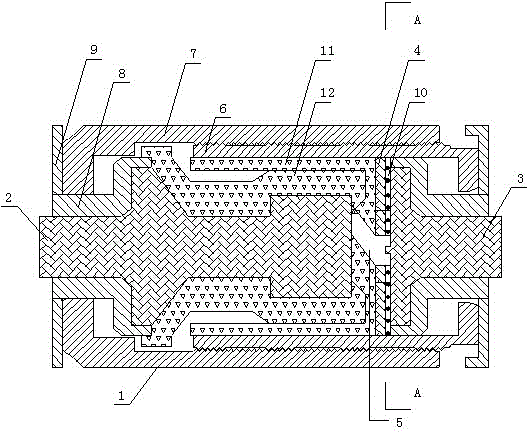
Figure 1 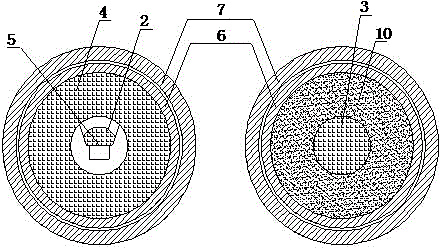
Figure 2 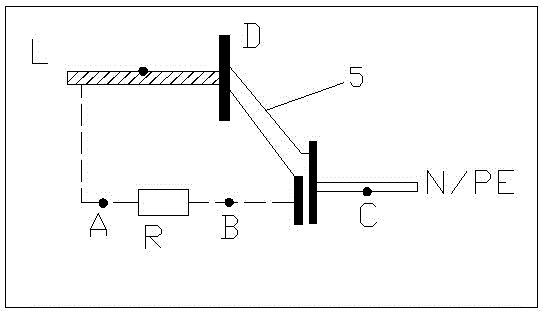
Figure 3
Abstract
Description
technical field
[0001] The invention relates to a three-pole discharge gap body and a discharge trigger circuit thereof. Background technique
[0002] There are three types of gap body discharge: air gap body, graphite gap body, and multilayer discharge tube gap body. When the gap body is applied to the protection of L-N / PE, the discharge maintenance voltage of the L electrode and the N / PE electrode is only tens of volts, and when the power frequency crosses zero, the internal discharge cannot be effectively cut off, so the gap body type surge protector must solve the gap For the arc extinguishing problem of the main body, the current products use the physical arc extinguishing angle to extinguish the arc, and some use the increase in the number of gaps in the main body layer to increase the discharge maintenance voltage for arc extinguishing. The surge protector with arc extinguishing angle depends on the internal air flow, although it can extinguish the arc most of the ti...
Examples
Embodiment Construction
[0020] refer to Figure 1-Figure 2 As shown, a three-pole discharge gap body includes a three-pole discharge structure and a gap body 1. The three-pole discharge structure is respectively a positive electrode L2, a negative electrode N / PE3, and a trigger electrode C4. The positive electrode L1 and the negative There is a discharge chamber 5 between the electrodes N / PE2, and the positive electrode L2 and the negative electrode N / PE3 are provided with a stainless steel sleeve A6 and a stainless steel sleeve B7 in turn, and the stainless steel sleeve A6 and stainless steel sleeve B7 are cone double-threaded sleeves In addition, the trigger electrode C4, the stainless steel sleeve A6 and the stainless steel sleeve B7 together form a trigger electrode, the gap body 1 adopts a fully enclosed structure, and the exposed distance between the positive electrode L2 and the negative electrode N / PE3 is 6mm.
[0021] The fully enclosed structure includes an inner layer and an outer layer. ...