

Method for preparing 2-bromine-5-trifluorotoluene chloride
A technology of fluorobenzotrifluoride and trifluoromethyl, which is applied in the field of preparation of 2-bromo-5-fluorobenzotrifluoride, can solve the problems of unsuitability for industrial production, expensive raw materials, harsh reaction conditions, etc. Effects of low isomer impurities, cheap raw materials, and short reaction steps
Patent Information
- Authority / Receiving Office
- CN · China
- Patent Type
- Applications(China)
- Current Assignee / Owner
- Publication Date
- 2015-03-25
Smart Images

Figure 1 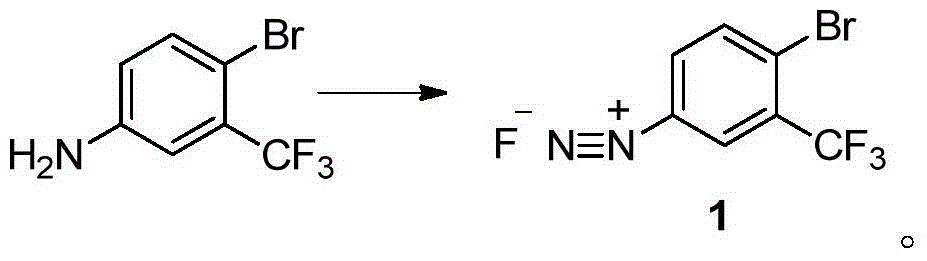
Figure 2 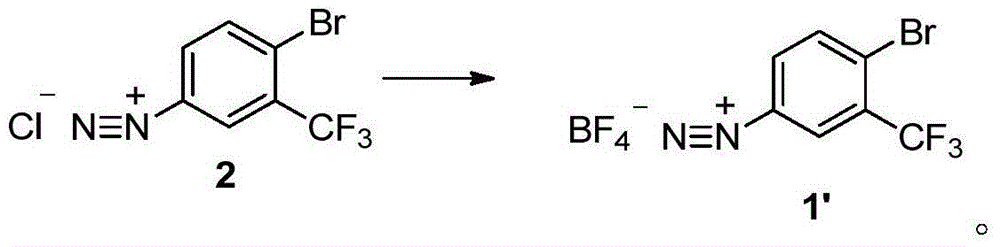
Figure 3
Abstract
Description
technical field
[0001] The present invention relates to the preparation method of 2-bromo-5-fluorobenzotrifluoride. Background technique
[0002] 2-Bromo-5-fluorobenzonitrile is a widely used pharmaceutical intermediate, which can be used to synthesize 2-trifluoromethyl-4-aminobenzonitrile, and 2-trifluoromethyl-4-aminobenzene Formaldehyde is a raw material and intermediate for the synthesis of antineoplastic drug bicalutamide. Bicalutamide is an antiandrogenic noncorticosteroid that is well tolerated and has no significant side effects after administration. At present, the market demand for 2-bromo-5-fluorobenzotrifluoride as an intermediate is gradually increasing.
[0003] The synthesis of 2-bromo-5-fluorobenzotrifluoride in the literature patents that have been publicly reported at present is mainly based on m-trifluoromethylfluorobenzene as a starting material, which is directly brominated in the presence of an acid and a brominating agent to obtain 2- Bromo-5-fluoro...
Examples
Embodiment 1-7
[0093] Embodiment 1-7 carries out the reaction of amino protection to m-trifluoromethylaniline
[0094] Add 500g of m-trifluoromethylaniline into a four-neck flask, raise the temperature to 60°C, add 337g of acetic anhydride dropwise while stirring, and the dropwise addition time is 1 to 3 hours. More than 99%, the yield reaches more than 99%.
[0095] With reference to the above synthetic method, select different solvents and reaction temperatures, the conversion and yield obtained are shown in Table 1:
[0096] The reaction condition table of table 1 embodiment 2-8
[0097]
[0098] The calculation method of the conversion rate is: GC / HPLC determines the amount of unreacted raw materials, (feed amount - unreacted raw material) divided by the feed amount equals the conversion rate)
Embodiment 9-19
[0099] Embodiment 9-19 prepares the reaction of compound 4
[0100] Add 185 g of glacial acetic acid, 50 g of water, 100 g of sodium chlorate, and 5.3 g of iron powder to the reaction solution of Example 1 (the amount of compound 3 is about 3 mol), add 275 g of bromine dropwise, and the temperature is 65 ° C, and the dropwise addition is completed in 3 hours After 8 hours of heat preservation, 1300g of 5% sodium bisulfite was added dropwise to the reaction liquid, kept at 20°C to 30°C for 4h, filtered, the filter cake was washed with 1000g of water, and filtered to obtain the wet product 5-acetamido-2-bromotrifluoro Toluene, reaction conversion rate 99.5%, yield 98.6%.
[0101] Referring to the above synthesis method, different solvents, oxidants, and bromination reaction temperatures were selected to obtain Examples 10-19, and the specific data are shown in Table 2.
[0102] Table 2 Example 10 - 19 reaction condition table
[0103]
[0104]
[0105] The mass concentr...
Embodiment 20-26
[0106] Example 20-26 Removal of amino protecting group to prepare 3-trifluoromethyl-4-bromoaniline (reaction of removing amino protecting group)
[0107] Drop into 5-acetamido-2-bromobenzotrifluoride 1100g (HPLC purity ≥ 96%), mass percentage composition be 48% liquid caustic soda 200g (the described mass percentage composition refers to the hydrogenation in four-necked bottle) The mass of sodium accounts for the percentage of the total mass of sodium hydroxide aqueous solution), methanol 148.5g, temperature 90°C, heat preservation and stirring for 5 hours and then cooling to 65°C for stratification, the organic layer is washed with water and then stratified, the lower layer is 3-trifluoroform Base-4-bromoaniline, the reaction conversion rate is 99.5%, and the yield is 98.2%.
[0108] With reference to the above-mentioned synthetic method, different solvents, alkaline substances, and reaction temperatures were selected to obtain Examples 21-26, and the specific data are shown ...