
A process and system for treating acrylonitrile tail gas by high temperature incineration
A technology of acrylonitrile and incineration, which is applied in combustion methods, incinerators, combustion types, etc., can solve the problems of increased treatment costs, slow reaction rate of biological methods, secondary pollution, etc., and achieves saving fuel consumption, safe and stable coking, No coking effect
Patent Information
- Authority / Receiving Office
- CN · China
- Patent Type
- Patents(China)
- Current Assignee / Owner
- Publication Date
- 2017-07-14
Smart Images
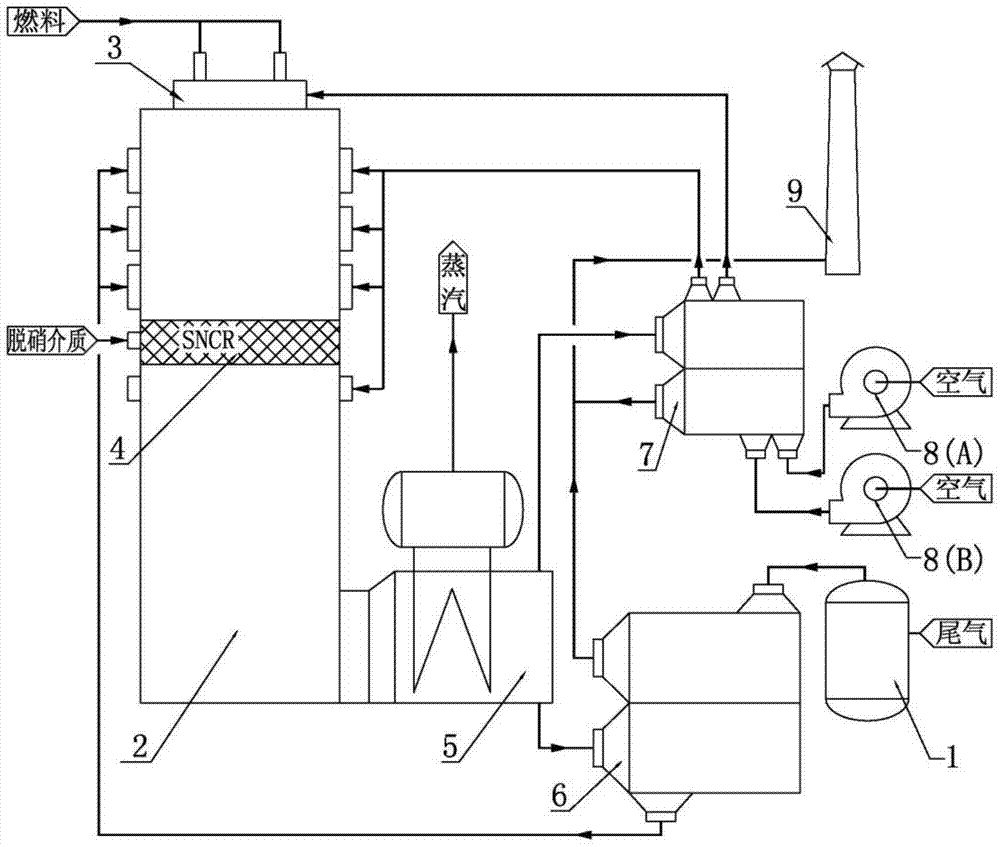
Figure 1 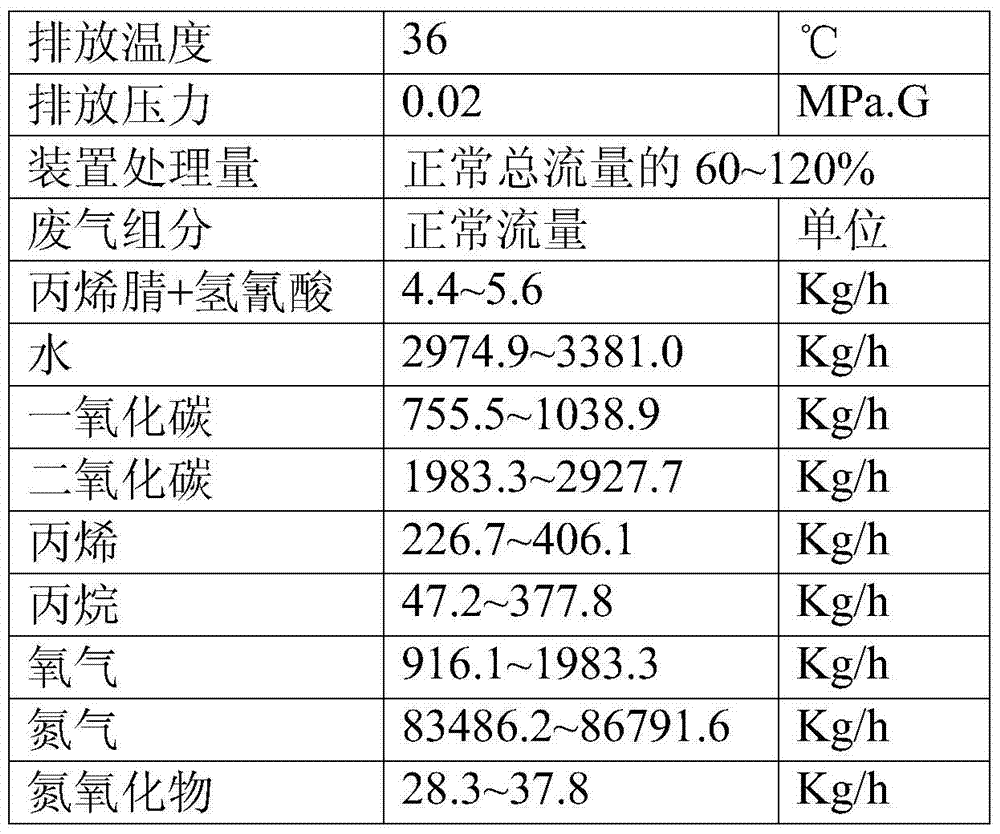
Figure 2 
Figure 3
Abstract
Description
technical field
[0001] The invention belongs to the technical field of chemical organic waste gas treatment and environmental protection, and in particular relates to a system for pretreatment, incineration and waste heat recovery of acrylonitrile tail gas. Background technique
[0002] Acrylonitrile tail gas refers to the exhaust gas discharged from the top of the acrylonitrile absorption tower. This type of exhaust gas is characterized by large gas volume, low calorific value, fluctuating components and high toxicity. Since the emissions of acrylonitrile, hydrocyanic acid, carbon monoxide and non-methane hydrocarbons in the tail gas exceed the national environmental protection standards, direct high-point emissions that will cause harm to the environment have been banned.
[0003] The current treatment methods for this waste gas include: biological method, catalytic incineration method, high temperature incineration method.
[0004] The biological method has a slow reacti...
Examples
Embodiment 1
[0033] The composition and state parameters of the acrylonitrile tail gas to be treated are shown in the following table 1:
[0034]
[0035]
[0036] The steps of adopting the method of the present invention to process the above-mentioned acrylonitrile tail gas are as follows:
[0037] Step 1: The acrylonitrile tail gas enters the gas-liquid separation tank 1, and the condensate in the tail gas is separated and then transported to the acrylonitrile tail gas-flue gas heat exchanger 6 through a pipeline for preheating. The preheating temperature is 450-500°C ;
[0038] Step 2: The blower 8 provides combustion-supporting air, which is first sent to the combustion-supporting air-flue gas heat exchanger 7 for preheating. The preheating temperature is 200-500°C. The preheated air is sent to the incinerator 2 and the combustion supporter 3 respectively. The temperature in the chamber of the incinerator 2 is adjusted by adjusting the flow rate of the fuel in the burner 3, and ...
Embodiment 2
[0043] The composition and state parameters of the acrylonitrile tail gas to be treated are shown in the following table 1:
[0044]
[0045]
[0046] The steps of adopting the method of the present invention to process the above-mentioned acrylonitrile tail gas are as follows:
[0047] Step 1: The acrylonitrile tail gas enters the gas-liquid separation tank 1, and the condensate in the tail gas is separated and then transported to the acrylonitrile tail gas-flue gas heat exchanger 6 through a pipeline for preheating. The preheating temperature is 450-500°C ;
[0048] Step 2: The blower 8 provides combustion-supporting air, which is first sent to the combustion-supporting air-flue gas heat exchanger 7 for preheating. The preheating temperature is 200-500°C. The preheated air is sent to the incinerator 2 and the combustion supporter 3 respectively. The temperature in the chamber of the incinerator 2 is adjusted by adjusting the flow rate of the fuel in the burner 3, and ...
Embodiment 3
[0053] The composition and state parameters of the acrylonitrile tail gas to be treated are shown in the following table 1:
[0054]
[0055]
[0056] The steps of adopting the method of the present invention to process the above-mentioned acrylonitrile tail gas are as follows:
[0057] Step 1: The acrylonitrile tail gas enters the gas-liquid separation tank 1, and the condensate in the tail gas is separated and then transported to the acrylonitrile tail gas-flue gas heat exchanger 6 through a pipeline for preheating. The preheating temperature is 450-500°C ;
[0058] Step 2: The blower 8 provides combustion-supporting air, which is first sent to the combustion-supporting air-flue gas heat exchanger 7 for preheating. The preheating temperature is 200-500°C. The preheated air is sent to the incinerator 2 and the combustion supporter 3 respectively. The temperature in the chamber of the incinerator 2 is adjusted by adjusting the flow rate of the fuel in the burner 3, and ...