
Preparation method of 2-methyl-3-bromopyridine
A technology of bromopyridine and nitropyridine, which is applied in the field of preparation of 2-methyl-3-bromopyridine, can solve the problems of many by-products and low yield, and achieve low production cost, high yield, and cheap raw material prices Effect
Patent Information
- Authority / Receiving Office
- CN · China
- Current Assignee / Owner
- Publication Date
- 2015-09-30
- Estimated Expiration
- Not applicable · inactive patent
Smart Images
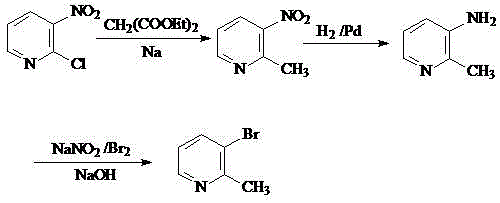
Figure 1
Abstract
Description
technical field
[0001] The invention belongs to the field of organic synthesis, and in particular relates to a preparation method of 2-methyl-3-bromopyridine. Background technique
[0002] 2-Methyl-3-bromopyridine is an important intermediate, mainly used as pharmaceutical intermediates, organic synthesis intermediates, organic solvents, and also used in the production of dyes, spices and pesticides.
[0003] At present, the main synthetic route of 2-methyl-3-bromopyridine is to use 2-methylpyridine as raw material, react with liquid bromine under the catalysis of Lewis acid, and its products are 3-bromo-2-methylpyridine and 5- A mixture of bromo-2-picoline, and 3-bromo-2-picoline and 5-bromo-2-picoline are difficult to separate. The shortcoming of this method is: the consumption of aluminum trichloride is big, and catalytic effect is poor; Bromine can carry out bromination in multiple positions, and by-product is many, and product yield is low; The boiling point of gained ...
Examples
Embodiment 1
[0019] (1) Preparation of 2-methyl-3-nitropyridine: Heat a mixture of diethyl malonate (80ml, 0.5mol) and sodium (2.53g, 0.11mol) in an oil bath to 90°C, stir for 1h, After heating up to 120°C and stirring for 45 min, it was cooled to room temperature. A toluene solution of 2-chloro-3-nitropyridine (15.6 g, 0.1 mol) was added dropwise. After the addition was complete, the reaction solution was heated to 110° C. for 1.5 h, cooled to room temperature and stirred for 15 h. The solvent was evaporated under reduced pressure, 6N hydrochloric acid (100ml) was added, the temperature was raised to reflux for 3.5h and then cooled to room temperature. Adjust the pH to alkaline with saturated sodium carbonate solution, extract with ethyl acetate, combine the base phases, dry over anhydrous sodium sulfate, and concentrate by suction filtration to obtain 2-methyl-3-nitropyridine with a molar yield of 92%. .
[0020] (2) Preparation of 2-methyl-3-aminopyridine: Dissolve 2-methyl-3-nitropyr...
Embodiment 2
[0023] (1) Preparation of 2-methyl-3-nitropyridine: Heat a mixture of diethyl malonate (80ml, 0.5mol) and sodium (2.76g, 0.12mol) in an oil bath to 90°C, stir for 1h, After heating up to 120°C and stirring for 45 min, it was cooled to room temperature. A toluene solution of 2-chloro-3-nitropyridine (15.6 g, 0.1 mol) was added dropwise. After the addition was complete, the reaction solution was heated to 110° C. for 1.5 h, cooled to room temperature and stirred for 15 h. The solvent was evaporated under reduced pressure, 6N hydrochloric acid (100ml) was added, the temperature was raised to reflux for 3.5h and then cooled to room temperature. Adjust the pH to alkaline with saturated sodium carbonate solution, extract with ethyl acetate, combine the base phases, dry over anhydrous sodium sulfate, and concentrate by suction filtration to obtain 2-methyl-3-nitropyridine with a molar yield of 95%. .
[0024] (2) Preparation of 2-methyl-3-aminopyridine: Dissolve 2-methyl-3-nitropyr...
Embodiment 3
[0027] (1) Preparation of 2-methyl-3-nitropyridine: Heat a mixture of diethyl malonate (80ml, 0.5mol) and sodium (2.99g, 0.13mol) in an oil bath to 90°C, stir for 1h, After heating up to 120°C and stirring for 45 min, it was cooled to room temperature. A toluene solution of 2-chloro-3-nitropyridine (15.6 g, 0.1 mol) was added dropwise. After the addition was complete, the reaction solution was heated to 110° C. for 1.5 h, cooled to room temperature and stirred for 15 h. The solvent was evaporated under reduced pressure, 6N hydrochloric acid (100ml) was added, the temperature was raised to reflux for 3.5h and then cooled to room temperature. Adjust the pH to alkaline with saturated sodium carbonate solution, extract with ethyl acetate, combine the base phases, dry over anhydrous sodium sulfate, and concentrate by suction filtration to obtain 2-methyl-3-nitropyridine with a molar yield of 95%. .
[0028] (2) Preparation of 2-methyl-3-aminopyridine: Dissolve 2-methyl-3-nitropyr...