

Method for synthesizing alogliptin intermediate
A technology for intermediates and compounds, applied in the field of intermediates for the production of dipeptidyl peptidase inhibitor alogliptin, can solve problems such as troublesome handling
Patent Information
- Authority / Receiving Office
- CN · China
- Current Assignee / Owner
- Publication Date
- 2015-11-25
Smart Images
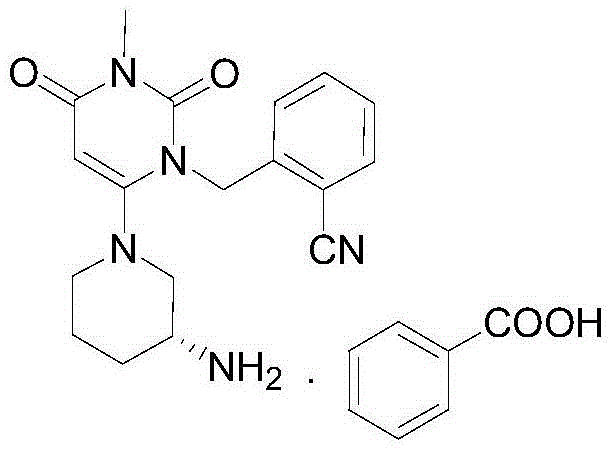
Figure 1 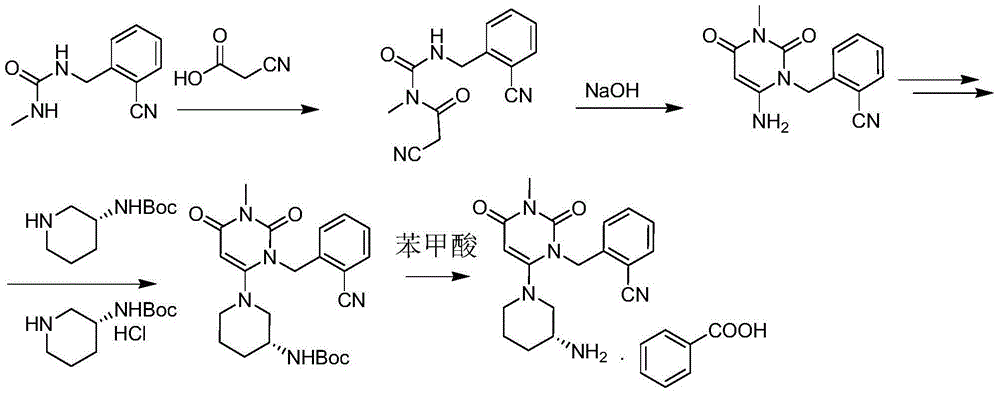
Figure 2 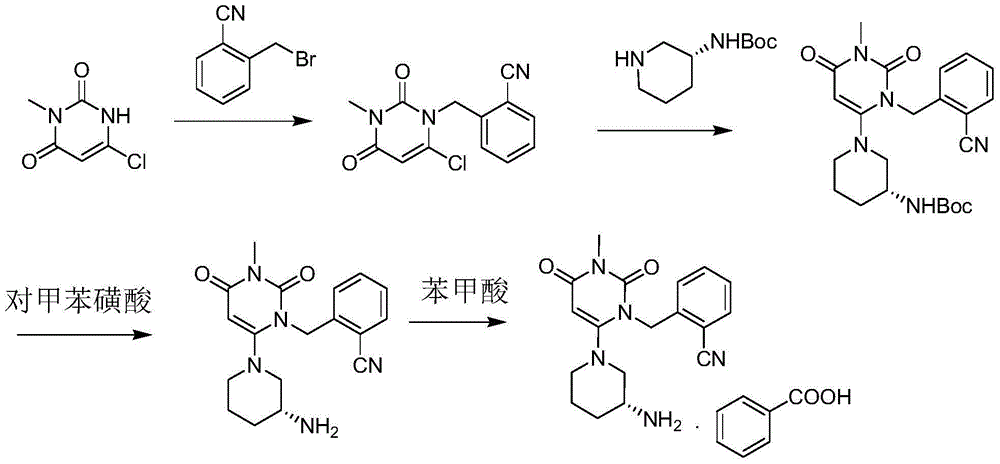
Figure 3
Abstract
Description
Technical field:
[0001] The present invention relates to a process for the synthesis of intermediates suitable for the production of the dipeptidyl peptidase inhibitor alogliptin. Background technique:
[0002] Diabetes mellitus is a series of clinical syndromes caused by absolute or relative insufficiency of insulin in the body. At present, the treatment of diabetes is mainly a combination of diet control combined with hypoglycemic drugs or insulin supplementation. People with type 2 diabetes cannot normally secrete or respond to insulin, which regulates blood sugar. Prolonged high blood sugar increases the risk of serious syndromes, including heart disease, nerve and kidney damage. At present, oral hypoglycemic drugs commonly used in clinical practice mainly include biguanides, sulfonylureas, thiazolidinediones, meglitinides, and α-glucosidase inhibitors. Dipeptidyl peptidase IV (DPP-IV) is one of the key enzymes that mainly promote the degradation and inactivation of gl...
Examples
Embodiment 1
[0040]
Embodiment 1-1
[0042] Add 6-chloro-3-methyluracil (30.2g, 0.19mol) and (R)-3-tert-butoxycarbonylaminopiperidine (37.4g, 0.19mol) into a 500ml reaction flask, add 180ml of acetonitrile, 36.0 g (0.28 mol) of N,N-diisopropylethylamine was stirred and heated to 78-82°C, and reacted for 10 hours. Stop heating, cool to 15-25°C, filter under reduced pressure, rinse the filter cake with 100ml of acetonitrile and drain to obtain 55.1g of off-white solid, yield: 90.8%. 1 HNMR(DMSO)δ: 10.57(br,1H), 6.87(d,1H), 4.79(s,1H), 3.59(dd,1H), 3.02(s,3H), 2.84~2.69(br,2H), 1.76~1.63(br,2H), 1.57~1.41(br,2H), 1.36(s,9H); 1.22~1.25(br,2H); MS + = 325.2.
Embodiment 1-2~1-12
[0044] Referring to Example 1-1, change the substituent R 2 , alkali, solvent and alkali and the mol ratio of I, yield result is as shown in table 1:
[0045] Table 1
[0046]
[0047]