

Alkali free glass
A technology of non-alkali glass and photoelastic constant, which is applied in the field of non-alkali glass, can solve the problems such as the deterioration of film properties, and achieve the effect of not easy to color unevenness, high strain point, and not easy to bend
Patent Information
- Authority / Receiving Office
- CN · China
- Patent Type
- Patents(China)
- Current Assignee / Owner
- Publication Date
- 2020-04-14
Smart Images
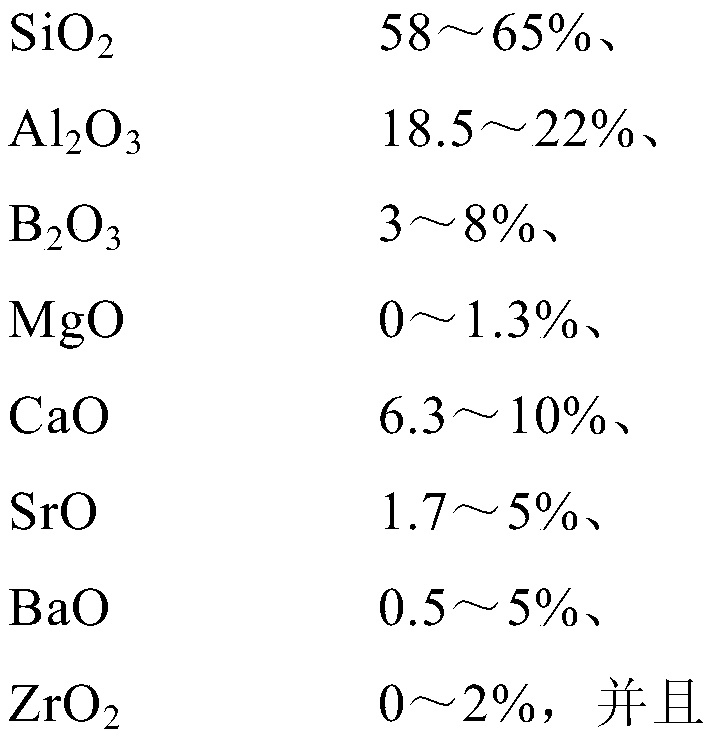
Figure 1 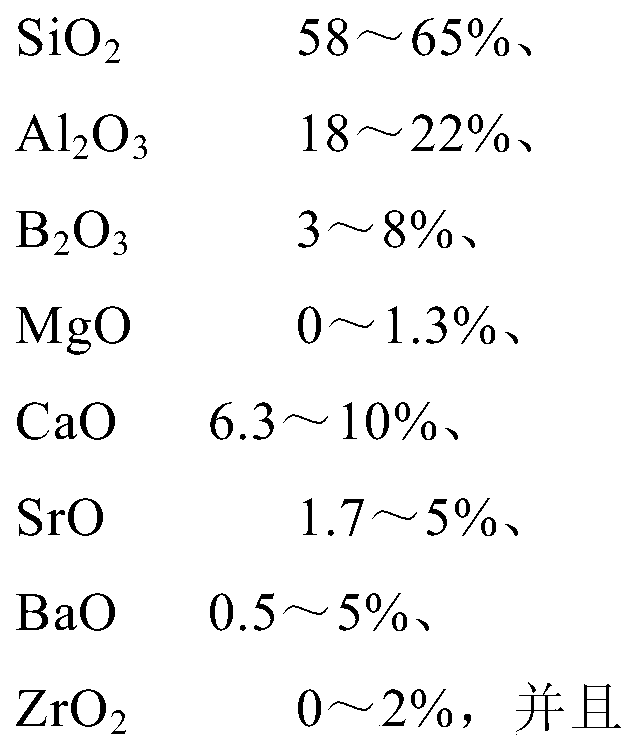
Figure 2 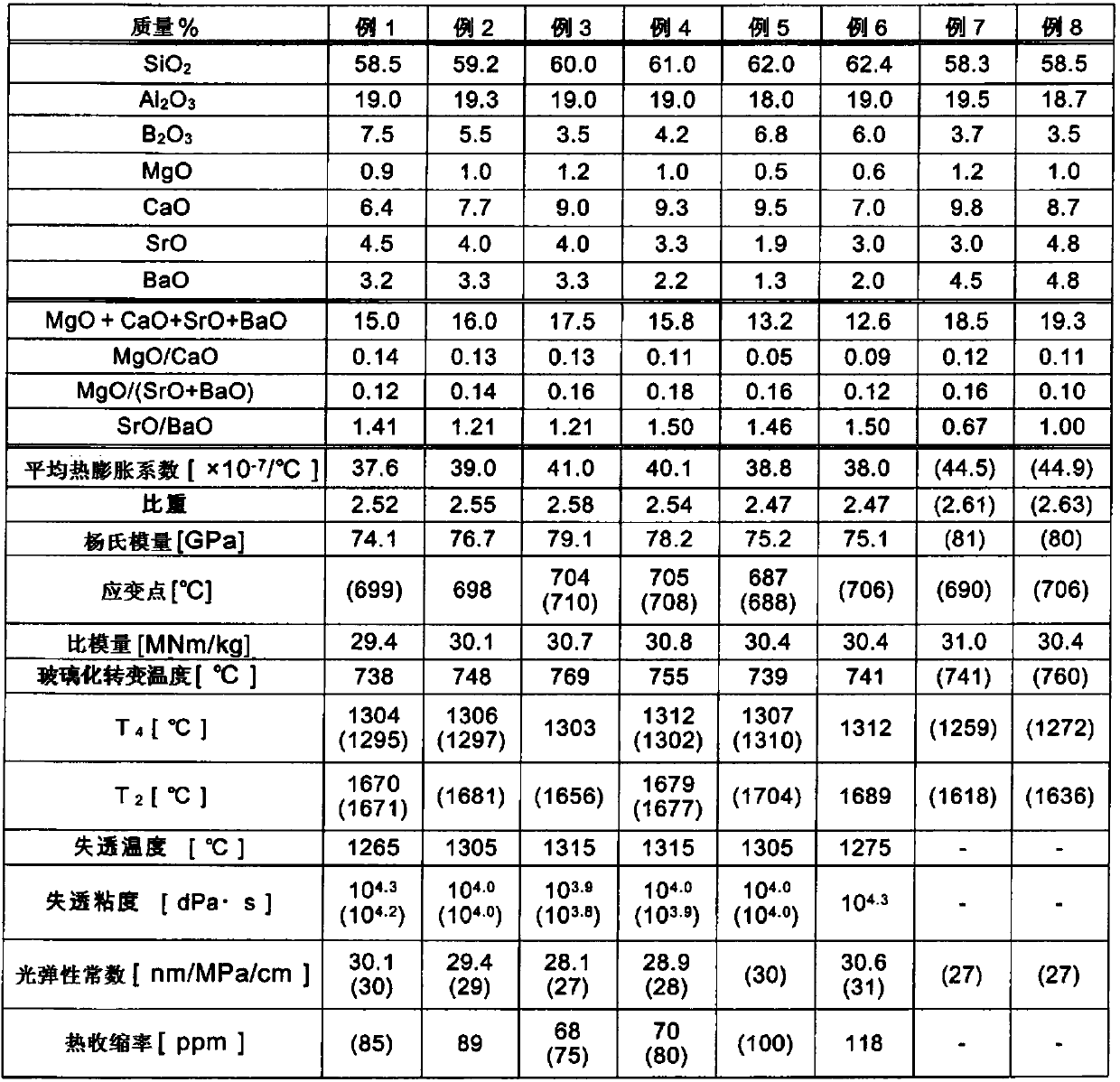
Figure 3
Abstract
Description
technical field
[0001] The present invention relates to alkali-free glass. More specifically, it relates to an alkali-free glass suitable as various substrate glasses for displays, substrate glasses for photomasks, etc., which does not substantially contain alkali metal oxides, and which can be formed by a float method or a fusion method. Background technique
[0002] Conventionally, various glass plates (glass substrates) for displays, especially glass used for glass plates on which thin films such as metals or oxides are formed on the surface, have required the following characteristics.
[0003] (1) When the glass contains an alkali metal oxide, the alkali metal ions diffuse into the thin film to degrade the film properties of the thin film. Therefore, it is required that the glass does not substantially contain alkali metal ions.
[0004] (2) When the glass sheet is exposed to high temperature in the film forming process, a high strain point is required in order to mini...
Examples
Embodiment
[0077] (Examples: Examples 1-6 and Examples 9-15, Comparative Examples: Examples 7-8)
[0078] Hereinafter, although an Example and a comparative example demonstrate this invention in detail, this invention is not limited to these Examples.
[0079] Raw materials of each component were prepared so that the glass composition became the target composition shown in Table 1 and Table 2 (glass composition (unit: mass %)), and melted at a temperature of 1600° C. for 1 hour using a platinum crucible. After melting, it was poured onto a carbon plate, held at the glass transition temperature + 30°C for 60 minutes, and then cooled to room temperature at 1°C per minute. The obtained glass was mirror-polished to obtain a glass plate, and various evaluations were performed.
[0080] In Tables 1 and 2, the average coefficient of thermal expansion at 50 to 350°C is shown (unit: ×10 -7 / ℃), specific gravity, Young's modulus (GPa), strain point (unit: ℃), glass transition temperature (unit:...