

Synthesis process for compound crizotinib
A technology for crizotinib and synthesis process, applied in the field of chemical medicine, can solve problems such as unfavorable industrial production, large usage of precious metals, waste of enantiomers, etc., and achieves easy control of total cost, low usage of catalyst, and total cost. high yield effect
Patent Information
- Authority / Receiving Office
- CN · China
- Current Assignee / Owner
- Publication Date
- 2016-09-07
- Estimated Expiration
- Not applicable · inactive patent
Smart Images
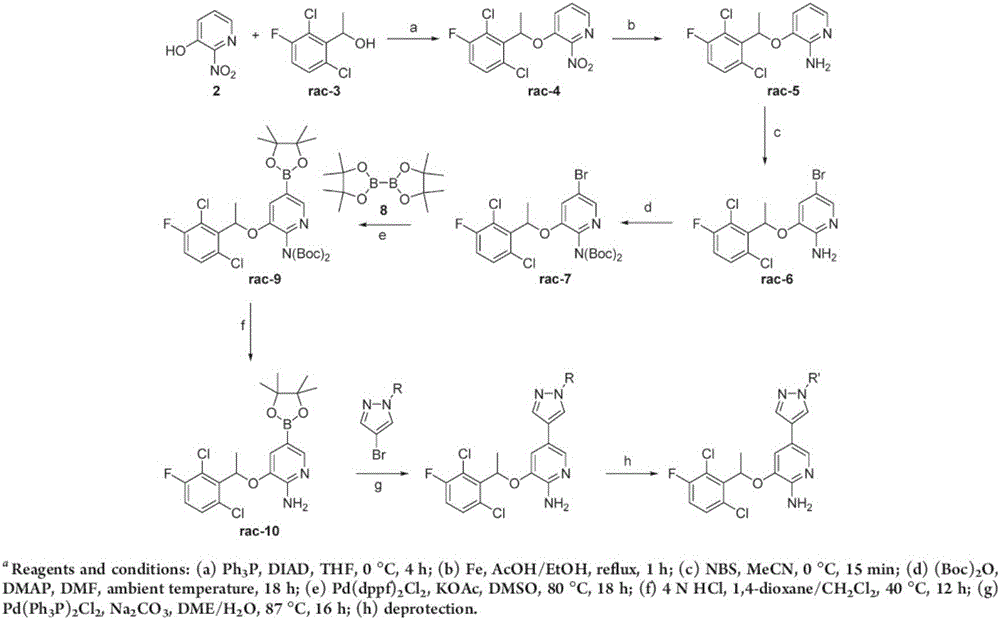
Figure 1 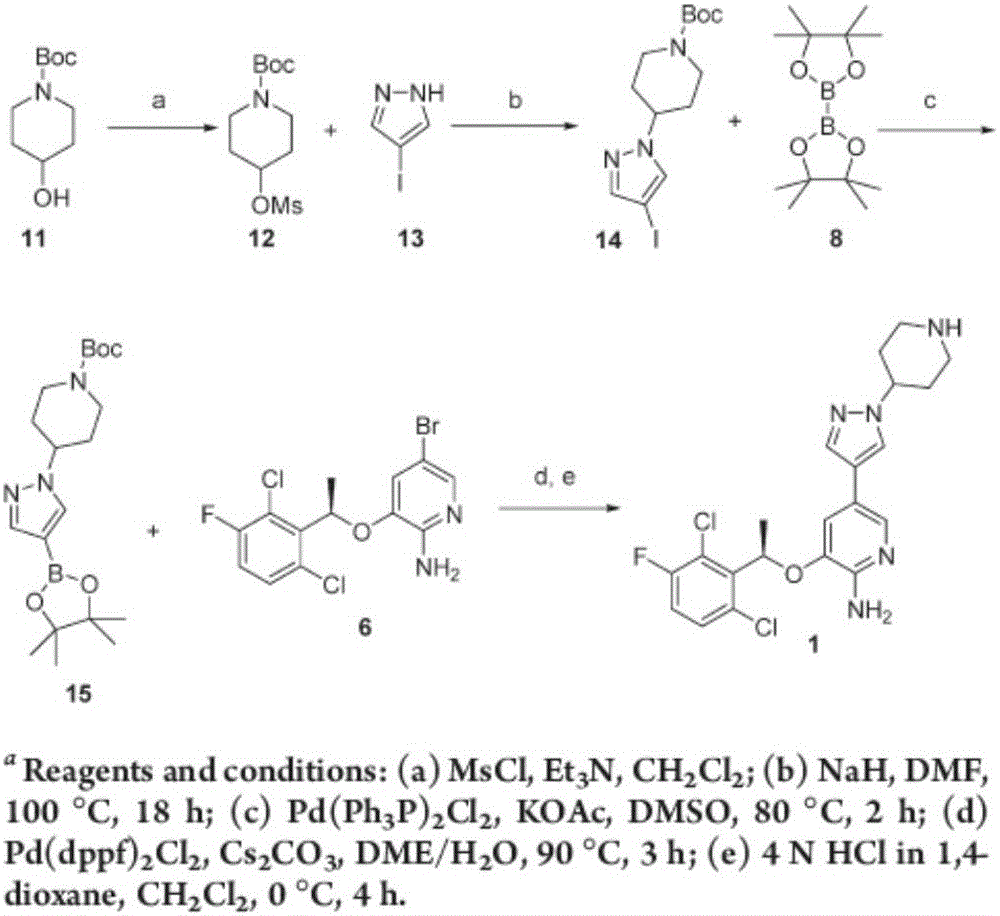
Figure 2 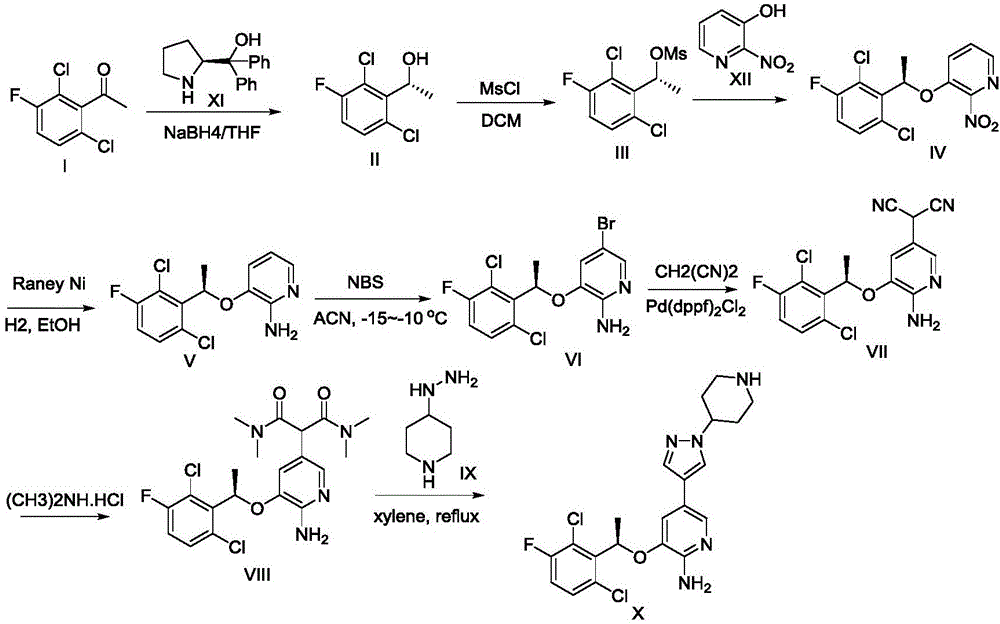
Figure 3
Abstract
Description
technical field
[0001] The invention relates to the technical field of chemistry and medicine, in particular to a synthesis process of a small molecule drug crizotinib, which is used for treating advanced non-small cell lung cancer. Background technique
[0002] The treatment of advanced non-small cell lung cancer (NSCLC) has entered a new era of individualized targeted therapy, and the therapy guided by targeted molecular markers has become a current research hotspot. Following the epidermal growth factor receptor (EGFR) mutation, echinoderm microtubule-associated protein 4 (EML4) and anaplastic lymphoma kinase (ALK) fusion gene, c-Met, Ros sarcoma oncogenic factor (ROS1), etc. The treatment of advanced NSCLC has a new target of guiding significance. Among them, the EML4-ALK fusion gene is caused by the insertion of the short arm of chromosome 2, which makes the kinase domains of the two EML4-ALK molecules combine with each other, and activates the downstream pathway throu...
Examples
Embodiment 1
[0039] (1) preparation of formula (II) compound
[0040]
[0041] Add formula (I) compound (20.7g, 0.1mol), tetrahydrofuran (200mL) and (S)-diphenylprolinol (2.53g, 0.01mol) in the reaction flask, stir at room temperature for 10min until the solid dissolves completely, use Cool to 1°C in an ice-water bath, add NaBH in batches 4 (4.5 g, 0.12 mol). After the addition was complete, the mixture was raised to room temperature and stirred overnight. TLC showed that the reaction of the raw materials was complete, and the reaction solution was poured into a half-saturated aqueous ammonium chloride solution, stirred for 30 minutes, extracted with ethyl acetate, and the organic phases were combined, and successively washed with 1N HCl, 5% NaHCO 3 Washed with saturated brine, dried over anhydrous sodium sulfate, concentrated acid under reduced pressure to dryness, the yield was quantitative, and the remaining light yellow oil was directly used in the next reaction.
[0042] The com...
Embodiment 2
[0073] (1) preparation of formula (II) compound
[0074]
[0075] Add formula (I) compound (20.7g, 0.1mol), methanol (200mL) and (S)-diphenylprolinol (25.3g, 0.1mol) in the reaction flask, stir at room temperature for 10min until the solid dissolves completely, and use Cool in an ice-water bath to 0-5°C, add NaBH in batches 4 (9 g, 0.24 mol). After the addition was complete, the mixture was raised to room temperature and stirred overnight. TLC showed that the reaction of the raw materials was complete, and the reaction solution was poured into a half-saturated aqueous ammonium chloride solution, stirred for 30 minutes, extracted with ethyl acetate, and the organic phases were combined, and successively washed with 1N HCl, 5% NaHCO 3 Washed with saturated brine, dried over anhydrous sodium sulfate, concentrated acid under reduced pressure to dryness, and the residue was purified by column chromatography to obtain a colorless oil, which was shown to be a racemic product by ...
Embodiment 3
[0077] (1) preparation of formula (II) compound
[0078]
[0079] Add formula (I) compound (20.7g, 0.1mol), 2-MeTHF (200mL) and (S)-diphenylprolinol (12.65g, 0.05mol) to the reaction flask, stir at room temperature for 10min until the solid is completely dissolved , cooled to 0°C with an ice-water bath, and added KBH in batches 4 (13.6 g, 0.36 mol). After the addition was complete, the mixture was raised to room temperature and stirred overnight. TLC showed that the reaction of the raw materials was complete, and the reaction solution was poured into a half-saturated aqueous ammonium chloride solution, stirred for 30 minutes, extracted with ethyl acetate, and the organic phases were combined, and successively washed with 1N HCl, 5% NaHCO 3 Wash with saturated brine, dry over anhydrous sodium sulfate, concentrate acid to dryness under reduced pressure, and purify the residue by column chromatography to obtain a colorless oil, which is 99.5% ee by chiral HPLC.