
A kind of preparation method of indoledione compound
A technology for indole dione and compound, which is applied in the field of pharmaceutical and organic chemistry synthesis, can solve the problems of complicated operation, influence on large-scale production and wide application, and high reaction temperature, achieves simple operation, good application prospect, and is suitable for large-scale production. Effect
Patent Information
- Authority / Receiving Office
- CN · China
- Patent Type
- Patents(China)
- Current Assignee / Owner
- Publication Date
- 2019-06-04
- Estimated Expiration
- Not applicable · inactive patent
Smart Images
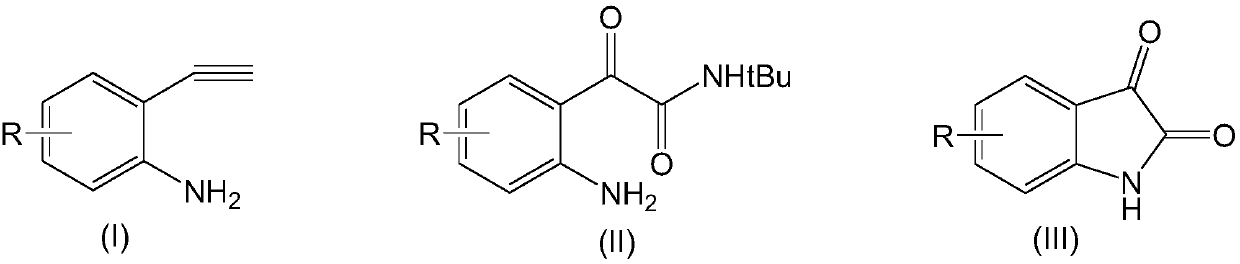
Figure 1 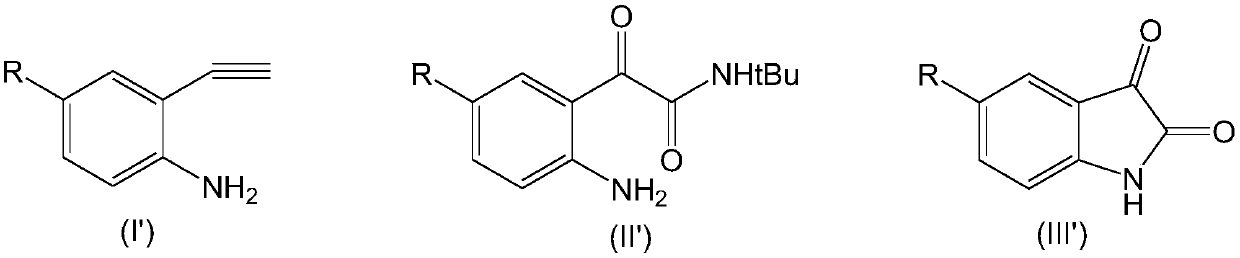
Figure 2 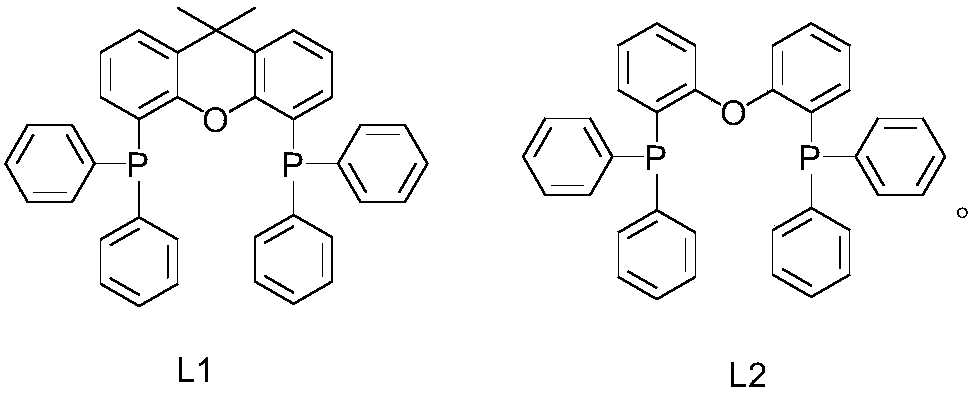
Figure 3
Abstract
Description
technical field
[0001] The invention relates to a preparation method of a biologically active intermediate compound, more particularly to a preparation method of a drug intermediate indoledione compound, which belongs to the technical field of medicine and organic chemical synthesis. Background technique
[0002] The indoledione structure widely exists in natural products, drugs and dyes, and can be used to synthesize a variety of heterocyclic compounds, such as indole and other fused heterocyclic structures, and is a very important drug synthesis intermediate.
[0003] The synthesis method of indoledione has been paid more and more attention by scientists, and people have carried out a lot of research on it, and achieved certain results. So far, the synthesis methods of indoledione include: oxidation of indole, intramolecular oxidation and so on. However, although there are many routes to obtain indoledione, these methods still have some defects, for example, the yield is ...
Examples
Embodiment 1
[0034]
[0035] Add 20ml dimethyl sulfoxide and 1mmol compound of formula (I-1), 1.5mmol tert-butylamine, 0.1mmol rhodium triphenylphosphinecarbonyl acetylacetonate, 0.1mmol ligand L1, 2mmol bis(trifluoroacetic acid) in the reactor Iodobenzene and 1 mmol triethylamine were reacted with stirring at 60°C for 8 hours. After the reaction was completed, the reaction mixture was concentrated and evaporated to dryness, the residue was dissolved in chloroform, washed with water, organically dried over anhydrous sodium sulfate, filtered and evaporated to remove the solvent, and the resulting residue was separated by silica gel column chromatography , the above-mentioned compound of formula (II-1) was obtained with a yield of 96.2%. 1H NMR (CDCl 3 ,400MHz): δ9.58(s,1H,Ar-H); 8.12(d,8Hz,1H,Ar-H); 7.03(br s,2H,NH 2 ); 6.79(br s,1H,CONH); 6.70(d,8Hz,1H,Ar-H); 1.40(s,9H,C(CH 3 ) 3 ).
[0036] Dissolve the obtained compound of formula (II-1) in 20 ml of tetrahydrofuran, add aqueous h...
Embodiment 2
[0038]
[0039] Add 20ml dimethyl sulfoxide and 1mmol compound of formula (I-2), 1.5mmol tert-butylamine, 0.15mmol rhodium triphenylphosphinecarbonyl acetylacetonate, 0.2mmol ligand L1, 3mmol bis(trifluoroacetic acid) in the reactor Iodobenzene and 1.5 mmol triethylamine were stirred and reacted at 50°C for 8 hours. After the reaction was completed, the reaction mixture was concentrated and evaporated to dryness, the residue was dissolved in chloroform, washed with water, organically dried over anhydrous sodium sulfate, filtered and evaporated to remove the solvent, and the resulting residue was separated by silica gel column chromatography , the compound of formula (II-2) was obtained with a yield of 95.3%. 1 H NMR (CDCl 3,400MHz): δ8.44(s,1H,Ar-H); 7.18(d,8Hz,1H,Ar-H); 6.71(br s,1H,CONH); 6.59(d,8Hz,1H,Ar- H); 6.23 (brs,2H,NH 2 ); 1.42(s,9H,C(CH 3 ) 3 ).
[0040] Dissolve the obtained compound of formula (II-2) in 20ml of tetrahydrofuran, add aqueous hydrochloric ac...
Embodiment 3
[0042]
[0043] In the reactor, add 20ml dimethyl sulfoxide and 1mmol compound of formula (I-3), 1.5mmol tert-butylamine, 0.1mmol rhodium triphenylphosphinecarbonyl acetylacetonate, 0.1mmol ligand L2, 2mmol bis(trifluoroacetic acid) Iodobenzene and 1.5 mmol triethylamine were stirred and reacted at 60°C for 8 hours. After the reaction was completed, the reaction mixture was concentrated and evaporated to dryness, the residue was dissolved in chloroform, washed with water, organically dried over anhydrous sodium sulfate, filtered and evaporated to remove the solvent, and the resulting residue was separated by silica gel column chromatography , the compound of formula (II-3) was obtained with a yield of 93.8%. 1 H NMR (CDCl 3 ,400MHz):δ8.14(s,1H,Ar-H); 7.12(d,8Hz,1H,Ar-H); 6.61(br s,1H,CONH); 6.56(d,8Hz,1H,Ar- H); 6.08 (brs,2H,NH 2 ); 2.19(s,3H,CH 3 ); 1.41(s,9H,C(CH 3 ) 3 ).
[0044] Dissolve the obtained compound of formula (II-2) in 20ml of tetrahydrofuran, add aque...