
Aryl pyridone compound preparation method
A technology of aryl pyridone and compound, which is applied in the field of pharmaceutical and organic chemical synthesis, can solve the problems affecting large-scale production and application, low yield, complicated operation, etc., and achieve the effect of good application prospect
Patent Information
- Authority / Receiving Office
- CN · China
- Current Assignee / Owner
- Publication Date
- 2017-06-30
- Estimated Expiration
- Not applicable · inactive patent
Smart Images
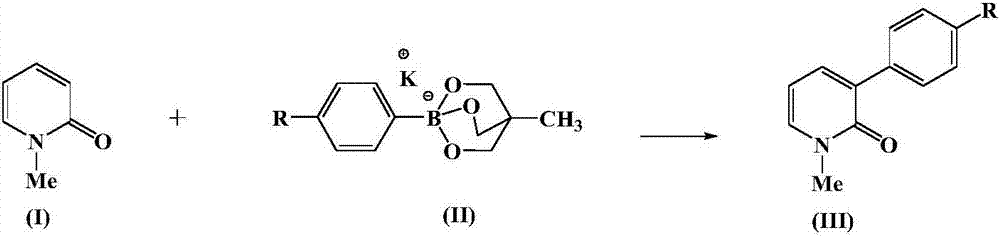
Figure 1 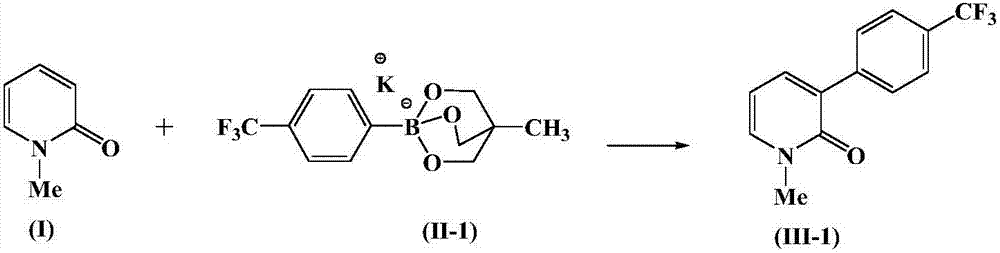
Figure 2 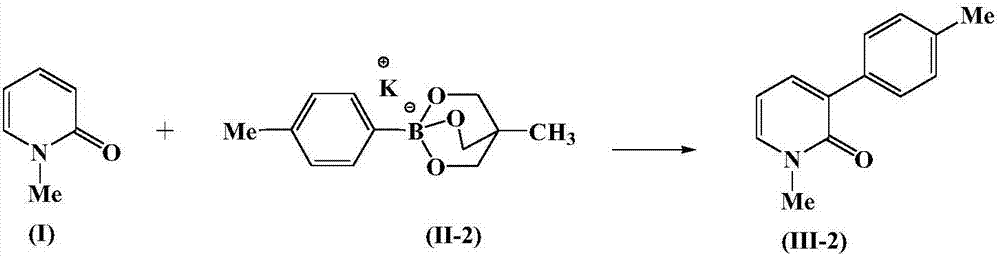
Figure 3
Abstract
Description
technical field
[0001] The invention relates to a preparation method of a biologically active intermediate compound, more particularly to a preparation method of a pharmaceutical intermediate aryl pyridone compound, which belongs to the technical field of medicine and organic chemical synthesis. Background technique
[0002] The structure of arylpyridone widely exists in natural active compounds and medicines, and this kind of compounds have very important applications in the pharmaceutical industry as synthetic intermediates. The preparation method of aryl pyridone compounds has been paid more and more attention by scientists, and a lot of researches have been done on it. So far, the preparation methods of arylpyridones have been reported in the prior art, such as "Iron catalyzedregio-selective directarylation at C-3position of N-alkyl-2-pyridone" reported by Atanu Modak et al. However, these existing methods still have some defects, such as low product yield, complicated ...
Examples
Embodiment 1
[0025]
[0026] At 0°C, add 1 mmol N-methyl-2-pyridone, 1.2 mmol formula (II-1) compound, 0.1 mmol bis(1,5-cyclooctadiene) rhodium tetrafluoroborate to the reactor , 0.1 mmol of Ligand L, 8 ml of N,N-dimethylformamide and 2 ml of toluene, stirred at 60°C for 6 hours. After the reaction was completed, the reaction mixture was poured into water and extracted with ethyl acetate, the organic phase was combined to remove the solvent, and the resulting residue was separated by silica gel column chromatography to obtain the compound of formula (III-1) with a yield of 89.5%. 1 HNMR (CDCl 3 ,400MHz): δ3.61(s,3H),6.27(dd,J=6.9,6.9Hz,1H),7.35(dd,J=2.0,6.9Hz,1H),7.53(dd,J=2.0,6.9 Hz, 1H), 7.62 (d, J=8.2Hz, 2H), 7.81 (d, J=8.2Hz, 2H).
Embodiment 2
[0028]
[0029] At 0°C, add 1 mmol N-methyl-2-pyridone, 1.5 mmol formula (II-2) compound, 0.1 mmol bis(1,5-cyclooctadiene) rhodium tetrafluoroborate to the reactor , 0.1 mmol of Ligand L, 6 ml of N,N-dimethylformamide and 4 ml of toluene, stirred at 60°C for 6 hours. After the reaction was completed, the reaction mixture was poured into water and extracted with ethyl acetate, the organic phase was combined to remove the solvent, and the resulting residue was separated by silica gel column chromatography to obtain the compound of formula (III-2) with a yield of 85.2%. 1 HNMR (CDCl 3 ,400MHz): δ2.37(s,3H),3.60(s,3H),6.22(dd,J=6.9,6.9Hz,1H),7.20(d,J=7.9Hz,2H),7.28(dd, J=2.0, 6.9Hz, 1H), 7.46(dd, J=2.0, 6.9Hz, 1H), 7.59(d, J=7.9Hz, 2H).
Embodiment 3
[0031] At a temperature of 0°C, 1 mmol of N-methyl-2-pyridone, 1.2 mmol of the compound of formula (II-1), 0.1 mmol of bis(1,5-cyclooctadiene) rhodium chloride, 0.1 mmol of Ligand L, 8 ml of N,N-dimethylformamide and 2 ml of toluene were stirred at 60°C for 6 hours. After the reaction was completed, the reaction mixture was poured into water and extracted with ethyl acetate, the organic phase was combined to remove the solvent, and the resulting residue was separated by silica gel column chromatography to obtain the compound of formula (III-1) with a yield of 86.7%.