
Synthesis method of medical intermediate phenanthridone compound
A synthesis method and compound technology, applied in the field of synthesis of phenanthridone compounds, can solve the problems of high cost, complicated operation, environmental pollution, etc., and achieve the effect of good application prospects
Patent Information
- Authority / Receiving Office
- CN · China
- Current Assignee / Owner
- Publication Date
- 2017-08-18
- Estimated Expiration
- Not applicable · inactive patent
Smart Images
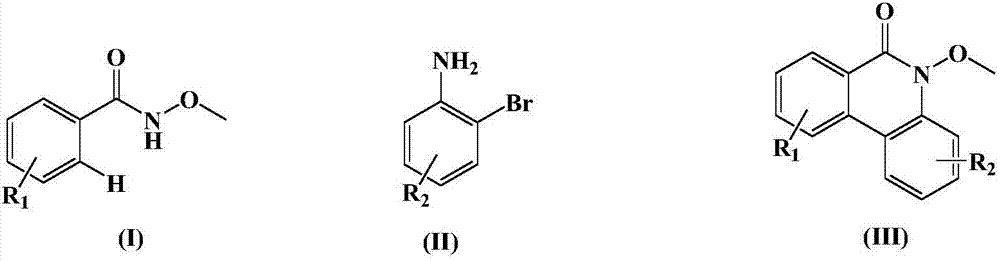
Figure 1 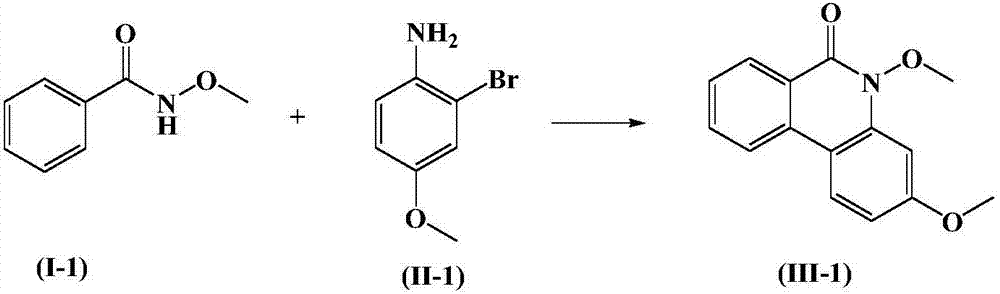
Figure 2 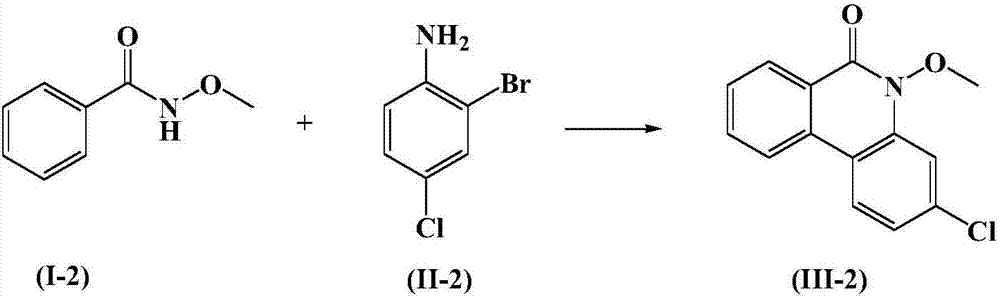
Figure 3
Abstract
Description
technical field
[0001] The present invention relates to a kind of synthetic method of pharmaceutical intermediate, more particularly relate to a kind of synthetic method of the phenanthridone compound as pharmaceutical intermediate. Background technique
[0002] Phenanthridone structure exists in various biologically active molecules, and is one of the important skeleton structures of many anti-tumor active compounds and compounds for treating mental diseases. Phenanthridone compounds, as intermediates in drug synthesis, can be expanded and modified through a variety of reactions to obtain biologically active compounds, which play an important role in organic chemical synthesis.
[0003] In recent years, more and more attention has been paid to the development of synthetic methods of phenanthridone compounds, and a lot of research has been carried out on it, and some new synthetic routes and methods have been obtained. So far, a variety of synthetic methods related to phena...
Examples
Embodiment 1
[0024]
[0025] Under the protection of an inert gas, add 100ml of mixed organic solvent of acetic acid and acetonitrile with a volume ratio of 2:1 in the reactor, add 10mmol of the above formula (I-1) compound, 12mmol of the above formula (II-1) compound, 1 mmol catalyst copper trifluoromethanesulfonate, 1 mmol cocatalyst, 20 mmol bis(trifluoroacetic acid) iodobenzene, and then add 15 mmol isoamyl nitrite to the reaction solution. While stirring, the temperature was raised to 50° C., and the reaction was stirred at this temperature for 8 hours. After the reaction was completed, all volatiles were removed in vacuo, the product was extracted with ethyl acetate, the solvent was removed from the organic phase, and the resulting residue was separated by 300-400 mesh silica gel column chromatography, and the elution solvent was petroleum ether and acetic acid at a volume ratio of 4:1. The mixture of ethyl esters was used to obtain the compound of formula (III-1) with a yield of ...
Embodiment 2
[0027]
[0028] Under the protection of an inert gas, add 10ml of a mixed organic solvent of acetic acid and acetonitrile with a volume ratio of 2:1 in the reactor, and add 1mmol of the above formula (I-2) compound and 1.2mmol of the above formula (II-2) compound to it successively , 0.1 mmol catalyst copper trifluoromethanesulfonate, 0.1 mmol cocatalyst, 2 mmol bis(trifluoroacetic acid) iodobenzene, and then add 1.5 mmol isoamyl nitrite to the reaction solution. While stirring, the temperature was raised to 50° C., and the reaction was stirred at this temperature for 8 hours. After the reaction was completed, all volatiles were removed in vacuo, the product was extracted with ethyl acetate, the solvent was removed from the organic phase, and the resulting residue was separated by 300-400 mesh silica gel column chromatography, and the elution solvent was petroleum ether and acetic acid at a volume ratio of 4:1. The mixture of ethyl esters can obtain the compound of formula ...
Embodiment 3
[0030]
[0031] Under the protection of an inert gas, add 10ml of a mixed organic solvent of acetic acid and acetonitrile with a volume ratio of 2:1 in the reactor, and add 1mmol of the above formula (I-3) compound and 1.2mmol of the above formula (II-3) compound to it successively , 0.12mmol catalyst copper trifluoromethanesulfonate, 0.12mmol cocatalyst, 2mmol bis(trifluoroacetic acid) iodobenzene, and then add 1.5mmol isoamyl nitrite in the reaction solution. While stirring, the temperature was raised to 50° C., and the reaction was stirred at this temperature for 8 hours. After the reaction was completed, all volatiles were removed in vacuo, the product was extracted with ethyl acetate, the solvent was removed from the organic phase, and the resulting residue was separated by 300-400 mesh silica gel column chromatography, and the elution solvent was petroleum ether and acetic acid at a volume ratio of 4:1. The mixture of ethyl esters was used to obtain the compound of fo...