
Adjustable overlapped community discovery method based on label propagation
A tag propagation and community discovery technology, applied in the field of adjustable overlapping community discovery based on tag propagation, can solve problems such as inability to effectively discover overlapping community structures, and achieve the effect of easy implementation, easy realization, and simple principle
Patent Information
- Authority / Receiving Office
- CN · China
- Patent Type
- Applications(China)
- Current Assignee / Owner
- Publication Date
- 2017-11-24
- Estimated Expiration
- Not applicable · inactive patent
Smart Images
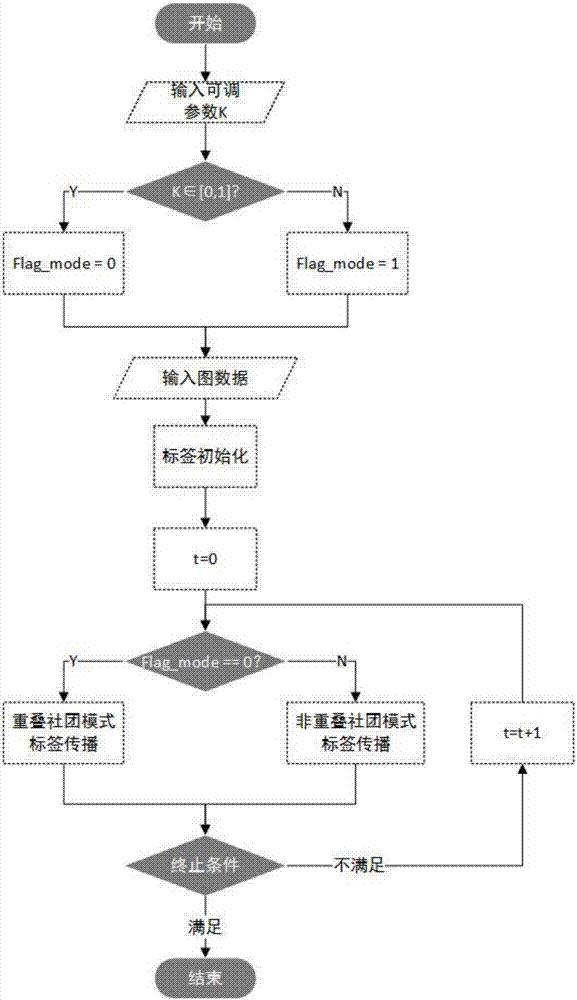
Figure 1 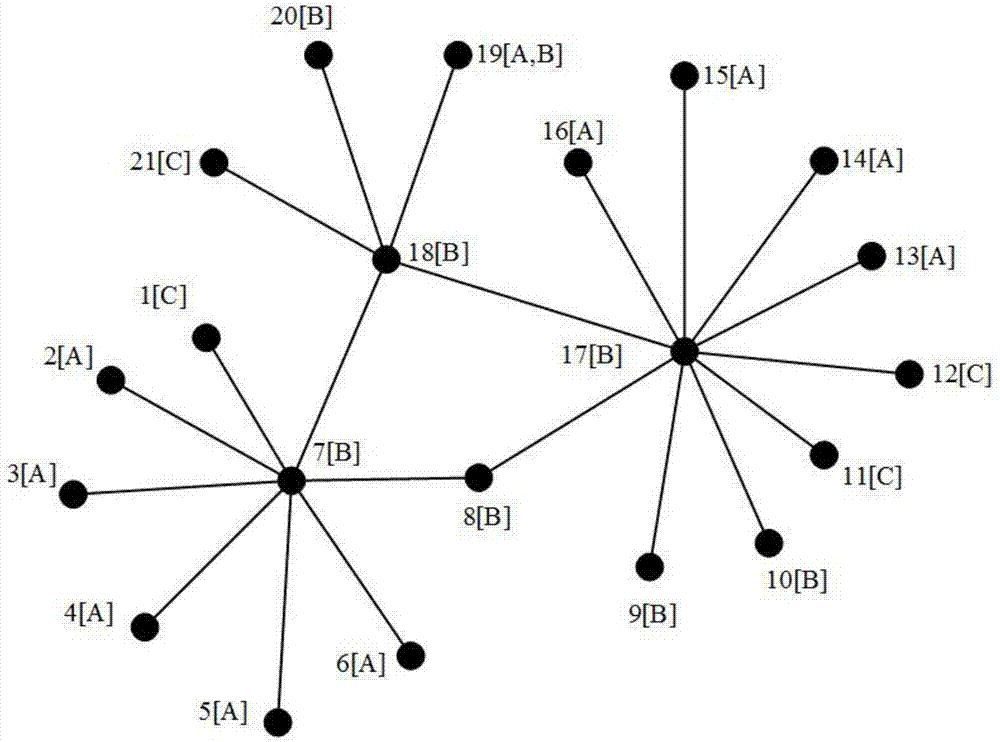
Figure 2 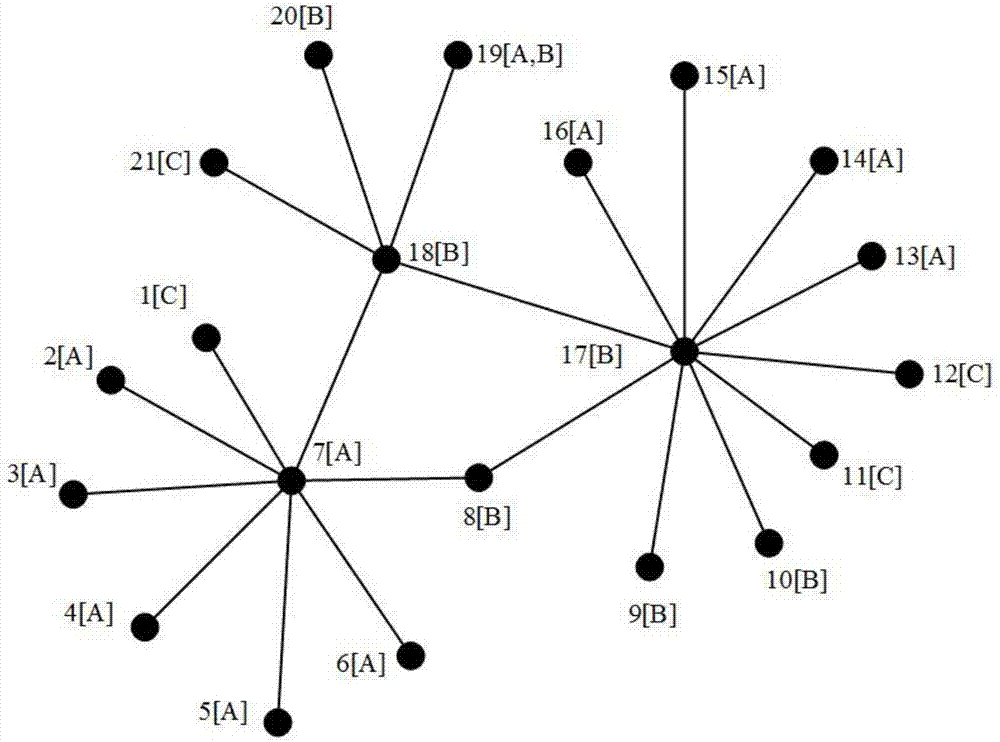
Figure 3
Abstract
Description
technical field
[0001] The invention relates to the technical field of social networks, in particular to an adjustable overlapping community discovery method based on tag propagation. Background technique
[0002] With the continuous development of computer technology and the Internet, devices such as computers, smartphones, and sensors generate data all the time. Ordinary people have more and more opportunities to access the Internet, and all walks of life are also taking advantage of the convenience brought by the Internet. These data grow exponentially, resulting in massive amounts of data. Most of the various information in life and production can be transformed into a network structure or a graph (Graph) structure, that is to say, network structures are everywhere. Newman summarized the networks in real life into four categories; communication networks, such as the World Wide Web of Information, the collection retrieval network of the University of Electronic Science ...
Examples
Embodiment 1
[0056] An example is given below to describe the label propagation process in detail. figure 2 is an intermediate state of an example network in the label propagation process, figure 2 The shown network contains 21 nodes and 21 edges, and the input parameter K=0.6. Propagate labels in a certain order, (7,17,18,3,2,7,11…). The label propagation of node 7 is performed first, and the labels contained in the neighbor nodes of node 7 are {C,A,A,A,A,A,A,B}. The label with the largest number is A, the number is 6; the number of labels B and C are both 1. because Where |B| represents the number of B labels, and |A| is the same, so label B does not meet the conditions and cannot be added to the label group of node 7. Therefore, it cannot join the label group of node 7 either. The label of node 7 is updated to A, such as image 3 shown. Continue to execute the label propagation of the node 17 in a specific order, and delete the labels in the label group of the node 17. The l...