
High-molecular compound containing space charge transfer polymer sensitizer and resonance structure fused ring unit and organic electroluminescent device
A polymer compound and resonance structure technology, applied in electrical components, electrical solid-state devices, semiconductor devices, etc., can solve the problems of reduced fluorescence quantum yield, red shift of luminescent spectrum emission, and large degree of electron cloud delocalization
Patent Information
- Authority / Receiving Office
- CN · China
- Patent Type
- Applications(China)
- Current Assignee / Owner
- Publication Date
- 2021-11-26
Smart Images
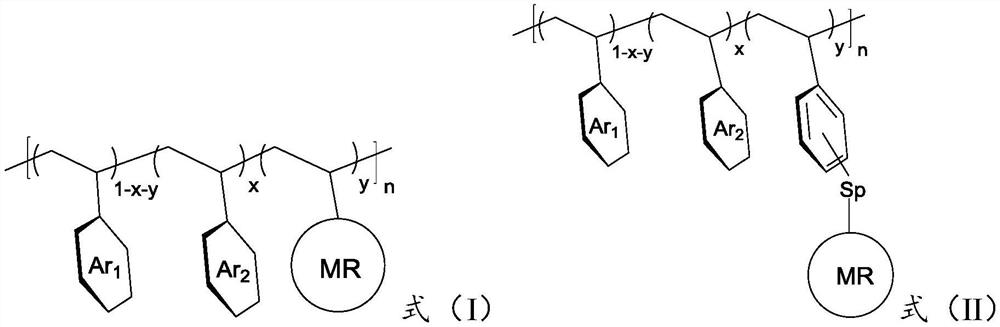
Figure 1 
Figure 2 
Figure 3
Abstract
Description
technical field
[0001] The invention belongs to the technical field of organic luminescent materials, and in particular relates to a polymer compound containing a space charge transfer polymer sensitizer and a resonance structure condensed ring unit and an organic electroluminescence device. Background technique
[0002] Polymeric light-emitting materials are the basis for the fabrication of low-cost and large-area organic light-emitting diodes (OLEDs) based on solution processing. According to different luminescent mechanisms, polymer luminescent materials can be divided into three types: fluorescent polymers, phosphorescent polymers and thermally activated delayed fluorescence (TADF) polymers. Among them, fluorescent polymers are limited by the spin statistics theory, and the fluorescent unit can only use singlet excitons accounting for 25% of the total number of excitons, so its luminous efficiency is low. Due to the spin-orbit coupling effect of heavy metals, phosphores...
Examples
preparation example Construction
[0089]The present invention also provides a method for preparing the polymer compound containing the space charge transfer polymer sensitizer and the resonance structure condensed ring unit, comprising: in a protective atmosphere, the monomer described in formula (III), the formula The monomer shown in (IV) reacts with the monomer shown in the formula (V) and / or the monomer shown in the formula (VI) through an initiator in the first solvent to obtain a polymer compound; The mol ratio of the monomer shown in (III), the monomer shown in formula (IV) and the monomer shown in formula (V) and / or the monomer shown in formula (VI) is (1-x-y): x:y;
[0090]
[0091] Among them, x, y, Both Sp and Sp are the same as above, and will not be repeated here.
[0092] In a protective atmosphere, the monomer shown in the formula (III), the monomer shown in the formula (IV) and the monomer shown in the formula (V) and / or the monomer shown in the formula (VI) in the first The reaction is ...
Embodiment 1
[0110]
[0111] Under argon atmosphere, add 0.948mmol MD1, 0.050mmol MA1, 0.002mmol MF1 and 0.020mmol AIBN to a 25mL Schlenk bottle, add 10mL tetrahydrofuran (THF) into the bottle, raise the temperature to 50°C, and stir the reaction under argon protection After 48 hours, it was cooled to room temperature, the reaction liquid was poured into acetone, and the precipitated solid was filtered, vacuum-dried, dissolved in dichloromethane, settled in methanol, and vacuum-dried again to obtain the desired polymer compound.
[0112] The polymer compound obtained in Example 1 has a number average molecular weight of 35,700 g / mol and a degree of dispersion (PDI) of 1.78.
Embodiment 2
[0114]
[0115] Under argon atmosphere, add 0.948mmol MD2, 0.050mmol MA2, 0.002mmol MF2 and 0.020mmol AIBN to a 25mL Schlenk bottle, add 10mL tetrahydrofuran (THF) into the bottle, raise the temperature to 50°C, and stir the reaction under argon protection After 48 hours, it was cooled to room temperature, the reaction liquid was poured into acetone, and the precipitated solid was filtered, vacuum-dried, dissolved in dichloromethane, settled in methanol, and vacuum-dried again to obtain the desired polymer compound.
[0116] The polymer compound obtained in Example 2 has a number average molecular weight of 23,500 g / mol and a degree of dispersion (PDI) of 2.01.