
Preparation method for Xeljanz related substance
A technology of tofacitinib and related substances, which is applied in the field of medicinal chemistry, can solve the problems of high cost and limited industrial application, and achieve the effects of simple operation, mild reaction conditions and high yield
Patent Information
- Authority / Receiving Office
- CN · China
- Current Assignee / Owner
- Publication Date
- 2018-02-16
- Estimated Expiration
- Not applicable · inactive patent
Smart Images
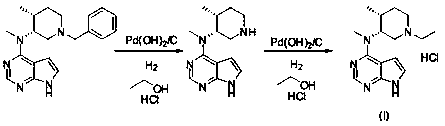
Figure 1 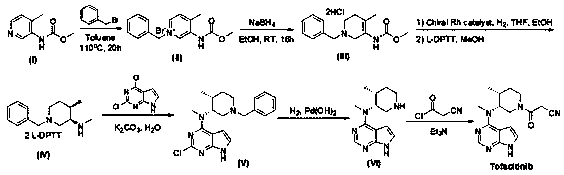
Figure 2 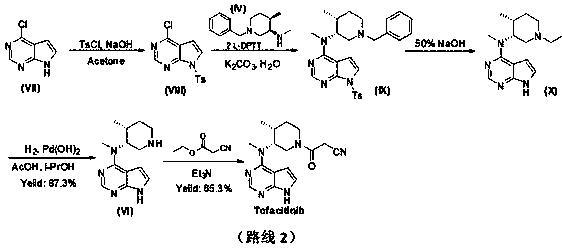
Figure 3
Abstract
Description
technical field
[0001] The invention relates to the field of medicinal chemistry, in particular to a method for preparing related substances of tofacitinib citrate, a medicine for treating rheumatoid arthritis. Background technique
[0002] Rheumatoid arthritis is an autoimmune disease in which the body's immune system mistakenly attacks healthy tissue, causing inflammation in the joints and surrounding tissues. Tofacitinib citrate is a drug for the treatment of rheumatoid arthritis developed by Pfizer Pharmaceuticals of the United States. Its trade name is Xeljanz. Adult patients with severely active rheumatoid arthritis (RA).
[0003] Pfizer announced two preparation routes in patent WO2007012953 (see route 1 and route 2). The route shown in route 1 uses methyl (4-methylpyridin-3-yl) carbamate (compound I) as the starting material, first introduces a benzyl group to obtain compound II, and reduces II with sodium borohydride to obtain compound III. After chiral rhodium c...
Examples
Embodiment 1
[0032] Add N-methyl-N-((3R,4R)-4-methylpiperidin-3-yl)-7H-pyrrolo[2,3-d]pyrimidine-4 to a 250ml three-necked flask at 25°C -Amine hydrochloride (6.0g, 21.3mmol), add methanol (60ml), stir to dissolve, then add formic acid (2.2g, 32.0mmol), acetaldehyde (10.8g, 213mmol), then add NaBH in three batches 4 (1.6g, 42.6mmol), TLC (DCM:MeOH=10:1) after 1h reaction, the reaction was complete. The reaction solution was concentrated to dryness, water (60ml) and EA (60ml) were added to the concentrate, the layers were stirred, the water layer was extracted once with EA (60ml), the organic phase was combined, and 35% HCl / ethanol solution (12ml) was added , a large amount of solids were precipitated, the mixture was stirred at room temperature for 1 h, filtered, the filter cake was collected, and vacuum-dried at 45° C. for 16 h to obtain 5.1 g of white solids with a yield of 75.7%. 1 HNMR (DMSO- d6 , 400MHz) δ 12.97(brs, 1H), 11.46(br,1H), 8.49(s, 1H), 7.50(s, 1H), 6.94(s, 1H), 5.32(m, 1...
Embodiment 2
[0034] Add N-methyl-N-((3R,4R)-4-methylpiperidin-3-yl)-7H-pyrrolo[2,3-d]pyrimidine-4 to a 250ml three-necked flask at 25°C -Amine hydrochloride (6.0g, 21.3mmol), add ethanol (60ml), stir to dissolve, then add acetic acid (2.2g, 32.0mmol), acetaldehyde (10.8g, 213mmol), then add NaBH in three batches 4 (1.6g, 42.6mmol), TLC (DCM:MeOH=10:1) after 1h reaction, the reaction was complete. Concentrate the reaction solution to dryness, add water (60ml) and EA (60ml) to the concentrate, stir and separate the layers, extract the water layer with EA (60ml) once more, combine the organic phases, add 35% HCl / ethanol solution (12ml) , a large amount of solids were precipitated, the mixture was stirred at room temperature for 1 h, filtered, the filter cake was collected, and vacuum-dried at 45°C for 16 h to obtain 4.5 g of white solids with a yield of 68.2%.
Embodiment 3
[0036] Add N-methyl-N-((3R,4R)-4-methylpiperidin-3-yl)-7H-pyrrolo[2,3-d]pyrimidine-4 to a 250ml three-necked flask at 25°C -Amine hydrochloride (6.0g, 21.3mmol), add methanol (60ml), stir to dissolve, then add formic acid (1.47g, 32.0mmol), acetaldehyde (10.8g, 213mmol), then add NaBH in three batches 4 (1.6g, 42.6mmol), TLC (DCM:MeOH=10:1) after 1h reaction, the reaction was complete. Concentrate the reaction solution to dryness, add water (60ml) and EA (60ml) to the concentrate, stir and separate the layers, extract the water layer with EA (60ml) once more, combine the organic phases, add 35% HCl / ethanol solution (12ml) , a large amount of solids were precipitated, the mixture was stirred at room temperature for 1 h, filtered, the filter cake was collected, and vacuum-dried at 45°C for 16 h to obtain 4.8 g of white solids with a yield of 72.7%.