
New method for preparing water-soluble carboxymethyl chitosan from chitin
A technology of carboxymethyl chitosan and chitin, which is applied in the field of preparing water-soluble carboxymethyl chitosan, can solve the problem that the degree of carboxylation is easily affected by temperature fluctuations, there are many by-products such as diglycolic acid, and there are irritating Sex and corrosiveness and other issues, to shorten the production process, improve the production environment, non-irritating and corrosive effects
Patent Information
- Authority / Receiving Office
- CN · China
- Patent Type
- Applications(China)
- Current Assignee / Owner
- Publication Date
- 2018-02-23
- Estimated Expiration
- Not applicable · inactive patent
Smart Images
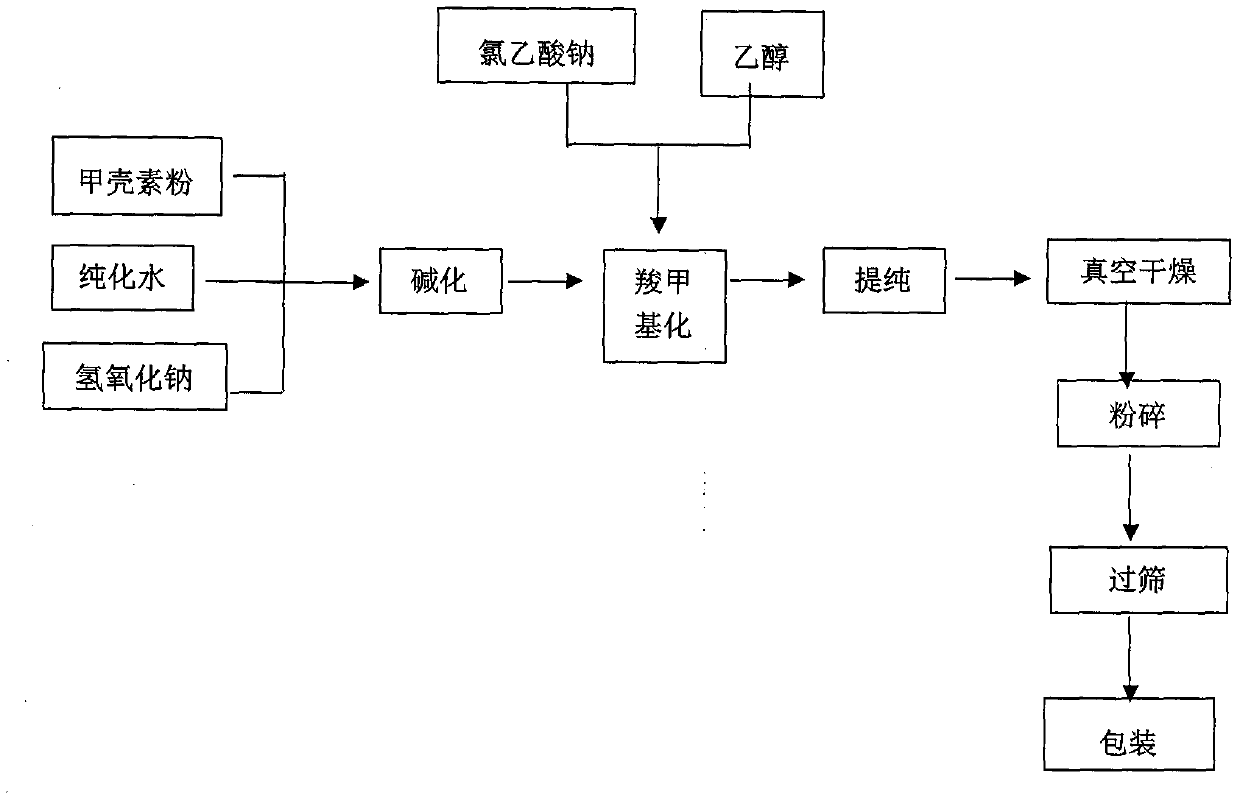
Figure 1
Abstract
Description
technical field
[0001] The invention relates to the field of fine chemical industry, belongs to marine chemical engineering technology, is a new N, O-substituted carboxymethyl chitosan preparation technology, and is a water-soluble carboxymethyl chitosan prepared from chitin new method. Water-soluble N, O-substituted carboxymethyl chitosan is obtained by reacting chitin powder and sodium chloroacetate in ethanol solution. Compared with the prior art, with the preparation method of the present invention, the raw material utilization rate is high, the working environment is significantly improved, the product purity is high, and the yield is high. This type of chitosan derivative C 6 Bit - 0H and C 2 The degree of substitution on -NH2 is as high as 80-110%. It has good water solubility, good antibacterial and antibacterial properties, and moisture absorption and moisturizing properties. Further purification can be widely used in the fields of medicine, food or cosmetics. Bac...
Examples
Embodiment 1
[0021] Add 20g of chitin powder to a beaker equipped with an electric stirrer, prepare 200g of 45% NaOH solution, pour it into the chitin powder, stir for 1.5h to alkalize, separate solid and liquid, add 120ml of 95% ethanol, and stir evenly Add 40g of sodium chloroacetate, react at 60°C for 3.0 hours, separate the solid and liquid after the reaction, adjust the pH to neutral with dilute acid, wash twice with 200ml of 75% ethanol solution, dehydrate once with 100ml of 95% ethanol , vacuum-dried to obtain the product, according to the method in "YY0953-2015 Medical Carboxymethyl Chitosan", the pH was 7.0, the degree of substitution was 96.1%, the degree of deacetylation was 81.7%, and the purity was 86.3%.
Embodiment 2
[0023] Add 20g of chitin powder to a beaker equipped with an electric stirrer, prepare 200g of 45% NaOH solution, pour it into the chitin powder, stir for 1.5h for alkalization, separate solid and liquid, add 150ml of 95% ethanol, and stir well Then add 50g of sodium chloroacetate, react at 65°C for 3.5 hours, separate the solid and liquid after the reaction, adjust the pH to neutral with dilute acid, wash twice with 200ml of 75% ethanol solution, and dehydrate with 100ml of 95% ethanol Once, the product was vacuum-dried to obtain a pH of 7.2 according to the method in "YY0953-2015 Medical Carboxymethyl Chitosan", the degree of substitution was 92.3%, the degree of deacetylation was 78.9%, and the purity was 90.8%.
Embodiment 3
[0025] Weigh 10kg of chitin raw material and put it into a stirring tank, prepare 100kg of NaOH solution with 45% concentration, stir and alkalize at room temperature for 2 hours, separate solid and liquid, add 60kg of 95% concentration ethanol solution, and then add 20kg of sodium chloroacetate to In the system, the reaction was carried out at 60°C for 5.0 hours. After the reaction, the crude product was dissolved in purified water, filtered through a 3 μm precision filter, precipitated with 95% ethanol solution, separated from solid and liquid, adjusted to neutral with dilute acid, and washed twice with 75% ethanol solution. % concentration ethanol was dehydrated once, vacuum-dried, pulverized and passed through an 80-mesh sieve to obtain the product. After testing, the pH of the product is 7.3, the degree of substitution is 111.2%, the degree of deacetylation is 87.9%, and the purity is 94.7%.