
Ethambutol hydrochloride synthesis method
A technology of ethambutol hydrochloride and butanol, which is applied in the directions of organic chemistry methods, chemical instruments and methods, and preparation of organic compounds, etc., can solve the problems of increasing the complexity of equipment, difficulty in large-scale application, and difficulty in controlling the feeding amount. , to achieve the effect of reducing solid waste, high product quality and improving product purity
Patent Information
- Authority / Receiving Office
- CN · China
- Current Assignee / Owner
- Publication Date
- 2018-06-29
Smart Images
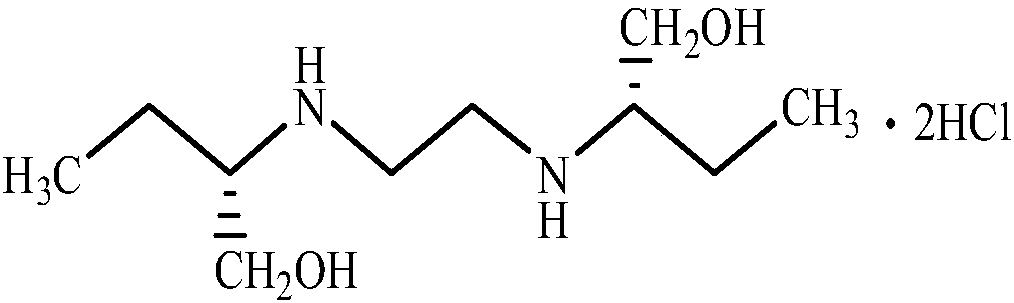
Figure 1 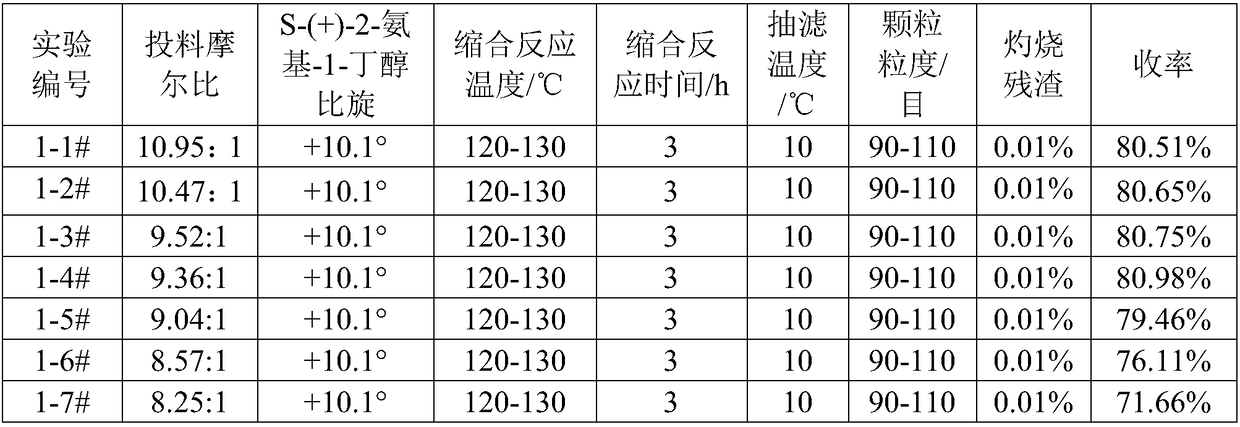
Figure 2 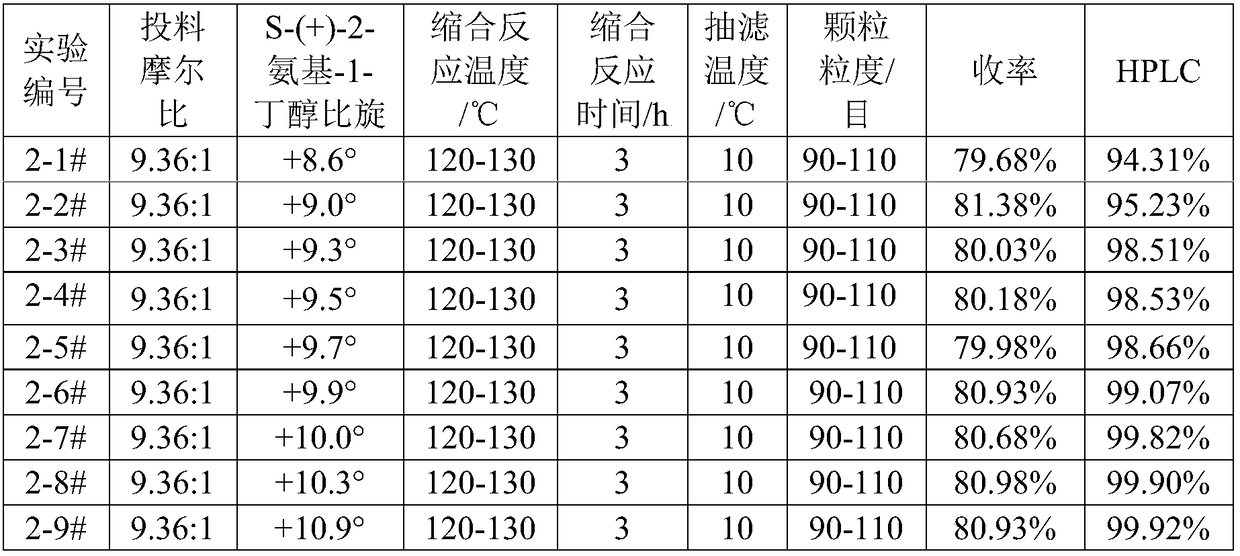
Figure 3
Abstract
Description
technical field
[0001] The application relates to a method for synthesizing ethambutol hydrochloride. Background technique
[0002] Ethambutol hydrochloride is widely used in combination with other anti-tuberculosis drugs to treat tuberculosis caused by Mycobacterium tuberculosis, and can also be used in the treatment of tuberculous meningitis and atypical mycobacterial infection. The drug accounts for more than 13% of the anti-TB drug market share.
[0003] Ethambutol hydrochloride (English name is Ethambutol Hydrochloride), its chemical name is [2R,2[S-(R * , R * )-R](+)-2,2-(1,2-Ethylenediimino)-bis-1-butanol dihydrochloride, the molecular formula is C 10 h 24 N 2 o 2 HCl, the molecular weight is 277.23, the CAS number is 1070-11-7, and its structural formula is:
[0004]
[0005] The currently reported synthesis methods include 1,2-epoxy-3-butene, (S)-2-aminobutyric acid ethyl ester, S-(+)-2-amino-1-butanol, etc. as starting materials synthesis process. [00...
Examples
Embodiment 1
[0049]Put 295g (3.3094mol) of S-(+)-2-amino-1-butanol (specific rotation +10.1°) into a 500mL three-neck flask, stir and heat up to 110°C, and slowly add 35g ( 0.3536mol) of 1,2-dichloroethane (the feeding ratio of aminobutanol to 1,2-dichloroethane is 9.36:1), the temperature is controlled at 110°C-140°C within 2 hours, and then in In this temperature range, heat preservation reaction was carried out for 3 hours. At 150°C, 221.5 g (2.4849 mol) of S-(+)-2-amino-1-butanol was recovered by vacuum distillation, and the vacuum pressure was controlled at -0.09 MPa. Cool down to 70°C, add 200g of absolute ethanol, stir, slowly cool down to about 30°C, add dropwise 37.3g of hydrochloric acid ethanol (HCl content 30%), stir, and control the pH between 3 and 3.5. Slowly lower the temperature to 8°C to 10°C, and separate by suction filtration to obtain ethambutol hydrochloride 79.3g (yield 80.98%, m.p.199°C to 204°C), purity 99.8%, residue on ignition 0.01%, particle size 90 to 110 mes...
Embodiment 2
[0055] With reference to the feed ratio and reaction conditions of Example 1, the specific rotation of S-(+)-2-amino-1-butanol is changed separately, and other conditions are unchanged, to determine the impact on product yield and quality, see Table 2 .
[0056] Table 2: Effect of S-(+)-2-amino-1-butanol specific rotation on product yield and quality
[0057]
Embodiment 3
[0059] With reference to the reaction conditions of Example 1, the condensation reaction temperature and the condensation reaction time were changed, and other conditions were kept constant, so as to determine the influence on the product yield, as shown in Table 3.
[0060] Table 3: Effect of condensation reaction temperature and reaction time on yield
[0061]