
Soil conditioner for enhancing crop stress resistance, and preparation and use methods thereof
A soil conditioner and crop enhancement technology, applied in soil conditioning materials, chemical instruments and methods, applications, etc., can solve the problems of lack of repairing degraded soil, improvement of soil nutrient deficiency, and inability to improve soil structure, so as to reduce crop physiology. Effects of drought, improved crop quality, increased crop yield
Patent Information
- Authority / Receiving Office
- CN · China
- Patent Type
- Applications(China)
- Current Assignee / Owner
- Publication Date
- 2018-07-27
Smart Images
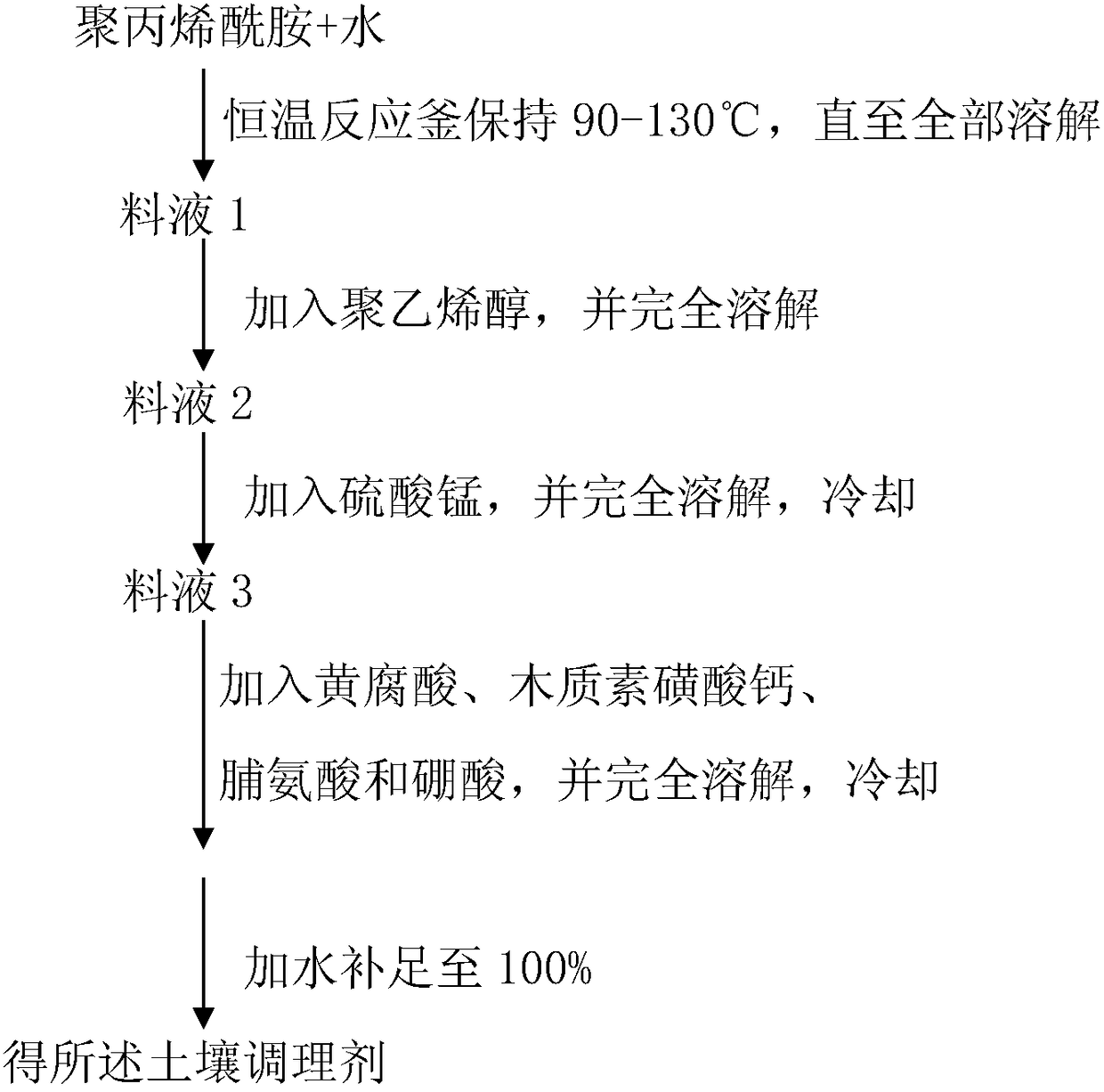
Figure 1 
Figure 2 
Figure 3
Abstract
Description
technical field
[0001] The invention belongs to the field of agricultural soil conditioners, and in particular relates to a soil conditioner for enhancing the stress resistance of crops and a preparation and use method thereof. Background technique
[0002] Soil degradation is a worldwide environmental problem, which has seriously threatened the sustainable development of agriculture. my country is one of the countries with serious soil degradation. Among them, the total area of saline-alkali soil is about 100 million hectares. Saline-alkali soil leads to a decrease in soil fertility, a decrease in nutrient utilization, and poor structural air permeability. The decline in disease resistance seriously affects the yield and quality of crops. my country is also one of the countries most severely affected by drought. The area of desertified soil in my country reaches 126 million hectares, mainly distributed in the arid and semi-arid areas of northern China, and the expans...
Examples
Embodiment 1
[0054] combine figure 1 Shown process flow chart, concrete preparation steps are as follows:
[0055] (1) Take 2kg of polyacrylamide in a reaction kettle, add 800kg of distilled water, heat it to 90°C to dissolve it completely, stir continuously during the dissolution process, and obtain feed liquid 1.
[0056] (2) Add 3 kg of polyvinyl alcohol to feed liquid 1, and stir continuously at 90° C. to completely dissolve it to obtain feed liquid 2.
[0057] (3) Weigh 10kg of manganese sulfate, add it into the feed liquid 2, and keep stirring continuously, without heating in this process, after making it completely dissolved, cool to room temperature to obtain the feed liquid 3.
[0058] (4) Add 50kg fulvic acid, 20kg calcium lignosulfonate, 0.05kg proline and 0.3kg boric acid to feed liquid 3, and stir until all materials are completely dissolved.
[0059] (5) There is also water loss in the process of step (1)(2), so it is necessary to weigh the weight of the feed liquid prepare...
Embodiment 2
[0070] Concrete preparation steps are as follows:
[0071] (1) Take 3kg of polyacrylamide in a reaction kettle, add 700kg of distilled water, heat it to 120°C to dissolve it completely, stir continuously during the dissolution process, and obtain feed liquid 1.
[0072] (2) Add 2 kg of polyvinyl alcohol into feed liquid 1, and stir continuously at 100° C. to completely dissolve it to obtain feed liquid 2.
[0073] (3) Weigh 20kg of manganese sulfate, add it into feed liquid 2, and keep stirring continuously, without heating in this process, after making it dissolve completely, cool to room temperature to obtain feed liquid 3.
[0074] (4) Add 70kg fulvic acid, 10kg calcium lignosulfonate, 0.1kg proline and 0.2kg boric acid to feed liquid 3, and stir until all materials are completely dissolved.
[0075] (5) There is also water loss in the process of step (1)(2), so it is necessary to weigh the weight of the feed liquid prepared in step (4) again, and then add distilled water ...
Embodiment 3
[0079] Concrete preparation steps are as follows:
[0080] (1) Take 5kg of polyacrylamide in a reaction kettle, add 500kg of distilled water, heat it to 100°C to dissolve it completely, stir continuously during the dissolution process, and obtain feed liquid 1.
[0081] (2) Add 10 kg of polyvinyl alcohol into feed liquid 1, and stir continuously at 100° C. to completely dissolve it to obtain feed liquid 2.
[0082] (3) The manganese sulfate of 50kg was weighed, added in the feed liquid 2, and kept stirring continuously, this process was not heated, after making it completely dissolved, cooled to room temperature, to obtain the feed liquid 3.
[0083](4) Add 60kg of fulvic acid, 50kg of calcium lignosulfonate, 0.01kg of proline and 0.2kg of boric acid into feed liquid 3, and stir until all materials are completely dissolved.
[0084] (5) There is also water loss in the process of step (1)(2), so it is necessary to weigh the weight of the feed liquid prepared in step (4) again,...