
Method for increasing residual manganese content in molten steel at end point of converter
A converter end point and content technology, which is applied in the field of steelmaking technology, can solve the problems that the tapping temperature cannot meet the requirements of tapping, the unfavorable cleanliness of molten steel, and the reduction of molten steel in the furnace, etc., so as to prevent rephosphorization and tapping Effects of lowering slag, reducing converter blowing loss, and reducing steelmaking cost
Patent Information
- Authority / Receiving Office
- CN · China
- Patent Type
- Applications(China)
- Current Assignee / Owner
- Publication Date
- 2018-08-14
- Estimated Expiration
- Not applicable · inactive patent
Smart Images
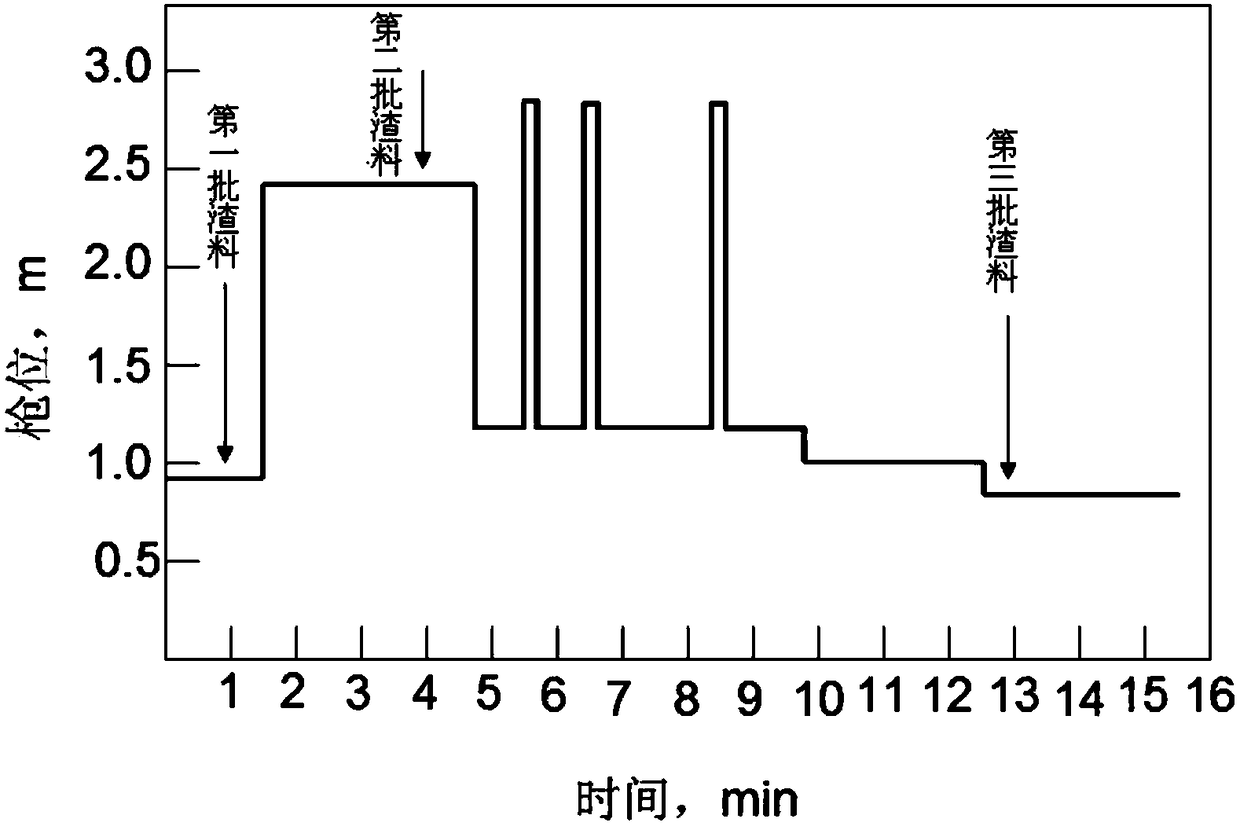
Figure 1 
Figure 2 
Figure 3
Abstract
Description
technical field
[0001] The invention belongs to the field of steelmaking technology, in particular to a method for increasing the residual manganese content of molten steel at the end point of a converter. Background technique
[0002] Manganese can improve the tensile strength, machinability, toughness, hardness and wear resistance of steel, and can also reduce the adverse effects of sulfur in steel, so manganese is regarded as one of the main elements in steel. After the converter completes the task of smelting molten iron, most of the manganese in the original molten iron is oxidized. According to different steel types, it is necessary to add manganese-ferroalloy to the molten steel to meet the composition requirements of the steel type. In the actual production process, the residual manganese content in molten steel has an important impact on the amount of ferromanganese added, the higher the residual manganese content, the less the amount of alloyed ferromanganese added...
Examples
Embodiment 1
[0043] Table 1 shows the conditions of molten iron and steel scrap mixed into the converter for blowing low-carbon steel with a steel carbon requirement of 0.05-0.10%.
[0044] Table 1 The situation of molten iron and steel scrap blended into the converter
[0045] C%
Si%
Mn%
P%
S%
T 铁 ℃
Amount of molten iron t
Amount of scrap steel t
4.02
0.46
0.12
0.075
0.005
1290
101
6
[0046] The total amount of lime added is converted according to the effective CaO content of 80%, the adjustment coefficient λ value of 1.1, and the final slag basicity of 3.0. The amount of added iron per ton is:
[0047] Then, the total amount of lime that needs to be added is: 40.59×101=4099.59kg≈4.1t.
[0048] When blowing oxygen in the lowering lance, first add 2.5t of lime and 0.5t of iron carbon balls to the first batch of slag, add the second batch of lime slag after blowing for 4.5min, the addition amount is 0.48t, and 3min befor...
Embodiment 2
[0058] Table 3 shows the conditions of molten iron and steel scrap that are blended into the converter for blowing high-carbon steel with a steel carbon requirement of 0.35-0.60%.
[0059] Table 3 The situation of molten iron and steel scrap blended into the converter
[0060] C%
Si%
Mn%
P%
S%
T 铁 ℃
Amount of molten iron t
Amount of scrap steel t
4.14
0.52
0.13
0.070
0.005
1330
102
5
[0061] The total amount of lime added is converted according to the effective CaO content of 80%, the adjustment coefficient λ value of 1.0, and the final slag basicity of 3.0.
[0062] It can be seen that the amount of iron added per ton is:
[0063] Then, the total amount of lime that needs to be added is: 45.9×102=4681.8kg≈4.7t.
[0064] When blowing oxygen in the lowering lance, first add 2.8t of lime to the first batch of slag, and add 0.6t of iron carbon balls. After blowing for 5 minutes, add the second batch of lime a...