
A preparation method of an alloy target forming ohmic contact on the surface of n-type gallium arsenide
An ohmic contact, alloy target technology, applied in metal material coating process, vacuum evaporation coating, coating and other directions, can solve the problems of poor processing performance, unfavorable high-performance thin film, high alloy brittleness, etc., to achieve good plasticity, increase The effect of nucleation capacity
Patent Information
- Authority / Receiving Office
- CN · China
- Patent Type
- Patents(China)
- Current Assignee / Owner
- Publication Date
- 2020-08-14
Smart Images
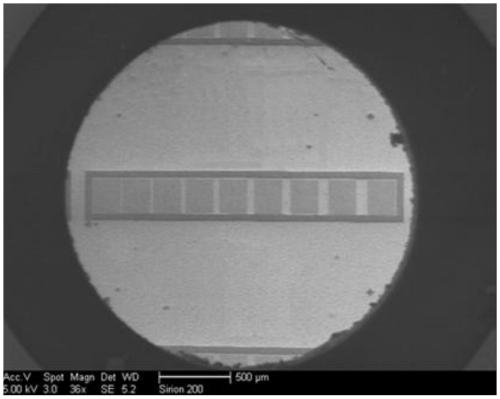
Figure 1 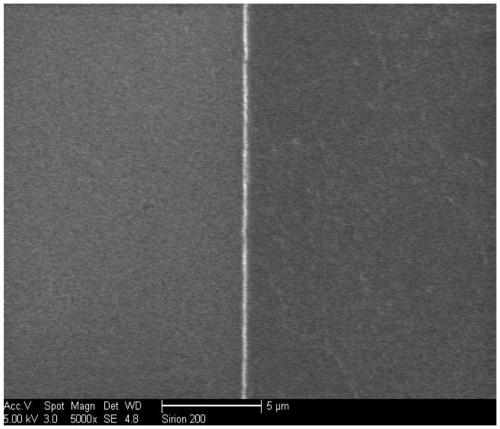
Figure 2
Abstract
Description
technical field
[0001] The invention relates to a method for preparing an alloy target, in particular to an indium-gold alloy target which forms an ohmic contact on the surface of an N-type compound semiconductor material and a preparation method thereof. Background technique
[0002] Excellent metal-semiconductor ohmic contact is very important for the manufacture of optoelectronic devices with compound semiconductors, the parameters and stability of microwave oscillators and microwave circuits. For gallium arsenide (GaAs) materials, gold-germanium (AuGe) alloys are generally used to form good ohmic contacts. Contact, the preparation process is to vapor-deposit AuGe eutectic on GaAs, and use rapid annealing technology for alloying. During the alloying process, Ge (germanium) quickly diffuses to heavily N-type doped GaAs, forming an electron tunnel between the metal and the semiconductor without generating a potential barrier. At present, under the optimal process, the spec...
Examples
Embodiment 1
[0022] The target material is mixed with 2 wt% gold and 98 wt% indium, and the preparation method includes the following steps:
[0023] 1) Use a vacuum induction melting furnace to melt metal indium (in a vacuum induction melting furnace with a vacuum degree of 8 Pa, heat the indium raw material to 200 ° C, and keep it warm for 30 minutes after the indium metal is completely melted), and then gold nano The powder (10-100nm) is mixed into the metal indium in the molten state and stirred evenly;
[0024] 2) When the melt is stirred, keep warm and degas for 15 minutes;
[0025] 3) Pour the indium-gold mixture into the casting mold at a temperature of 180°C, and cool it to room temperature (15-30°C) to form an indium-gold alloy ingot with eutectic composition or hypoeutectic composition;
[0026] 4) The ingot is subjected to hot pressing and rolling (45°C, the deformation rate of the hot rolling pass is 3%), and the internal pores and grain boundaries are removed;
[0027] 5) U...
Embodiment 2
[0031] The target material is mixed with 8 wt% gold and 92 wt% indium, and the preparation method includes the following steps:
[0032] 1) Use a vacuum induction melting furnace to melt metal indium (in a vacuum induction melting furnace with a vacuum degree of 12Pa, heat the indium raw material to 220°C, and keep it warm for 40 minutes after the indium metal is completely melted), and then gold nano powder Mixed into the metal indium in the molten state and stirred evenly;
[0033] 2) When the melt is stirred, keep warm and degas for 20 minutes;
[0034] 3) Pour the indium-gold mixture into the casting mold at a temperature of 220°C, and cool to room temperature to form an indium-gold alloy ingot with eutectic composition or hypoeutectic composition;
[0035] 4) The ingot is subjected to hot pressing and rolling (55°C, the deformation rate of the hot rolling pass is 8%), and the internal pores and grain boundaries are removed;
[0036] 5) Use a heating furnace to homogeniz...
Embodiment 3
[0040] The target material is mixed with 5 wt% gold and 95 wt% indium, and the preparation method includes the following steps:
[0041] 1) Use a vacuum induction melting furnace to melt metal indium (in a vacuum induction melting furnace with a vacuum degree of 10 Pa, heat the indium raw material to 210 ° C, and keep it warm for 32 minutes after the indium metal is completely melted), and then gold nano The powder is mixed into the metal indium in the molten state and stirred evenly;
[0042] 2) When the melt is stirred, keep warm and degas for 18 minutes;
[0043] 3) Pour the indium-gold mixture into the casting mold at a temperature of 200°C, and cool it to room temperature to form an indium-gold alloy ingot with eutectic composition or hypoeutectic composition;
[0044] 4) The ingot is subjected to hot pressing and rolling (50°C, the deformation rate of the hot rolling pass is 5%), and the internal pores and grain boundaries are removed;
[0045] 5) Use a heating furnace...