
Metal halide acid radical ion liquid for catalyzing acetylene hydrochlorination as well as application method thereof
A technology of acetylene hydrochlorination and ionic liquids, applied in the field of metal halide ionic liquids, can solve the problems of unfavorable industrial production, low catalytic activity, poor stability, etc., to avoid local overheating, catalytic activity and selectivity reduction, thermal stability good sex effect
Patent Information
- Authority / Receiving Office
- CN · China
- Patent Type
- Applications(China)
- Current Assignee / Owner
- Publication Date
- 2019-01-08
Smart Images
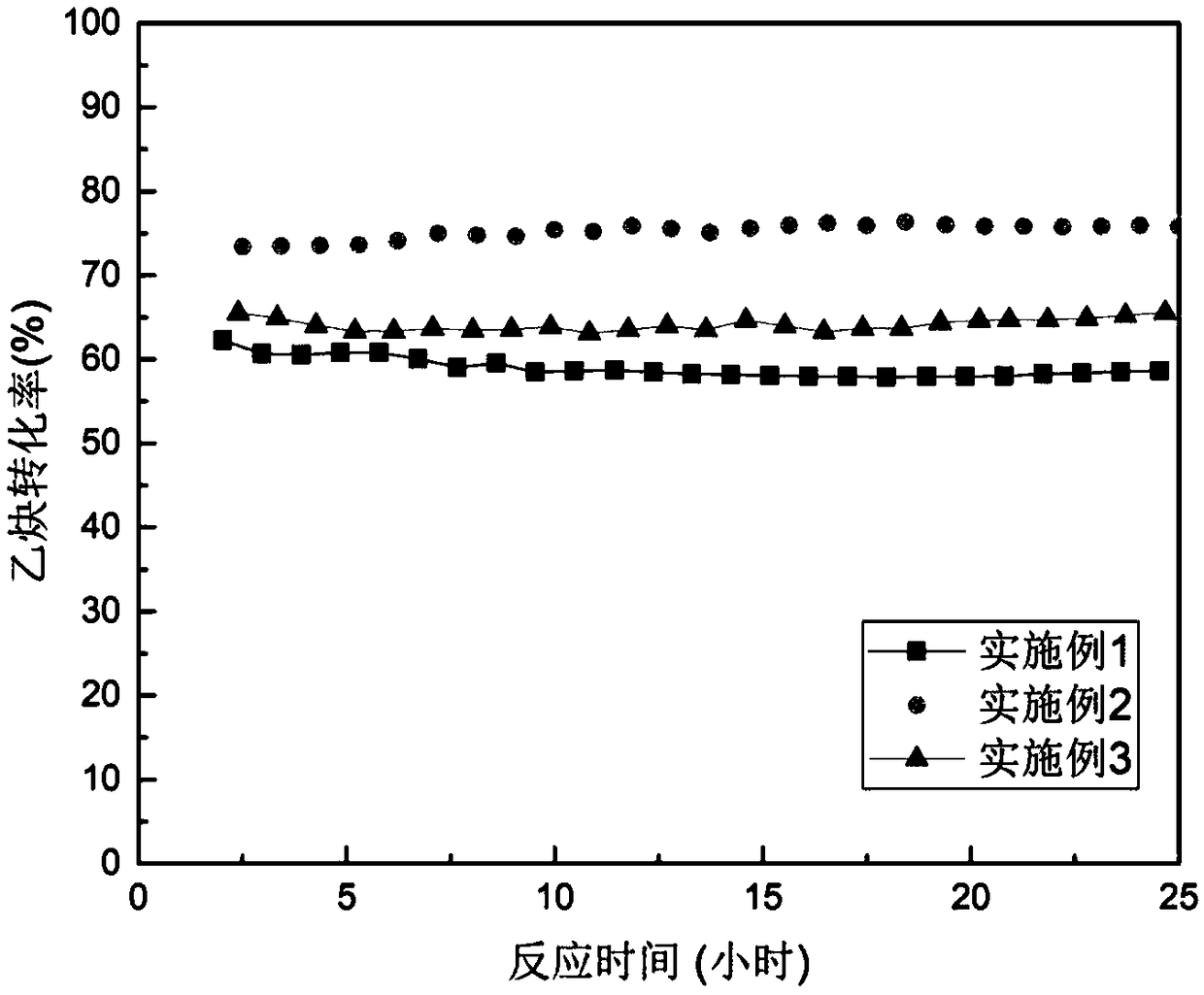
Figure 1 
Figure 2 
Figure 3
Abstract
Description
technical field
[0001] The invention belongs to the technical field of preparing vinyl chloride by hydrochlorination of acetylene, and furthermore, relates to a metal halide ion liquid for catalyzing hydrochlorination of acetylene and an application method thereof. Background technique
[0002] Vinyl chloride is a colorless, easily liquefied, insoluble gas at room temperature, and is an important chemical raw material for the synthesis of polyvinyl chloride. As one of the five most widely used general-purpose plastics, polyvinyl chloride is closely related to our lives. Therefore, the industrial production of vinyl chloride is of great significance. my country is the main consumer and producer of polyvinyl chloride. According to the domestic energy pattern of "poor oil, rich coal, and little gas", the acetylene method with coal as the basic raw material is the main method of vinyl chloride production in my country. At present, mercury catalysts have been used in the indust...
Examples
Embodiment 1
[0029] (1) Slowly add 0.25 moles (24.75 grams) of CuCl to 0.25 moles (23.89 grams) of trimethylamine hydrochloride, under nitrogen protection, stir at 100°C for 12 hours to complete the reaction to obtain trimethylammonium chloride Cuprite ionic liquid [Me 3 NH]Cl / CuCl.
[0030] (2) get 18 milliliters of synthetic trimethylammonium cuprous chloride ionic liquid [Me 3 NH]Cl / CuCl, put it into the reaction tube for acetylene hydrochlorination reaction, the conversion rate of acetylene was 58.46% after reaction at 140°C for 12 hours, the selectivity of vinyl chloride was 99.69%, and the reaction continued for 24 hours There was no significant decrease in activity. The change curve of acetylene conversion rate with reaction time is shown in figure 1 .
Embodiment 2
[0032] (1) Slowly add 0.25 moles (24.75 grams) of CuCl to 0.25 moles (34.41 grams) of triethylamine hydrochloride, under nitrogen protection, stir at 100°C for 12 hours to complete the reaction to obtain triethylammonium chloride Cuprousite ionic liquid [Et 3 NH]Cl / CuCl.
[0033] (2) get 18 milliliters of synthetic triethylammonium cuprous chloride ionic liquid [Et 3 NH]Cl / CuCl, put it into the reaction tube for acetylene hydrochlorination reaction, the conversion rate of acetylene was 75.87% after reaction at 140°C for 12 hours, the selectivity of vinyl chloride was 99.78%, and the reaction continued for 24 hours There was no significant decrease in activity. The change curve of acetylene conversion rate with reaction time is shown in figure 1 .
Embodiment 3
[0035] (1) Slowly add 0.25 moles (24.75 grams) of CuCl to 0.25 moles (28.89 grams) of pyridine hydrochloride, under nitrogen protection, and stir at 100°C for 12 hours to complete the reaction to obtain pyridine cuprous chloride Ionic liquid [PyH]Cl / CuCl.
[0036] (2) Get 18 milliliters of synthetic pyridine cuprous chloride ionic liquid [PyH]Cl / CuCl, put it into the reaction tube and carry out the acetylene hydrochlorination reaction, and the acetylene conversion rate is 63.53%, the selectivity of vinyl chloride is 99.73%, and there is no obvious decrease in activity during the 24-hour continuous reaction. The change curve of acetylene conversion rate with reaction time is shown in figure 1 .