
Preparation for degrading printing and dyeing pollution in natural fabric and preparation method of preparation
A technology of natural plants and preparations, applied in plant fibers, animal fibers, textiles and papermaking, etc., can solve the problems of environmental pollution, difficult degradation and discharge, complicated procedures, etc., and achieve simple preparation methods, good degradation effects, and wide sources of raw materials Effect
Patent Information
- Authority / Receiving Office
- CN · China
- Patent Type
- Applications(China)
- Current Assignee / Owner
- Publication Date
- 2019-06-28
Smart Images
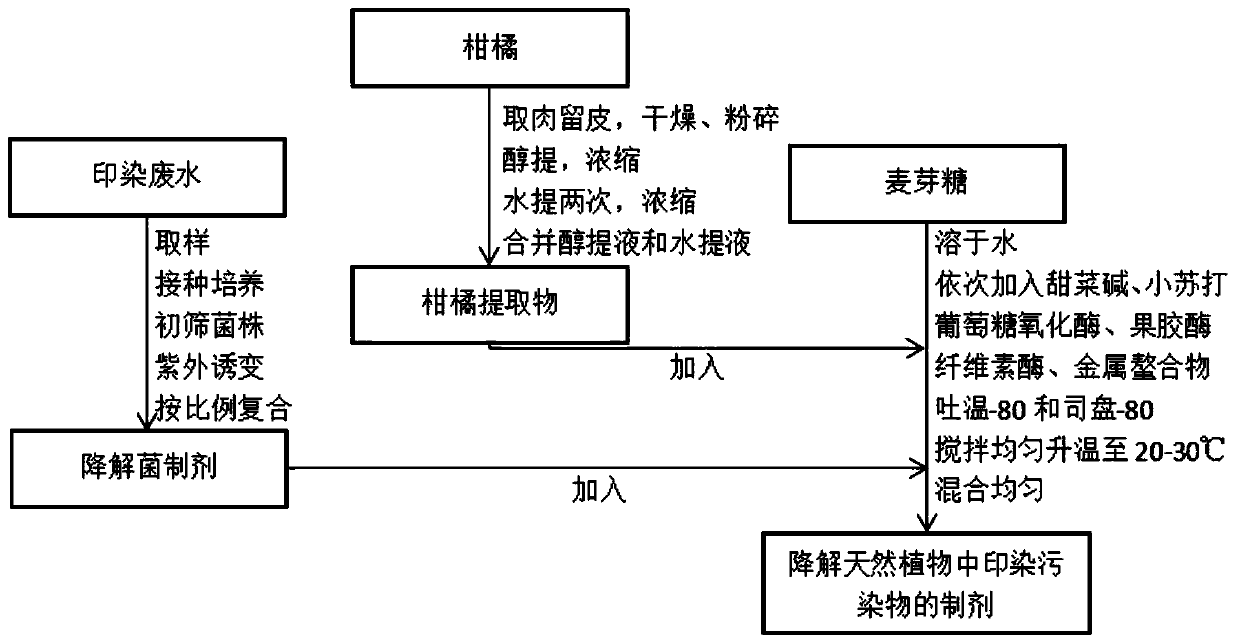
Figure 1
Abstract
Description
technical field
[0001] The invention relates to the technical field of biological preparations, in particular to a preparation for degrading printing and dyeing pollution in natural fabrics. Background technique
[0002] As we all know, the surface of cotton fiber contains pectin, wax and other hydrophobic substances. The traditional process mainly uses pretreatment measures such as high temperature and alkali scouring to remove these hydrophobic substances before dyeing. It is carried out in an independent process, the defects of its operation are very obvious, and the process is complicated. The pretreatment process of high temperature and alkali scouring needs to be carried out at 98°C-100°C, which requires a large amount of steam consumption, high energy consumption, long time, low efficiency, and high cost. In addition, the alkali scouring process requires the use of caustic soda , leading to the discharge of a large amount of alkaline waste liquid, increasing the pres...
Examples
Embodiment 1
[0027] Composition of raw materials (parts by weight): 10 parts of citrus extract, 5 parts of degrading bacteria preparation, 3 parts of maltose, 2 parts of betaine, 1 part of baking soda, 2 parts of glucose oxidase, 1 part of pectinase, 1 part of cellulase , 2 parts of xanthate, 1 part of Tween-80, 1 part of Span-80 and 100 parts of deionized water; the glucose oxidase is isolated from Penicillium insolens, and the pectinase is isolated from Aspergillus niger, The cellulase is isolated from alkaliphilic bacteria.
[0028] The degrading bacteria preparation is composed of the following bacteria according to colonies: 35 parts of Escherichia coli, 15 parts of Bacillus, 10 parts of Aspergillus pylorus, 5 parts of Aspergillus, 3 parts of Penicillium, 5 parts of Mycobacterium, 2 parts of Karstella and Escherichia 2 parts.
[0029] Preparation:
[0030] S1. Preparation of citrus extract: take the citrus and leave the skin, dry and pulverize, soak in ethanol solution for 2 hours, ...
Embodiment 2
[0034] Composition of raw materials (parts by weight): 20 parts of citrus extract, 15 parts of degrading bacteria preparation, 10 parts of maltose, 5 parts of betaine, 3 parts of baking soda, 5 parts of glucose oxidase, 3 parts of pectinase, 2 parts of cellulase , 5 parts of sodium dithiocarbamate, 2 parts of Tween-80, 2 parts of Span-80 and 120 parts of deionized water; Isolated, the cellulase is isolated from alkaliphilic bacteria.
[0035] The degrading bacteria preparation is composed of the following bacteria according to colonies: 35 parts of Escherichia coli, 15 parts of Bacillus, 10 parts of Aspergillus pylorus, 5 parts of Aspergillus, 3 parts of Penicillium, 5 parts of Mycobacterium, 2 parts of Karstella and Escherichia 2 parts.
[0036] Preparation:
[0037]S1. Preparation of citrus extract: take citrus and leave the skin, dry and crush, soak in ethanol solution for 4 hours, filter, collect alcohol solution, concentrate to obtain alcohol concentrate A, concentrate ...
Embodiment 3
[0041] Composition of raw materials (parts by weight): 12 parts of citrus extract, 7 parts of degrading bacteria preparation, 5 parts of maltose, 3 parts of betaine, 2 parts of baking soda, 2 parts of glucose oxidase, 2 parts of pectinase, 1.2 parts of cellulase , 2 parts of 2,2'-bipyridine disodium, 1.2 parts of Tween-80, 1.1 parts of Span-80 and 105 parts of deionized water; the glucose oxidase is isolated from Penicillium insolens, and the pectinase is isolated from niger, and the cellulase was isolated from alkaliphilic bacteria.
[0042] The degrading bacteria preparation is composed of the following bacteria according to colonies: 22 parts of Escherichia coli, 11 parts of Bacillus, 6 parts of Aspergillus pylorus, 3 parts of Aspergillus, 2 parts of Penicillium, 3 parts of Mycobacterium, 1.2 parts of Karstella and Escherichia 1.1 parts.
[0043] Preparation:
[0044] S1. Preparation of citrus extract: take citrus and leave the skin, dry and crush, soak in ethanol solutio...