

A kind of preparation method of acetylenic alcohol
A technology of acetylenic alcohol and acetylene, which is applied in the field of base-catalyzed preparation of acetylenic alcohol, which can solve the problems of affecting product quality and no addition of polymerization inhibitors, and achieve the effects of avoiding polymerization side reactions, shortening reaction time, and improving product yield
Patent Information
- Authority / Receiving Office
- CN · China
- Patent Type
- Patents(China)
- Current Assignee / Owner
- Publication Date
- 2020-01-10
Smart Images

Figure 1 
Figure 2 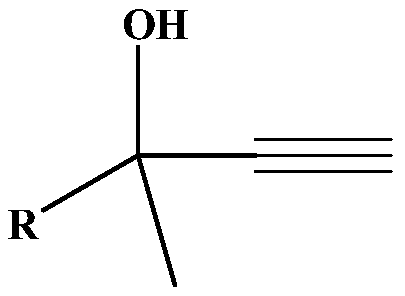
Figure 3
Abstract
Description
technical field
[0001] The invention belongs to the technical field of alkali-catalyzed preparation of acetylenic alcohols, and specifically relates to a method in which an alkali metal hydroxide is used as a catalyst and 4-hydroxyl-2,2,6,6-tetramethylpiperidine is supported on silica gel in a reaction kettle. Nitroxide free radicals are a method for preparing acetylenic alcohols through acetylenylation of polymerization inhibitors. Background technique
[0002] Alkynyl alcohol is an important intermediate for the synthesis of flavors and fragrances, pharmaceutical intermediates, and vitamin E, such as 3,7-dimethyl-3-octynol, dehydronerolidol, 3,7,11,15-tetramethyl Base-1-hexadecyn-3-ol, etc., due to the prominent position of acetylenic alcohols in the chemical industry, many scholars have conducted a lot of research on their synthetic methods.
[0003] CN1125015C adopts cationic exchange resin method to catalyze the synthesis of enynyl alcohol. The method uses weakly acidi...
Examples
Embodiment 1
[0038] Under nitrogen protection, add 1.6g PGMA / SiO to a 5L autoclave 2 -TEMPO, then add 798.5g of methyl heptanone and 3.1g of KOH (45wt% solution), and then feed 2.15kg of liquid ammonia into the reaction kettle. The mixture was cooled to 15°C. Then feed 166.8g of acetylene into the autoclave, and control the pressure of the reactor to be 12bar. After reacting for 3.3 hours, carry out solid-liquid separation by filter, then add 25g90% (mass fraction) aqueous acetic acid solution in liquid phase, release pressure, wherein most of ammonia is evaporated, be heated to 40 ℃, remove remaining ammonia. Subsequently, the reaction mixture was washed twice with 250 mL of deionized water, twice with 250 mL of 8% (mass fraction) sulfuric acid aqueous solution, and then twice with 250 mL of deionized water to obtain a colorless transparent liquid.
[0039]The solid phase was applied 7 times, the average conversion rate was 99.3%, the average yield before washing was 98%, the average yi...
Embodiment 2~5
[0047] Experiments were carried out according to the operating conditions in Table 2, and the unlisted conditions were the same as in Example 1, and the yields and selectivities were shown in Table 2.