
Piglet mixed feed additive for improving feed intake and application thereof
A feed additive, mixed technology, applied in animal feed and other directions, can solve the problems of insignificant increase in feed intake, poor adaptability, complex components, etc., to achieve simplified and optimized compounding, stable and reliable effect, and improved The effect of feed intake
Patent Information
- Authority / Receiving Office
- CN · China
- Patent Type
- Applications(China)
- Current Assignee / Owner
- Publication Date
- 2019-09-06
- Estimated Expiration
- Not applicable · inactive patent
Smart Images
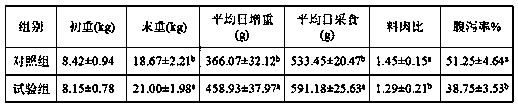
Figure 1
Abstract
Description
technical field
[0001] The invention relates to the field of piglet feed additives, in particular to a piglet mixed feed additive for improving feed intake and its application. Background technique
[0002] During the weaning period of piglets, their physiology, immunity, etc. are not fully developed, and their digestive system is due to factors such as weaning stress, inadaptation to solid feed, and environmental changes, which lead to a significant decrease in feed intake of piglets. With the continuous improvement of the pig industry's requirements for production scale and production efficiency, how to solve the problem of feeding connection when piglets are weaned has become the key to breaking through the existing production efficiency.
[0003] At present, there are some related feed additives on the market to solve the problem of low feed intake of piglets. However, the formulations of these feed additives are relatively complex, the cost is high, and the mechanism o...
Examples
Embodiment 1
[0020] The mixed feed additive for piglets of this embodiment comprises the following components by weight: 5 parts of Bacillus subtilis, 2 parts of Lactobacillus acidophilus, 30 parts of Acremonium acremonium culture, 5 parts of vitamin C, lysozyme 2 parts, 4 parts of calcium formate, 2 parts of glucose oxidase, 50 parts of milk powder. The raw materials are uniformly mixed to obtain the mixed feed additive.
Embodiment 2
[0022] The piglet mixed feed additive of the present embodiment comprises the following components by weight components: 8 parts of Bacillus subtilis, 4 parts of Lactobacillus acidophilus, 40 parts of Acremonium acremonium culture, 8 parts of vitamin C, lysozyme 4 parts, 6 parts of calcium formate, 4 parts of glucose oxidase, 40 parts of milk powder. The raw materials are uniformly mixed to obtain the mixed feed additive.
Embodiment 3
[0023] Embodiment 3 feeding test
[0024] Test period: December 20, 2018 to January 17, 2019 (28 days).
[0025] Test location: pig farm in Xinji City, Hebei Province.
[0026] Selection of test objects: 160 healthy Dudu long-term three-way hybrid pigs aged 21-25 days and weighing 8.00kg±0.57kg were selected; they were randomly divided into two groups according to body weight and sex, one group was the test group, and the other was the test group. Control group, 80 piglets in each group, 8 replicates, 10 piglets in each replicate. Control group: diet is 60% corn + 40% suckling pig concentrate mixture of a certain company in Shijiazhuang; test group: diet is 59.5% corn + 40% suckling pig concentrate + 0.5% feed additive (Example 1 formula); except for the above-mentioned settings, feeding, management, and immunization were carried out according to the same daily procedures of the pig farm during the experiment.
[0027] Test result record: On the 0th day and the 28th day of ...