
Liquid grinding aid capable of promoting coagulating, and preparation method thereof
A grinding aid and liquid technology, which is applied in the field of coagulation-accelerating liquid grinding aid and its preparation, can solve the problems of restricting the popularization and application of cement grinding aid, unstable quality of grinding aid, fluctuation of cement quality, etc., and achieve adaptability Good performance, reasonable proportion, change the effect of hardness and strength
Patent Information
- Authority / Receiving Office
- CN · China
- Patent Type
- Applications(China)
- Current Assignee / Owner
- Publication Date
- 2019-10-15
Smart Images
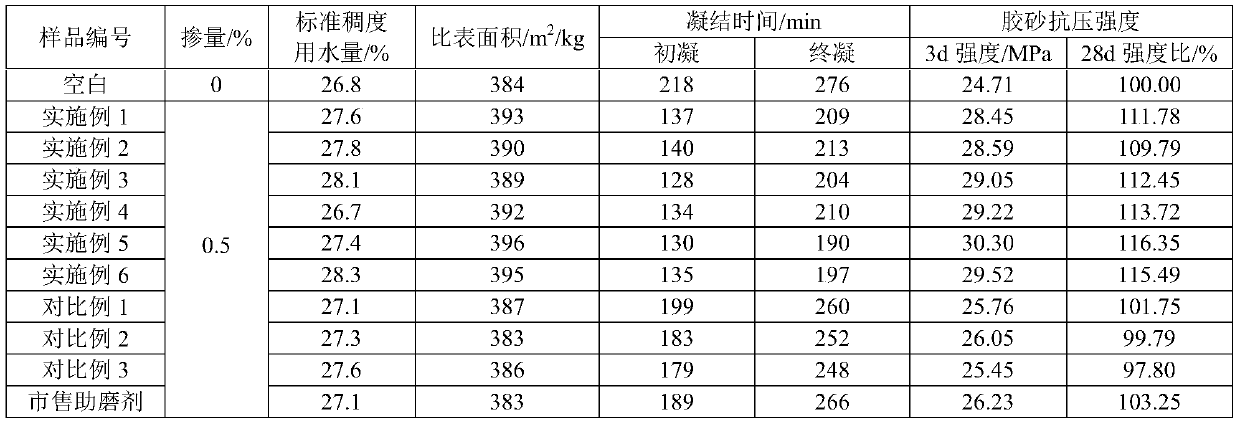
Figure 1
Abstract
Description
technical field
[0001] The invention belongs to the technical field of cement admixtures, and in particular relates to a coagulation-promoting liquid grinding aid and a preparation method thereof. Background technique
[0002] Grinding aid refers to the admixture used in cement concrete, which can significantly improve the grinding efficiency of the mill, reduce power consumption and steel ball loss, and increase cement production. It can effectively shorten the grinding time, improve cement performance, save energy and reduce emissions. , has become recognized as an important cement additive. Cement grinding aids can be adsorbed on the high-energy active points of particle fracture fine grains, reduce free energy, and at the same time penetrate into fine particle crevices, provide foreign ions or molecules, reduce powder electrostatic effect, prevent coalescence, and increase the ratio of cement Increase the surface area and increase the content of 3-32μm cement particles....
Examples
Embodiment 1
[0025] A coagulation-promoting liquid grinding aid, which is made of the following components and mass fractions of raw materials: 5% aluminum sulfate, 5% magnesium sulfate, 40% modified alcohol amine organic small molecules, 3% sodium lignosulfonate %, calcium formate 1.5%, the rest is deionized water;
[0026] The modified small organic molecules of alcohol amines are prepared by the following method: the polyamines and the small organic molecules of epoxy are placed in a reaction vessel, the temperature is raised to 30° C., and after reacting for 1 hour under the action of a catalyst, the obtained Then add an organic acid to the solution and react for 0.5h to obtain a modified alcohol amine organic small molecule; the molar ratio of the polyamine, epoxy organic small molecule, catalyst and organic acid is: 1:2:0.001:2 .
[0027] The polyamines are ethylenediamine.
[0028] The epoxy organic small molecule is ethylene oxide.
[0029] The catalyst is ferric chloride.
[0...
Embodiment 2
[0039] A coagulation-promoting liquid grinding aid, which is made of the following components and mass fractions of raw materials: 7% aluminum sulfate, 7% magnesium sulfate, 42% modified alcohol amine small organic molecules, 5% sodium lignosulfonate %, calcium formate 2%, the rest is deionized water;
[0040] The modified small organic molecules of alcohol amines are prepared by the following method: the polyamines and the small organic molecules of epoxy are placed in a reaction vessel, the temperature is raised to 35° C., and after reacting for 1.5 hours under the action of a catalyst, the Add an organic acid to the obtained solution and react for 1 hour to obtain a modified alcohol amine organic small molecule; the molar ratio of the polyamine, epoxy organic small molecule, catalyst and organic acid is: 1.5:3:0.0015:3 .
[0041] The polyamines are p-phenylenediamine.
[0042] The epoxy organic small molecule is propylene oxide.
[0043] The catalyst is aluminum chloride...
Embodiment 3
[0053] A coagulation-promoting liquid grinding aid, which is made of the following components and mass fractions of raw materials: 8% aluminum sulfate, 8% magnesium sulfate, 43% modified alcohol amine small organic molecules, 6% sodium lignosulfonate %, calcium formate 2%, the rest is deionized water;
[0054] The modified small organic molecules of alcohol amines are prepared by the following method: the polyamines and the small organic molecules of epoxy are placed in a reaction vessel, the temperature is raised to 45° C., and after reacting for 2 hours under the action of a catalyst, the obtained Then add an organic acid to the solution and react for 1.5h to obtain a modified alcohol amine organic small molecule; the molar ratio of the polyamine, epoxy organic small molecule, catalyst and organic acid is: 2:4:0.002:3 .
[0055] The polyamines are 1,4-butanediamine.
[0056] The epoxy organic small molecule is 1,2-epoxybutane.
[0057] The catalyst is tin chloride.
[00...