
Method for preparing substituted carbonyl compound by catalyzing pinacol rearrangement reaction through molecular sieve
A molecular sieve catalytic frequency, carbonyl compound technology, applied in the preparation of carbon-based compounds, chemical instruments and methods, preparation of organic compounds, etc. Wide range of applications, cheap catalysts, and simple steps
Patent Information
- Authority / Receiving Office
- CN · China
- Current Assignee / Owner
- Publication Date
- 2020-09-01
- Estimated Expiration
- Not applicable · inactive patent
Smart Images
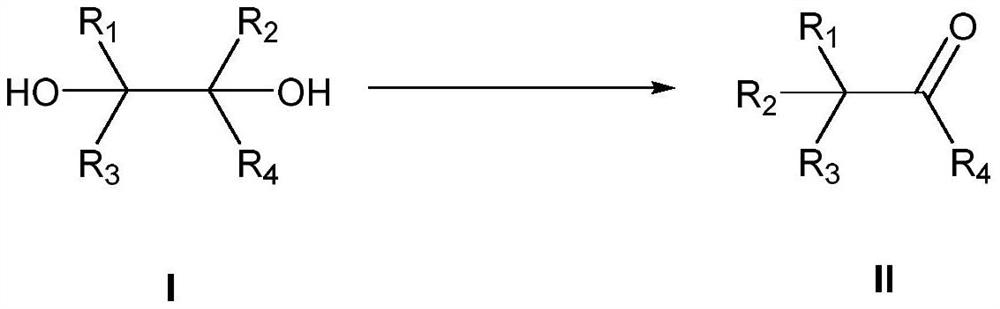
Figure 1 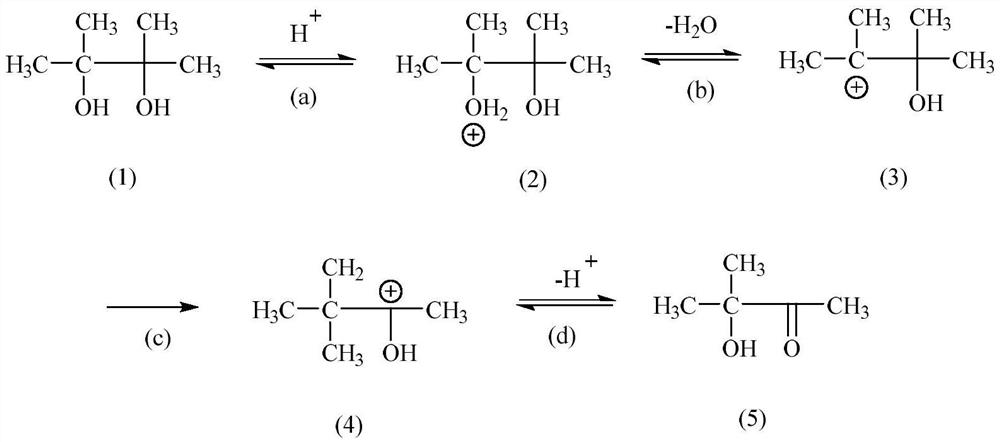
Figure 2 
Figure 3
Abstract
Description
technical field
[0001] The invention relates to the technical field of synthesis of substituted carbonyl compounds, in particular to a method for preparing substituted carbonyl compounds by molecular sieve catalyzed pinacol rearrangement. Background technique
[0002] Pinacol rearrangement, also known as "naqua rearrangement", is a type of nucleophilic rearrangement reaction that occurs in the molecule. Under acid-catalyzed conditions, pinacol rearrangement undergoes hydroxyl elimination and intramolecular rearrangement to obtain asymmetric Carbonyl compounds (aldehydes and ketones). The product pinacolone is widely used, and it is an important synthetic intermediate of fine chemicals in drugs, pesticides and dyes. The mechanism of this rearrangement is as shown in the following reaction structure formula:
[0003]
[0004] Among them, a hydroxyl group and acidic H + Combined, water molecules leave to obtain carbocation intermediates, and group migration occurs in the ...
Examples
Embodiment 1
[0016] Weigh 50 mg of benzoin hydrochloride, measure 5 mL of toluene with a graduated cylinder, mix and dissolve, slowly add 10 mg of USY-6 molecular sieve, and heat, stir and reflux, and carry out the pinacol rearrangement reaction of the following reaction equation at 110°C :
[0017]
[0018] After reacting for 5 hours, add 10ml of ethyl acetate to dissolve the organic matter, then filter out the molecular sieve, remove a small amount of water from the ethyl acetate solution with anhydrous sodium sulfate, filter, spin dry, and separate by column chromatography to obtain 44.3 mg of the product as di Phenylacetaldehyde, its yield is 88.6%.
[0019] The above-mentioned product is detected as the target compound by nuclear magnetic spectroscopy, and its test data are as follows:
[0020] 1 H NMR (400MHz, CDCl 3 )δ=9.99(d,J=3.4Hz,1H),7.45-7.31(m,6H),7.29-7.22(m,4H)4.93(d,J=3.4Hz,1H)ppm; 13 C NMR (100MHz, CDCl 3 ) δ = 199.9, 135.3, 130.0, 129.9, 127.8, 64.0 ppm.
Embodiment 2
[0022] Weigh 50mg of benzopinacol, measure 5mL of toluene with a measuring cylinder, mix and dissolve, slowly add 10mg of MCM-41 molecular sieve, and heat, stir and reflux, and carry out the pinacol rearrangement reaction of the following reaction equation at 110°C :
[0023]
[0024] After reacting for 3 hours, add 10ml ethyl acetate to dissolve the organic matter, then filter out the molecular sieves, remove a small amount of water from the ethyl acetate solution with anhydrous sodium sulfate, filter, spin dry, and separate by column chromatography to obtain 45.8 mg of the product as three Benzyl acetophenone, its yield is 91.6%.
[0025] The above-mentioned product is detected as the target compound by nuclear magnetic spectroscopy, and its test data are as follows:
[0026] 1 HNMR (400MHz, CDCl 3 )δ=7.15-7.21 (m, 2H), 7.21-7.35 (m, 16H), 7.67–7.73 (m, 2H) ppm; 13 C NMR (100MHz, CDCl 3 ) δ = 71.2, 126.8, 127.7, 127.9, 131.0, 131.2, 131.8, 137.6, 143.3, 199.0 ppm.
Embodiment 3
[0028] Weigh 50mg of 1,2-di-p-tolylmethyl 1,2-diol, measure 5mL of toluene with a graduated cylinder, mix and dissolve, then slowly add 10mg of ZSM-35 molecular sieve, and heat, stir and reflux at 110°C. The pinacol rearrangement reaction of said reaction equation:
[0029]
[0030] After reacting for 4 hours, add 10ml of ethyl acetate to dissolve the organic matter, then filter out the molecular sieve, remove a small amount of water from the ethyl acetate solution with anhydrous sodium sulfate, filter, spin dry, and separate by column chromatography to obtain 45.4 mg of the product as 2 , 2-two p-tolyl acetaldehyde, the yield was 90.8%.
[0031] The above-mentioned product is detected as the target compound by nuclear magnetic spectroscopy, and its test data are as follows:
[0032] 1 H NMR (400MHz, CDCl 3 )δ=9.91(d, 1H, J=2.5Hz), 7.17(m, 4H), 7.10(m, 4H), 4.82(d, J=2.5Hz 1H,), 2.34(s, 6H)ppm; 13 C NMR (100MHz, CDCl 3 ) δ = 198.9, 137.3, 133.4, 129.6, 129.0, 63.4, 21....