
Quinoline 4-hydroxypicolinate compound and application thereof in prevention and treatment of magnaporthe oryzae
A technology of hydroxypicolinic acid and rice blast fungus, applied in application, fungicide, organic chemistry and other directions, can solve the problem of no research and development report on the activity of rice blast fungus, and achieve the effect of improving comprehensive performance and good environmental compatibility
Patent Information
- Authority / Receiving Office
- CN · China
- Patent Type
- Applications(China)
- Current Assignee / Owner
- Publication Date
- 2020-09-11
- Estimated Expiration
- Not applicable · inactive patent
Smart Images
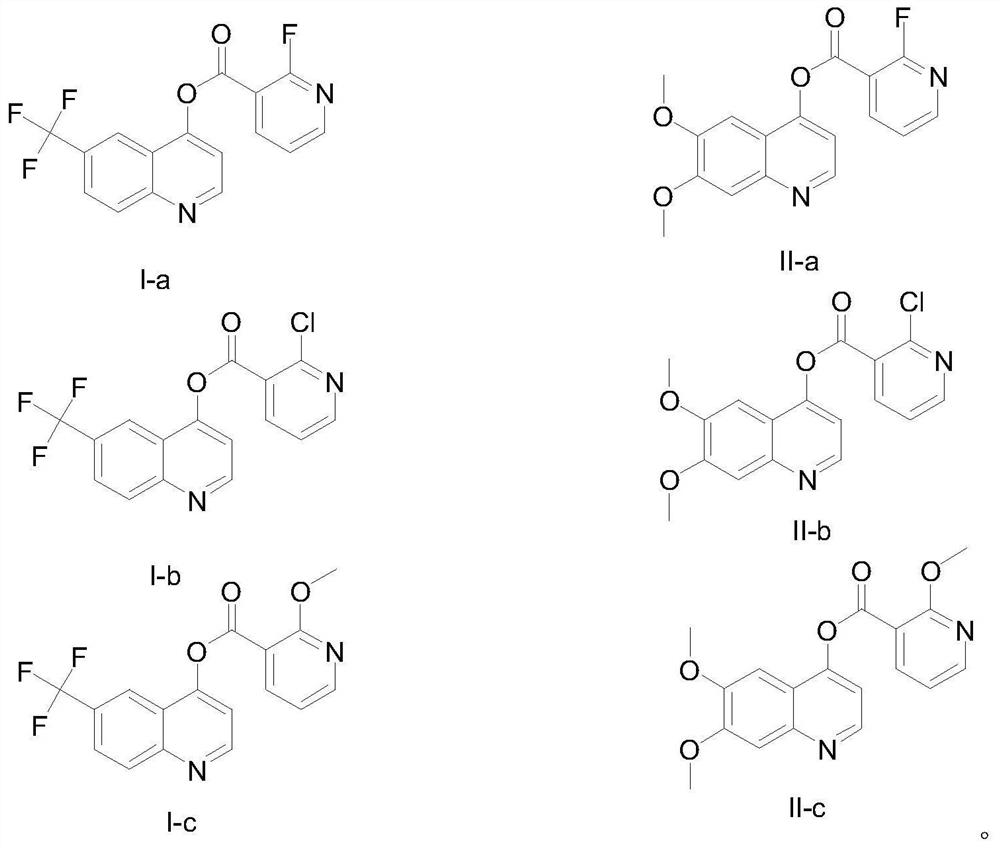
Figure 1 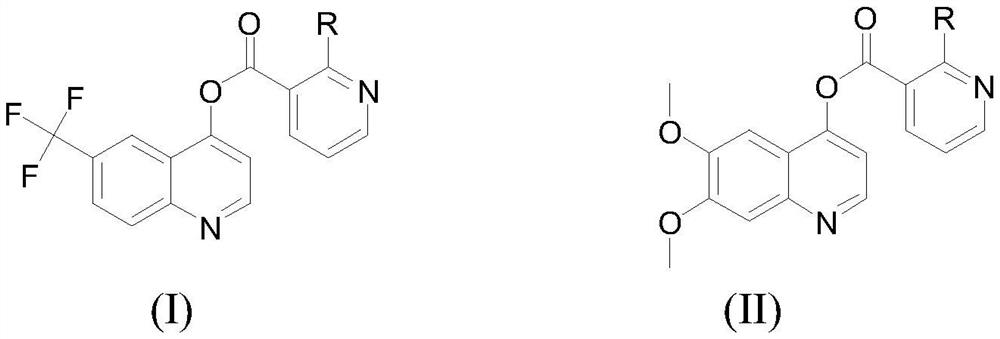
Figure 2 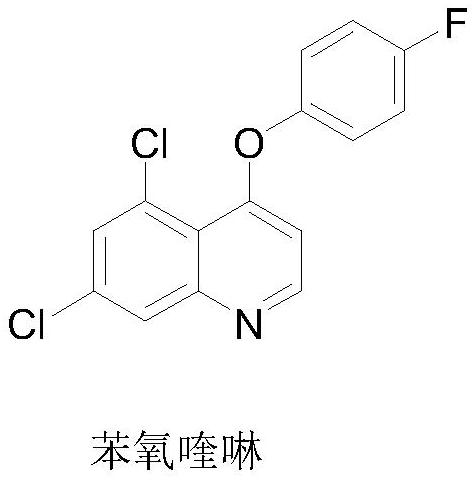
Figure 3
Abstract
Description
technical field
[0001] The invention relates to a class of novel compounds and applications thereof, in particular to a quinoline 4-hydroxypicolinate compound and its application in preventing and treating rice blast fungus. Background technique
[0002] Quinolines have a wide range of biological activities, such as insecticide, fungicide and herbicide. In the field of fungicides, two varieties of phenoxyquin and tebufloquin have been listed. It has gradually become a research hotspot for major pesticide companies at home and abroad.
[0003] The first variety of quinoline fungicides is phenoxyquinoline, English name quioxyfen, developed by Dow AgroSciences, which exerts its medicinal effect by disturbing the germination of spores. It is mainly used for strawberry powdery mildew and wheat powdery mildew. Since the 1970s Since it was launched in the 1990s, it has been widely used in crops such as vegetables and wheat, and it has systemic and protective characteristics. [...
Examples
Embodiment 1
[0030] Preparation of 6-(trifluoromethyl)-quinolin-4-yl(2-fluoropyridine)carboxylate (I-a)
[0031] 2-Fluoropyridine-3-carboxylic acid (1.1 mol) and intermediate 6-trifluoromethyl-4-quinolinol (1.0 mmol) were dissolved in 3 mLofCH 2 Cl 2 The solvent was stirred and cooled down to 0°C, and EDCI (1.2 mmol) and DMAP (1.2 mmol) were added to the above system. The reaction was carried out at 40°C under nitrogen protection for 15h-20h. After the reaction was completed, the reaction solution was washed with saturated brine (2×2mL), and washed with water (2×2mL), dried over sodium sulfate, filtered with suction, and the crude product was obtained by flash column chromatography (petroleum ether / ethyl acetate, v / v=10 :1–1:1) to obtain compound 6-(trifluoromethyl)-quinolin-4-yl(2-fluoropyridine)carboxylate, white powder, yield 51%, 1 H NMR (400MHz, CDCl 3 )δ: 9.08 (d, J = 4.8Hz, 1H), 8.62–8.67 (m, 1H), 8.58 (d, J = 4.4Hz, 1H), 8.45 (s, 1H), 8.29 (d, J 1 =8.8Hz,1H),7.95(dd,J 1 =8.8Hz...
Embodiment 2
[0033] Preparation of 6-(trifluoromethyl)-quinolin-4-yl(2-chloropyridine)carboxylate (I-b)
[0034] White powder, yield 37%, 1 H NMR (400MHz, CDCl 3 )δ: 9.11(d,J=4.8Hz,1H), 8.70(dd,J 1 =4.8Hz,J 2 =2.0Hz,1H),8.51(dd,J 1 =8.0Hz,J 2 =2.0Hz,1H),8.41(s,1H),8.31(d,J 1 =8.8Hz,1H),7.96(dd,J 1 =8.8Hz,J 1 =1.5Hz,1H),7.64(d,J=4.8Hz,1H),7.53(dd,J 1 =8.0Hz,J 2 = 4.8Hz, 1H).
Embodiment 3
[0036] Preparation of 6-(trifluoromethyl)-quinolin-4-yl(2-methoxypyridine)carboxylate (I-c)
[0037] White powder, yield 26%, 1 H NMR (400MHz, CDCl 3 )δ:9.07(d,J=4.6Hz,1H), 8.63(s,1H),8.48(dd,J 1 =4.8Hz,J 2 =1.7Hz,1H),8.44(dd,J 1 =7.5Hz,J 2 1.7 Hz, 1H), 8.28(d, J=8.8Hz, 1H), 7.95(d, J=8.8Hz, 1H), 7.72(d, J=4.9Hz, 1H), 7.11 (dd, J 1 =7.5Hz,J 2 =4.9Hz, 1H), 4.19(s, 3H).