
Device and method for synchronous in-situ measurement of linear displacement and straightness of guide rail
A technology of straightness and linear displacement, applied in the field of precision measurement, can solve the problems of off-line measurement, large assembly volume, affecting production speed and quality, etc., achieve high positioning accuracy, small installation volume, and avoid uneven heat transfer
Patent Information
- Authority / Receiving Office
- CN · China
- Patent Type
- Applications(China)
- Current Assignee / Owner
- Publication Date
- 2020-10-02
Smart Images
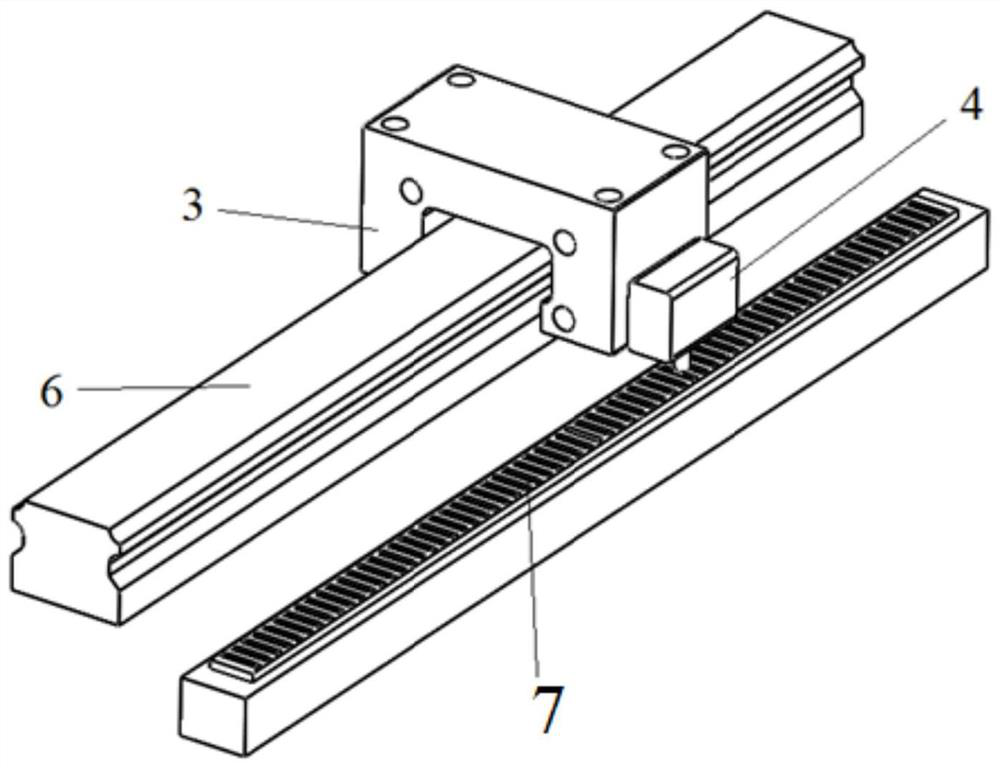
Figure 1 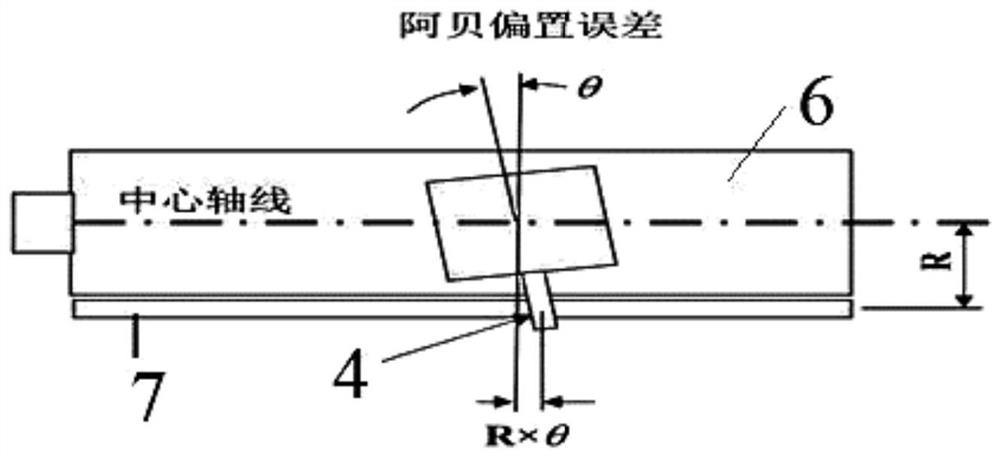
Figure 2 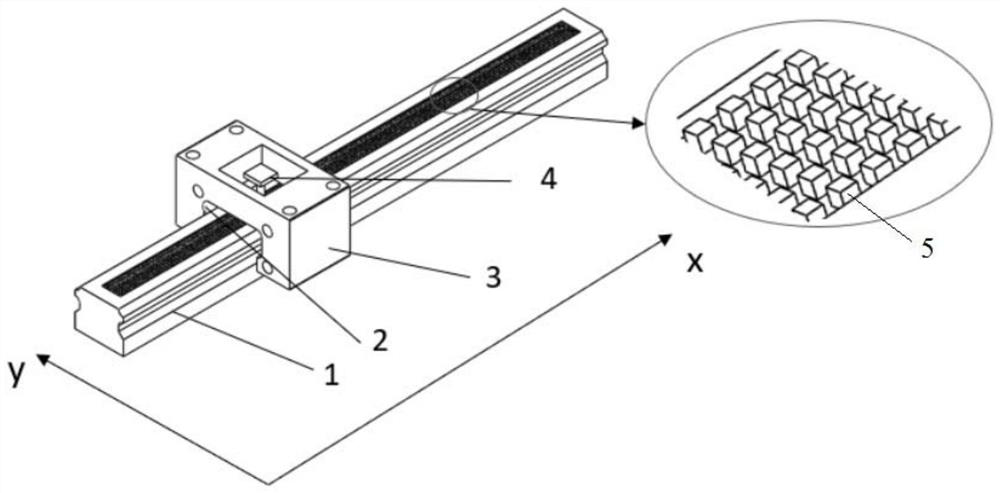
Figure 3
Abstract
Description
technical field
[0001] The invention belongs to the technical field of precision measurement, and in particular relates to a device and method for synchronously measuring the linear displacement and straightness of a guide rail in situ. Background technique
[0002] The continuous improvement of positioning accuracy is one of the "stuck neck" technical problems in the development of high-end equipment. Linear guide rail components are the core basic components of high-end equipment, and their precise guidance and positioning accuracy play a decisive role in the accuracy of high-end equipment.
[0003] refer to figure 1 and figure 2 , the structural form of the traditional guide rail assembly is the assembly combination of the guide rail 6, the one-dimensional grating 7 and multiple external sensors. The uncertainty becomes larger; secondly, the two materials are inconsistent, and it is easy to introduce nonlinear errors under the condition of heating, which cannot be eff...
Examples
Embodiment Construction
[0031] In order to make the purpose and technical solution of the present invention clearer and easier to understand. The present invention will be further described in detail below in conjunction with the drawings and embodiments. The specific embodiments described here are only used to explain the present invention, not to limit the present invention.
[0032] In describing the present invention, it should be understood that the terms "center", "longitudinal", "transverse", "upper", "lower", "front", "rear", "left", "right", " The orientations or positional relationships indicated by "vertical", "horizontal", "top", "bottom", "inner" and "outer" are based on the orientations or positional relationships shown in the drawings, and are only for the convenience of describing the present invention and Simplified descriptions, rather than indicating or implying that the device or element referred to must have a particular orientation, be constructed and operate in a particular ori...