
Preparation method of relugolix drug intermediate
A technique of rilugoli and intermediates, applied in the field of drug synthesis, can solve the problems of high flammability, low flash point, high production environment requirements, etc., and achieve the effect of avoiding substitution reaction
Patent Information
- Authority / Receiving Office
- CN · China
- Patent Type
- Applications(China)
- Current Assignee / Owner
- Publication Date
- 2021-02-05
- Estimated Expiration
- Not applicable · inactive patent
Smart Images
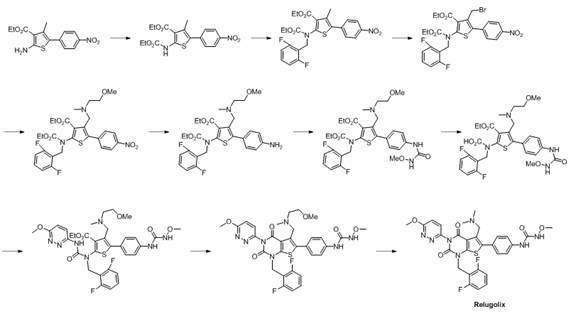
Figure 1 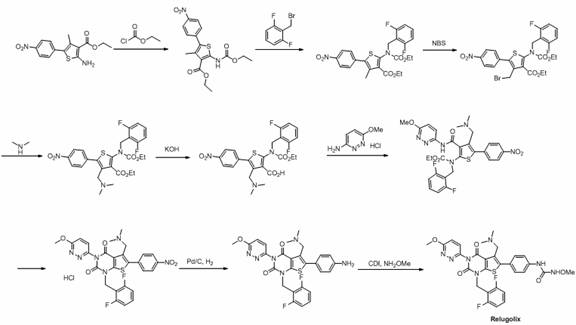
Figure 2 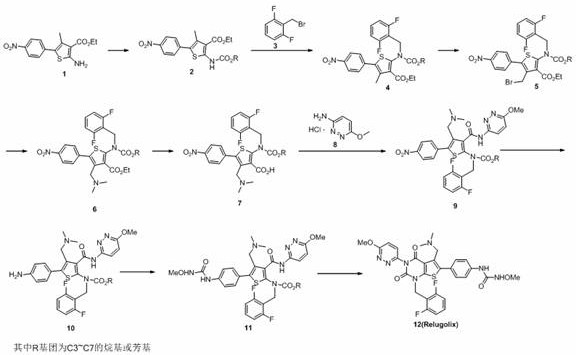
Figure 3
Abstract
Description
technical field
[0001] The application relates to the field of drug synthesis, in particular to a preparation method of a thieno[2,3-d]pyrimidine compound exhibiting gonadotropin-releasing hormone (GnRH) antagonistic activity and an intermediate thereof. Background technique
[0002] Endometriosis is caused by the growth of endometrium in any part other than the uterine cavity. It is a common estrogen-dependent gynecological disease that often occurs during women's reproductive years. Its mechanism of action is still unclear. The difficult diagnosis and complex symptoms of endometriosis, such as unknown etiology, have seriously hindered the discovery of effective treatments. At present, endometriosis is mainly diagnosed by laparoscopy and treated by surgery, or by taking contraceptives, GnRH receptor agonists or progestins to reduce estrogen levels in the body to control. In July 2018, Eragolix Sodium, the world's first oral GnRH antagonist in this field, was approved by th...
Examples
Embodiment 1
[0021]
[0022] Toluene (450 mL) and compound 1 (150 g) were added in sequence to a 2 L reaction flask, stirring was started, propyl chloroformate (120 g) was added dropwise, and the reaction was heated under reflux for 2 h. Cool down to 50-60 °C, control the internal temperature at 50-60 °C and add ethanol (1350 mL) dropwise. After the dropwise addition, slowly lower the temperature to an internal temperature of 0-10 °C, stir for 1 h, filter, and rinse the filter cake with ethanol (300 mL). Drying in vacuo at 45 °C gave a yellow solid with a yield of 84.4% and a purity of 98%.
[0023] The NMR data of compound 2-a are as follows:
[0024] 1 H NMR (400 MHz, CDCl 3 ) δ 10.67 (s, 1H), 8.31-8.22 (m, 2H), 7.59-7.52 (m,2H), 4.39 (q, J = 7.1 Hz, 2H), 4.21 (t, J = 6.7 Hz, 2H) , 2.42 (s, 3H), 1.80-1.67 (m, 2H), 1.42 (t, J = 7.1 Hz, 3H), 1.00 (t, J = 7.4 Hz, 3H).
Embodiment 2
[0026]
[0027] Add toluene (1.5 mL) and compound 1 (0.5 g) to the 10 mL reaction flask in sequence, start stirring, add isopropyl chloroformate (0.4 g) dropwise, and heat to reflux for 2 h. Cool down to 20-30 °C, add purified water (4 mL) and dichloromethane (4 mL), separate layers, extract the aqueous phase with dichloromethane (4 mL), combine the organic phases, and concentrate under reduced pressure to obtain compound 2 -b The crude product was purified by column (ethyl acetate: n-heptane = 1:10) to obtain 0.58 g of a bright yellow solid with a yield of 90% and a purity of 98%.
[0028] The NMR data of compound 2-b are as follows:
[0029] 1 H NMR (400 MHz, DMSO-d6) δ 10.45 (s, 1H), 8.29 – 8.23 (m, 2H), 7.69 – 7.63 (m, 2H), 5.02 – 4.91 (m, 1H), 4.32 (m, J = 7.1 Hz, 2H), 2.34 (s, 3H), 1.33 (t, J = 7.1 Hz, 3H), 1.29 (d, J = 6.3 Hz, 6H).
Embodiment 3
[0031]
[0032] Add toluene (1.5 mL), compound 1 (0.10 g) in sequence to the 10 mL reaction bottle, add K 2 CO 3 (90 mg), start stirring, add benzyl chloroformate (0.136 g) dropwise, and heat under reflux for 4 h. Cool down to 20-30 °C, add purified water (4 mL) and toluene (4 mL), separate the layers, extract the aqueous phase with toluene (4 mL), combine the organic phases, and concentrate under reduced pressure to obtain the crude compound 2-c. After column purification (ethyl acetate: n-heptane = 1:6), 0.103 mg of a bright yellow solid was obtained, with a yield of 71.5% and a purity of 98%.
[0033] The NMR data of compound 2-c are as follows:
[0034] 1 H NMR (400 MHz, CDCl 3 ) δ 10.75 (s, 1H), 8.37-8.16 (m, 2H), 7.62-7.50 (m,2H), 7.49-7.32 (m, 5H), 5.27 (s, 2H), 4.37 (q, J = 7.1 Hz, 2H), 2.41 (s, 3H), 1.40 (t, J = 7.1 Hz, 3H).