

Synthesis method of 5-chloro-1-indanone
A synthesis method and indanone technology are applied in the field of synthesis of 5-chloro-1-indanone, which can solve the problems of potential safety hazards, high temperature, carbonization, etc., so as to improve environmental protection benefits, reduce the generation of tar, and improve product quality. and yield effect
Patent Information
- Authority / Receiving Office
- CN · China
- Patent Type
- Applications(China)
- Current Assignee / Owner
- Publication Date
- 2021-07-09
Smart Images
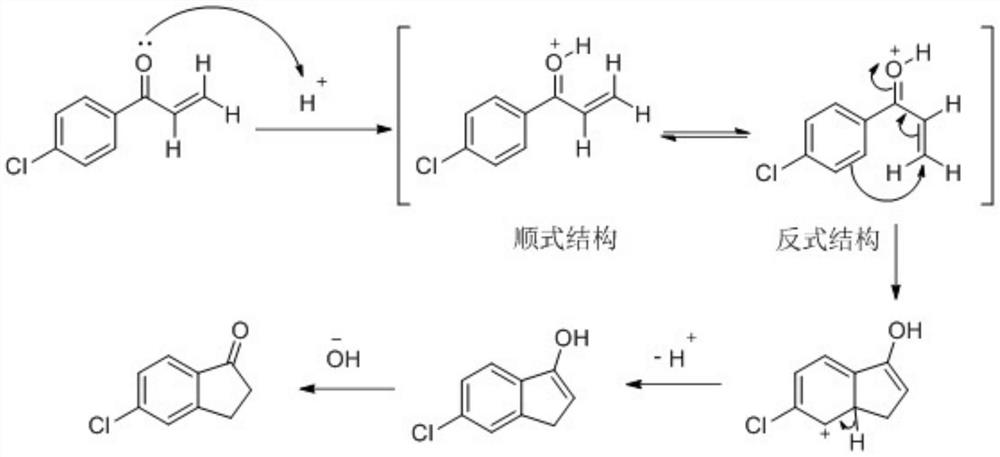
Figure 1
Abstract
Description
technical field
[0001] The invention belongs to the technical field of organic synthesis, and in particular relates to a synthesis method of 5-chloro-1-indanone. Background technique
[0002] 5-Chloro-1 indanone is an important intermediate for the synthesis of new pesticide indoxacarb. At present, the main process for synthesizing 5-chloro-1-indanone is the Friedel-Crafts alkylation reaction of 3,4'-dichloropropiophenone in an aluminum chloride system at a temperature above 150°C. Due to the weak reactivity of 3,4'-dichloropropiophenone, a high reaction temperature and an excessive amount of aluminum trichloride catalyst are required, while the coking temperature and carbonization temperature of raw materials and products are low, so in the Friedel-Crafts alkylation reaction Different degrees of coking and carbonization occurred in the process. The degree of coking and carbonization of the reaction system not only affects the purity and yield of the product, but also affe...
Examples
Embodiment 1
[0026] (1) Weigh 175.2 g (1.0 mol) of 1-(4-chlorophenyl)-2-propen-1-one with a purity of 95% and 350 g of toluene, place in a high-pressure reaction flask, and stir to dissolve.
[0027] (2) Place the reaction bottle in a low-temperature tank and stir to lower the temperature. When the temperature in the reaction bottle drops to -5~0°C, start to pass hydrogen chloride gas slowly. React with hydrogen chloride.
[0028] (3) After 3 hours of aeration reaction, the temperature of the system no longer showed an upward trend, and 15.0% of 1-(4-chlorophenyl)-2-propen-1-one was detected by sampling. Close the tail gas venting valve of the reaction bottle, continue to pass hydrogen chloride gas, close the hydrogen chloride venting valve when the pressure of the high-pressure reaction bottle reaches 0.2-0.25 MPa, and continue the heat preservation reaction at 0-5 °C for 2 hours.
[0029] (4) Sampling and detection of 1-(4-chlorophenyl)-2-propen-1-one remaining at 0.2%, the reaction is ...
Embodiment 2
[0031] (1) Weigh 175.2 g (1.0 mol) of 1-(4-chlorophenyl)-2-propen-1-one with a purity of 95% and 400 g of toluene, place in a high-pressure reaction flask, and stir to dissolve.
[0032] (2) Place the reaction bottle in a low-temperature tank and stir to lower the temperature. When the temperature in the reaction bottle drops to -5-0°C, start to pass hydrogen chloride gas slowly. React with hydrogen chloride.
[0033] (3) After 2 hours of aeration reaction, the temperature of the system no longer showed an upward trend, and 15.4% of 1-(4-chlorophenyl)-2-propen-1-one was detected by sampling. Close the tail gas venting valve of the reaction bottle, continue to pass hydrogen chloride gas, close the hydrogen chloride venting valve when the pressure of the high-pressure reaction bottle reaches 0.2-0.25 MPa, and continue the heat preservation reaction at 0-5 °C for 2 hours.
[0034] (4) Sampling and detection of 1-(4-chlorophenyl)-2-propen-1-one remaining at 0.3%, the reaction is ...
Embodiment 3
[0036] (1) Weigh 175.2 g (1.0 mol) of 1-(4-chlorophenyl)-2-propen-1-one with a purity of 95% and 400 g of methanol, place in a high-pressure reaction flask, and stir to dissolve.
[0037] (2) Place the reaction bottle in a low-temperature tank and stir to lower the temperature. When the temperature in the reaction bottle drops to -5~0°C, start to pass hydrogen chloride gas slowly. React with hydrogen chloride.
[0038] (3) After 2 hours of ventilation reaction, the temperature of the system no longer showed an upward trend, and 13.0% of 1-(4-chlorophenyl)-2-propen-1-one was detected by sampling. Close the tail gas venting valve of the reaction bottle, continue to pass hydrogen chloride gas, close the hydrogen chloride venting valve when the pressure of the high-pressure reaction bottle reaches 0.2-0.25 MPa, and continue the heat preservation reaction at 0-5 °C for 2 hours.
[0039] (4) Sampling and detection of 1-(4-chlorophenyl)-2-propen-1-one remaining at 0.28%, the reactio...