
Ultra-wideband frequency-modulated continuous wave SAR self-focusing imaging method
A technology of frequency modulation continuous wave and imaging method, which is applied in radio wave measurement system, radio wave reflection/re-radiation, utilization of re-radiation, etc., can solve the problem that the self-focusing method is no longer applicable, and avoid physical calibration experiments, Wide application prospect and low dependence effect
Patent Information
- Authority / Receiving Office
- CN · China
- Patent Type
- Applications(China)
- Current Assignee / Owner
- Publication Date
- 2021-08-06
Smart Images
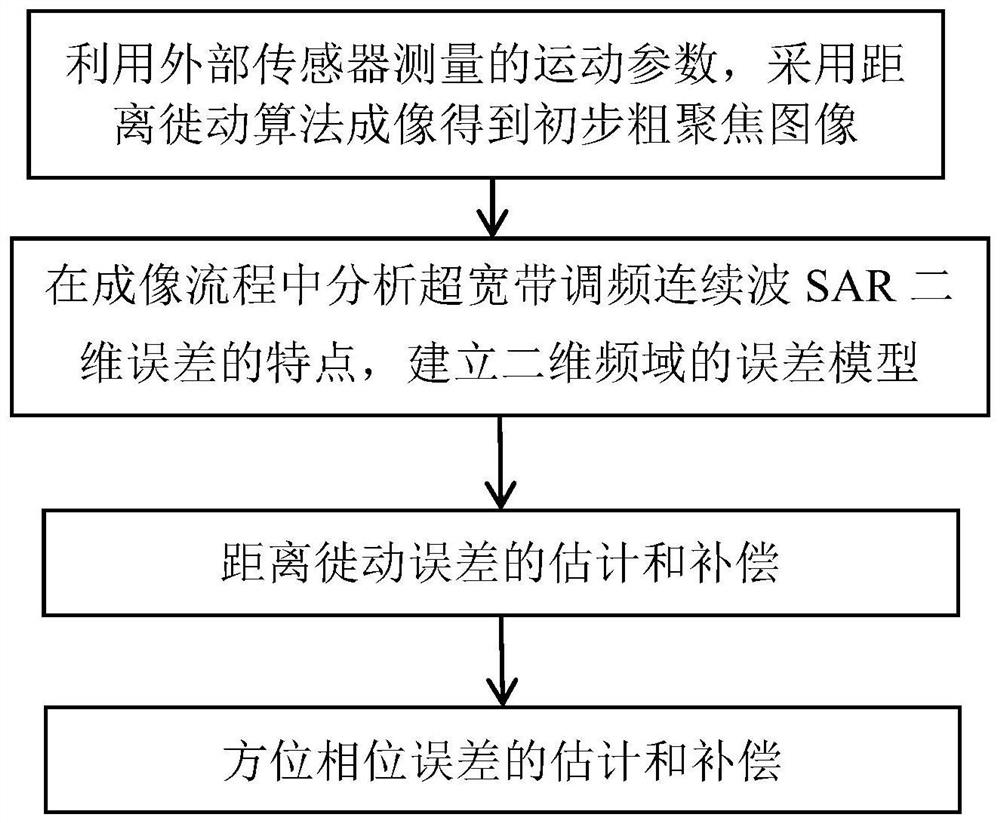
Figure 1 
Figure 2 
Figure 3
Abstract
Description
technical field
[0001] The invention relates to the technical field of ultra-wideband FM continuous wave radar, in particular to an ultra-wideband FM continuous wave SAR self-focusing imaging method. Background technique
[0002] Synthetic Aperture Radar (SAR), as a modern popular remote sensing technology, can penetrate clouds and fog, break through the limitations of time and space, and efficiently obtain high-resolution images. It is widely used in civilian and military fields. Target imaging, tracking and identification. It is also its broad and complex application scenarios that put forward higher requirements for the performance of the SAR system, such as: higher spatial resolution, larger surveying and mapping width, and faster response time. Therefore, corresponding to the realization of the radar system, the core requirement is high-speed manipulation of broadband signals, that is, generation, control, transmission, and processing of broadband signals. However, tr...
Examples
Embodiment Construction
[0044] For a long time, the realization of large swaths and high-resolution imaging of scene objects has been the goal pursued by SAR in the field of remote sensing, which is of great significance in both civilian and military applications. The realization of the above functions requires the radar to have a large operating bandwidth and fast data processing capabilities. In terms of hardware system implementation, traditional electronic technology has been difficult to meet the design requirements. Microwave photonic technology is considered to be the main technical means of the new generation of radar in the future because of its advantages such as large broadband, low loss, and anti-electromagnetic interference, and has broad application prospects. However, because it can provide ultra-wideband and high-resolution signals, the system will face difficulties such as additional unknown time delay and wavelength drift. The current basic imaging algorithm cannot support it to achi...