
Preparation method of taper-core optical fiber with gradually-changed core-to-package ratio and taper-core optical fiber
A tapered core and core-wrapped technology, applied in cladding fibers, glass fibers, optical waveguides, etc., can solve the problems of reducing pump light absorption efficiency, reducing laser output power, thermally induced mode instability, etc.
Patent Information
- Authority / Receiving Office
- CN · China
- Patent Type
- Applications(China)
- Current Assignee / Owner
- Publication Date
- 2021-08-20
Smart Images
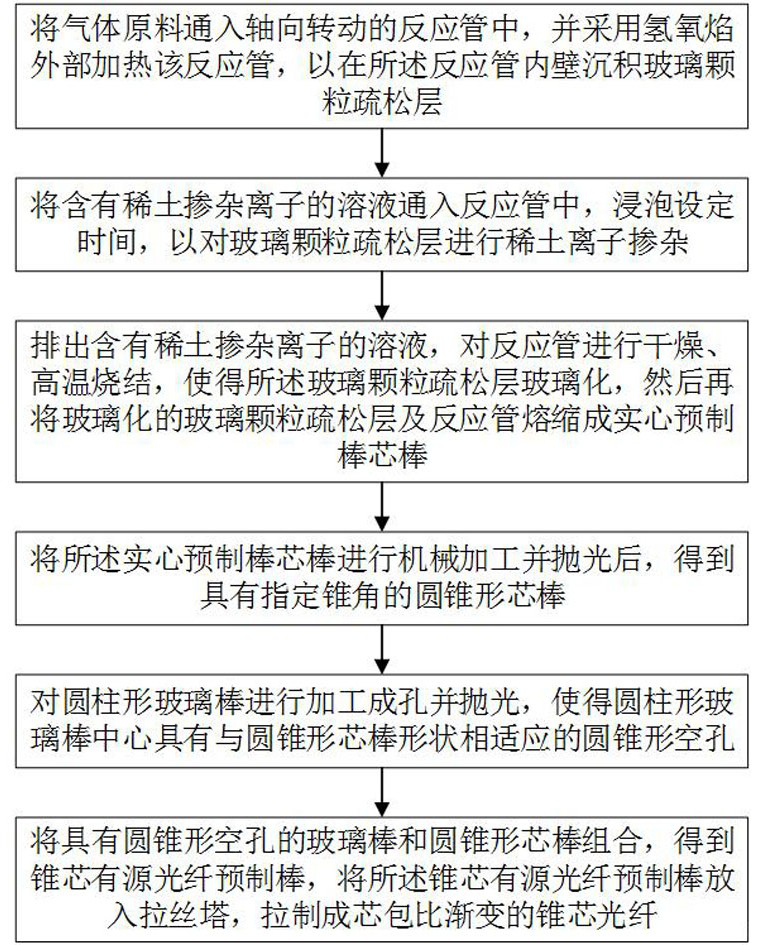
Figure 1 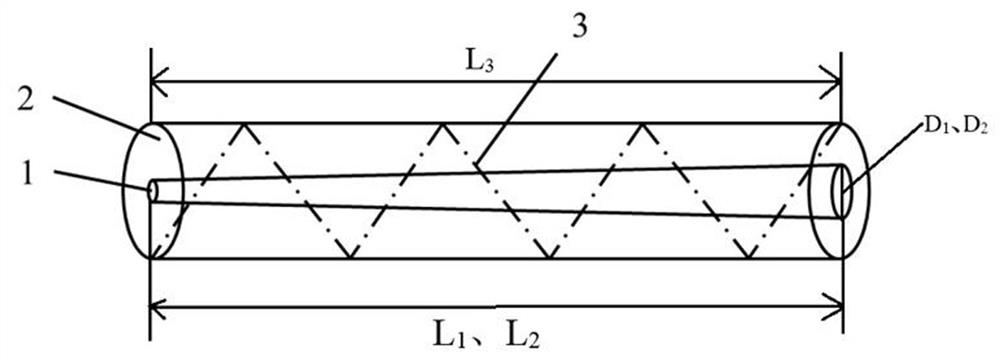
Figure 2 
Figure 3
Abstract
Description
technical field
[0001] The invention belongs to the technical field of optical fiber manufacturing, and more specifically relates to a preparation method of a tapered-core optical fiber with a gradually changing core-to-clad ratio and the tapered-core optical fiber. Background technique
[0002] High-power narrow-linewidth fiber lasers have the advantages of small size, light weight, good beam coherence, good beam quality, and excellent thermal management performance. They are widely used in industrial processing, intelligent manufacturing, biomedicine, and beam synthesis. With the expansion of application fields, higher requirements are put forward for the output power and beam quality of high-power narrow-linewidth fiber lasers. At present, the output power of a single high-power narrow-linewidth fiber laser has reached the kilowatt level. As the power is further increased, nonlinear effects and thermally induced mode instability effects become the main factors that limit...
Examples
Embodiment 1
[0054] In this embodiment, a method for designing and manufacturing a cone-core ytterbium-doped optical fiber with a gradually changing core-to-clad ratio, the specific method and steps are as follows:
[0055] Step 1, the SiCl 4 with O 2 Pass into the axially rotating reaction tube together, the hydrogen-oxygen flame is externally heated, and SiO is deposited on the inner wall of the reaction tube 2 A loose layer of glass particles.
[0056] Step 2, 6.0g YbCl 3 ·6H 2 O was dissolved in 500mL deionized water to make a solution, injected into the reaction tube, soaked for 3h, and carried out Yb 3+ Doped.
[0057] Step 3, discharge YbCl 3 ·6H 2 O aqueous solution, drying the reaction tube, sintering at 1650°C at high temperature to achieve vitrification of the loose layer, and then melting and shrinking at 1850°C to form a solid prefabricated core rod.
[0058]Step 4, after machining and polishing the solid prefabricated rod mandrel, a conical mandrel is obtained, and th...
Embodiment 2
[0062] Step 1: Prepare a quartz reaction tube, clean the quartz reaction tube, install a rotary joint on the inlet section of the quartz reaction tube, install the quartz reaction tube on a deposition lathe, and preheat the quartz reaction tube externally with an oxyhydrogen flame. Quartz reaction tube, during the preheating process, gradually increase the temperature of the quartz reaction tube to 1200°C. After the temperature of the reaction tube is heated to 1750°C, SiCl is introduced into the quartz reaction tube according to the preset flow rate. 4 、GeCl 4 with O 2 , during the repeated rotation of the reaction tube, a loose layer of glass particles with a specified thickness of 1.5 cm is deposited on the inner wall of the reaction tube. The loose layer of glass particles is SiO 2 and GeO 2 .
[0063] Step 2, carry out Nd 3+ 5.2g Nd(NO 3 ) 3 ·6H 2 O was dissolved in 500mL of absolute ethanol to make a solution, injected into the reaction tube, soaked for 2h, and c...
Embodiment 3
[0069] Step 1, the SiCl 4 , POCl 3 with O 2 Pass into the axially rotating reaction tube together, the hydrogen-oxygen flame is externally heated, and SiO is deposited on the inner wall of the reaction tube 2、 P 2 o 5 A loose layer of glass particles.
[0070] Step 2, carry out Er 3+ Doped. 6.2gErCl 3 ·6H 2 O was dissolved in 400mL of absolute ethanol to make a solution, injected into the reaction tube, soaked for 2.5h, and performed Er 3+ Doped.
[0071] Step 3, discharge ErCl 3 ·6H 2 O absolute ethanol solution, drying the reaction tube, sintering at a high temperature of 1350 ° C to achieve vitrification of the loose layer, and then melting and shrinking at 1860 ° C to form a solid prefabricated rod mandrel.
[0072] Step 4, after machining and polishing the solid prefabricated rod mandrel, a conical mandrel is obtained, and the diameter of the end face of the mandrel is D 1 =5cm, the length L of mandrel 1 =200cm.
[0073] Step five, machining the inner wall ...