
Rural electric heating combined system coupling element planning method
A combined system and coupling element technology, applied in the field of electrical engineering, can solve problems such as not considering the characteristics of rural energy systems, and achieve the effect of improving energy utilization and economic development
Patent Information
- Authority / Receiving Office
- CN · China
- Patent Type
- Applications(China)
- Current Assignee / Owner
- Publication Date
- 2021-12-24
Smart Images
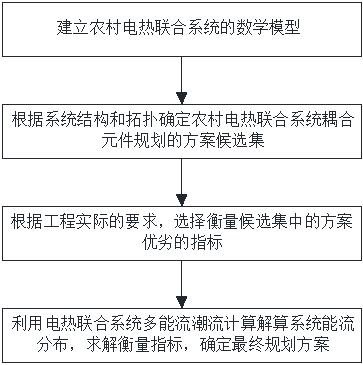
Figure 1 
Figure 2 
Figure 3
Abstract
Description
technical field
[0001] The invention belongs to the field of electrical engineering, and in particular relates to a planning method for coupling elements of a combined electric heating system in rural areas. Background technique
[0002] With the depletion of fossil fuels and environmental pollution, renewable energy such as wind energy and solar energy is developing rapidly. However, renewable energy is uncertain and intermittent, and it is difficult for the power system to make full use of it. Therefore, to improve energy utilization Efficiency, discovery of new energy sources, and realization of large-scale development of renewable energy sources have become inevitable choices to resolve the contradictions between energy demand growth, energy shortage, and environmental protection.
[0003] The integrated energy system breaks the existing mode of separate planning, separate design and independent operation of various energy supply systems such as electricity, heat, and ga...
Examples
Embodiment Construction
[0097] In order to make the purpose, technical solution and advantages of the present invention more clear, the present invention will be further described in detail below in conjunction with the accompanying drawings and examples. It should be understood that the specific embodiments described here are only used to explain the present invention, not to limit the present invention.
[0098] A method for planning coupling elements of a combined electric heating system in rural areas, comprising the following steps:
[0099] Step 1: Establish a mathematical model of the combined power and heat system in rural areas
[0100] Mathematical models of combined electric and heat systems in rural areas include: power system model, thermal system model and coupling element model.
[0101] 1.1 Power system model
[0102] The power system model is expressed in the following form
[0103]
[0104] P i =(P i G +P i RE +P i CHP +P i BCHP )-(P i HP +P i EB +P i D ) (2)
...