
Flame-retardant polyurethane and preparation method thereof
A polyurethane and flame-retardant technology, applied in the field of flame-retardant polyurethane and its preparation, can solve the problems of easy migration, low hardness, poor matrix compatibility, etc., and achieve the effect of simple process, good performance and long-lasting flame retardancy
Patent Information
- Authority / Receiving Office
- CN · China
- Patent Type
- Applications(China)
- Current Assignee / Owner
- Publication Date
- 2022-04-22
Smart Images

Figure 1 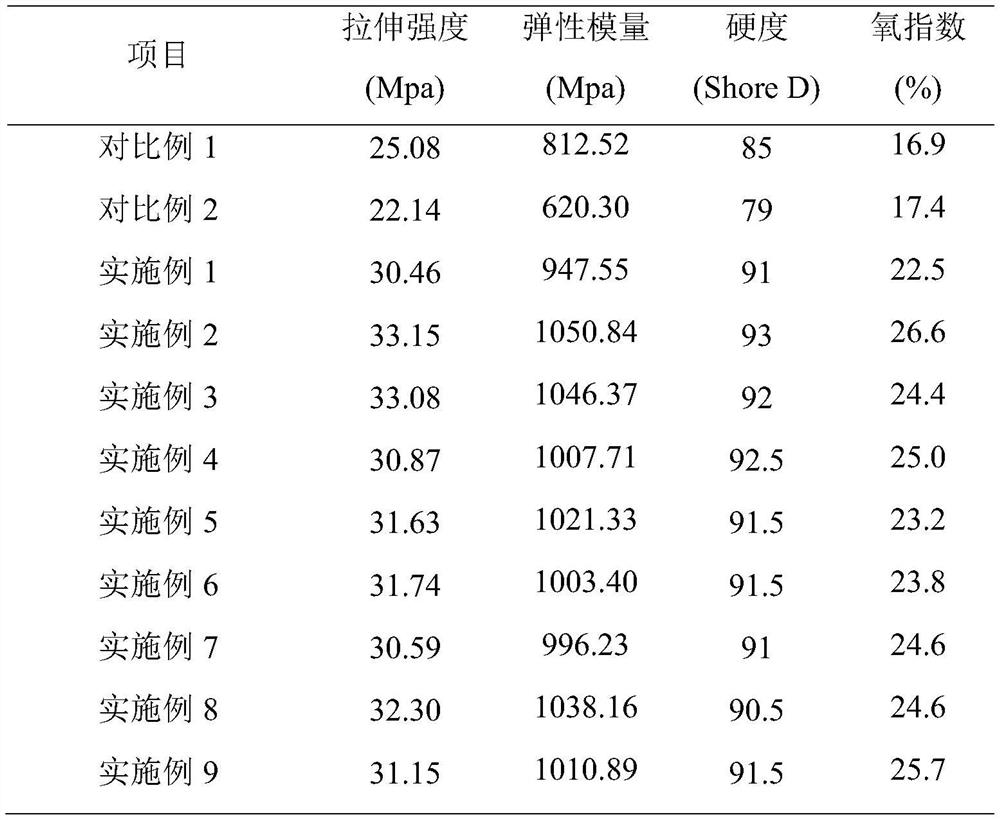
Figure 2
Abstract
Description
technical field
[0001] The invention belongs to the technical field of new materials, and relates to a flame-retardant polyurethane and a preparation method thereof. Background technique
[0002] Polyurethane (PU) is a block polymer formed by the reaction of diisocyanate or polyisocyanate (hard segment) and polyol (soft segment) with more than 2 hydroxyl groups. The PU main chain contains many carbamate groups, so a large number of hydrogen bonds can be formed in the molecule and between the molecules, so that physical cross-linking occurs in the molecular chain. Due to the thermodynamic incompatibility of the cross-linked soft and hard phases, it makes The aggregation of hard segments and soft segments leads to microphase separation, that is, the uniform cross distribution of soft and hard segments acts as an elastic crosslinking effect, which makes polyurethane have excellent mechanical properties and various characteristics such as insulation, oil resistance, hydrolysis r...
Examples
Embodiment 1
[0032] (1) Preparation of component A
[0033] In parts by weight, 50 parts of hydroxyl-terminated polybutadiene, 10 parts of polycaprolactone diol, 30 parts of polypropylene glycol, 10 parts of trimethylolpropane, 5 parts of 9,10-dihydro-9-oxygen Hetero-10-phosphaphenanthrene-10-oxide was stirred at 1000 rpm and vacuum at 120°C for 3 hours, mixed evenly and cooled to 50°C to obtain the component A.
[0034] (2) Take 56 parts of component A and 40 parts of component B (4,4'-diphenylmethane diisocyanate) in the same container, and stir at room temperature for 5 minutes until the mixture is uniform to obtain a solvent-free two-component polyurethane.
Embodiment 2
[0036] (1) Preparation of component A
[0037] In parts by weight, 60 parts of hydroxyl-terminated polybutadiene, 10 parts of polycaprolactone triol, 10 parts of polypropylene glycol, 5 parts of trimethylolethane, 10 parts of 9,10-dihydro-9- Oxa-10-phosphaphenanthrene-10-oxide, stirred at 1500 rpm and vacuum at 100°C for 3 hours, mixed uniformly and cooled to 70°C to obtain the component A.
[0038] (2) Take 60 parts of component A and 40 parts of component B (toluene diisocyanate) in the same container, stir at room temperature for 6 minutes until they are evenly mixed to obtain a solvent-free two-component polyurethane.
Embodiment 3
[0040] (1) Preparation of component A
[0041] In parts by weight, 40 parts of hydroxyl-terminated polybutadiene, 25 parts of polycaprolactone diol, 25 parts of polypropylene glycol, 10 parts of trimethylolpropane, 10 parts of 9,10-dihydro-9-oxygen Hetero-10-phosphaphenanthrene-10-oxide was stirred at 1600 rpm and vacuum at 110°C for 2.5 hours, mixed evenly and cooled to 50°C to obtain the component A.
[0042] (2) Take 60 parts of component A and 40 parts of component B (toluene diisocyanate) in the same container, stir at room temperature for 8 minutes until they are evenly mixed to obtain a solvent-free two-component polyurethane.