
Phenidate drug formulations having diminished abuse potential
a technology of phenidate and drug formulation, which is applied in the field of phenidate drugs, can solve the problems of high potential for substance abuse in patients, notable side effects, insomnia, etc., and achieves the effects of fewer or reducing side effects, high serum levels of l-threo methylphenidate, and high pharmaceutical efficacy
Patent Information
- Authority / Receiving Office
- US · United States
- Patent Type
- Applications(United States)
- Current Assignee / Owner
- Publication Date
- 2002-03-21
- Estimated Expiration
- Not applicable · inactive patent
Smart Images
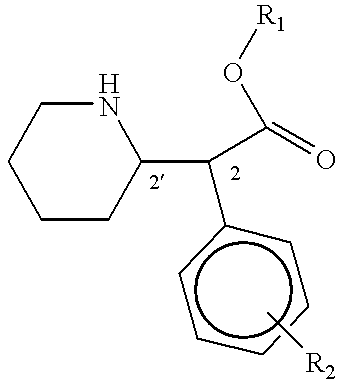
Figure 1 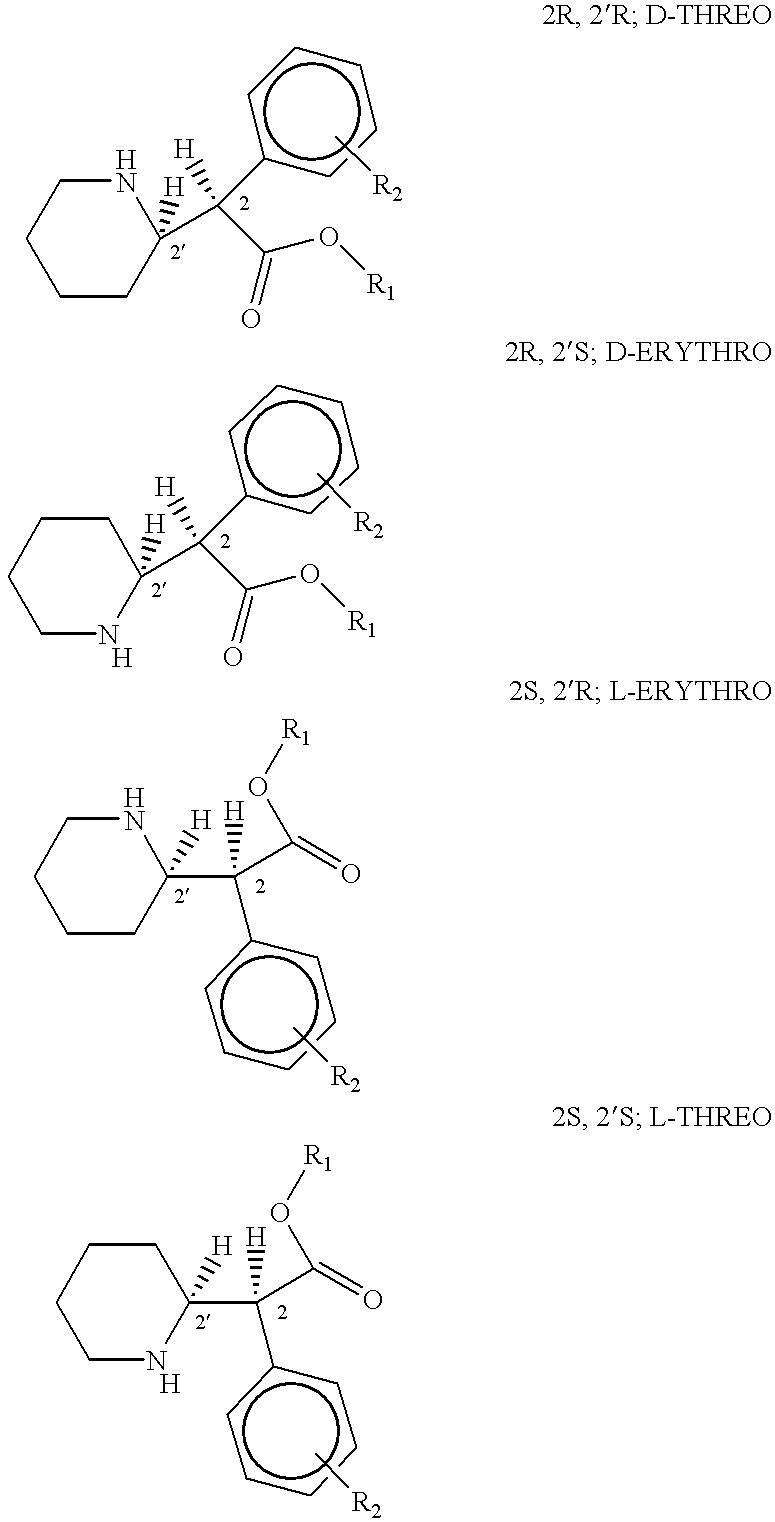
Figure 2 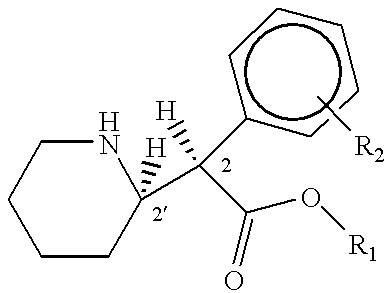
Figure 3
Abstract
Description
[0001] This application is a continuation-in-part of Ser. No. 08 / 567,131 filed Dec. 4, 1995 and Ser. No. 08 / 583,317, filed Jan. 5, 1996, both assigned to the assignee hereof. The foregoing applications are incorp-orated herein by reference.
[0002] The present invention relates to phenidate drug compositions for treating certain Central Nervous System disorders such as Attention Deficit Disorder (ADD), Attention Deficit Hyperactivity Disorder (ADHD), HIV / AIDS cognitive decline, and AIDS Dementia Complex. This invention features such drugs having decreased side effects, reduced euphoric effect, and reduced drug abuse potential.
[0003] Attention Deficit Disorder (ADD) is the most commonly diagnosed nervous system illness in children. Patrick et al., J. Phamacol. & Exp. Therap., 241:152-158 (1987). Symptoms of ADD include distractibility and impulsivity. A related disorder, termed Attention Deficit Hyperactivity Disorder (ADHD), is further characterized by increased symptoms of hyperactiv...
Examples
example 1
[0039] Preparation of D-threo-2-(piperid-2-yl)-2-phenyl-acetic acid
[0040] from trans-7-phenyl-l-azabicyclo(4,2,0) -octan-8-one
[0041] Preparation of Biocatalyst
[0042] Lactamase is obtained from Pseudomonas cepacia grown on 1-2% penicillin as the sole carbon and nitrogen source in a minimal media. Fifty milliliters of Media A containing 2 g / l of penicillin is inoculated with Pseudomonas cepacia. After the mixture is incubated at 30.degree. C. for 48 hours, 10 ml of the mixture are subcultured into 250 ml of Media A with 2 g / l penicillin. After 40 hours of incubation at 30.degree. C., the cells are concentrated to a paste by centrifugation at 10,000 G and washed with 50 ml phosphate buffer pH 7 and again concentrated to a paste by centrifugation at 10,000 G. The washed paste then is passed through a French Press at 17,000 psi to rupture the cells and produce cell extract. Cell debris is removed by centrifugation for one half hour at 100,000 G and the enzyme-containing supernatant colle...
example 2
[0047] Preparation of D-threo-2-(piperid-2-yl)-2-phenylacetic acid
[0048] from threo-2-(piperid-2-yl)-2-phenyl-2-acetamide
[0049] Preparation of Amidase
[0050] Amidase is obtained from Acinetobacter baumanni grown on 30 mM 2-cyanobutane as the sole carbon and nitrogen source in a minimal media. Fifty milliliters of Media A containing 30 mM 2-cyanobutane is inoculated with Acinetobacter baumanni. After the mixture in incubated at 30.degree.C. for 48 hours, 10 ml of the mixture are subcultured into 250 ml of Media A with 30 mM 2-cyanobutane. After 40 hours of incubation at 30.degree.C., the cells are concentrated to a paste by centrifugation at 10,000 G and washed with 50 ml phosphate buffer pH 7.5 and again concentrated to a paste by centrifugation at 10,000 G. The washed paste then is passed through a French Press at 17,000 psi to rupture the cells and produce cell extract. Cell debris is removed by centrifugation for one half hour at 100,000 G and the enzyme-containing supernatant col...
example 3
[0052] Preparation of D-threo-2-(piperid-2-yl)-2-phenyl acetic acid from trans-7-phenyl-1-azabicyclo(4,2,0)-octan-8-one
[0053] Racemic trans-7-phenyl-1-azabicyclo(4,2,0)-octan-8-one (0.5 g) is added to a mixture of 20 ml 50 mM phosphate buffer pH 7.5 and 1 ml of Pseudomonas putida cell extract. The reaction is maintained at 30.degree. C. until the enantiomeric excess as determined by chiral chromatography is no less than 98% D-ritalinic acid, generally about 24 hours under these conditions. Alternatively, a cell extract containing an amidase of opposite stereoselectivi.ty may be used to effect a resolution of racemic trans-7-phenyl-1-azabicyclo(4,2,0)-octan-8-one where L-ritalinic acid is produced and the D-lactam is isolated as the product.
[0054] Isolation of D-lactam
[0055] The reaction mixture prepared above is extracted with methylene chloride and the organic layer dried with MgSO.sub.4. The organic layer is then filtered and concentration by rotary evaporation at 30.degree. with ...